Browsed by
Author: Anne Cassidy

13 Hours

13 Hours

I was confused at church yesterday morning when I heard there were prayers for El Paso and Dayton. Dayton? How did I miss Dayton?

It wasn’t hard to do, given the timing and the (apparently magical) thinking that there just couldn’t be two mass shootings in less than 24 hours. But of course, there were.

Even though we’re getting hardened to random violence, I hope that having two mass shootings in 13 hours will make even the most resigned and cynical among us cry “Enough!”

The resigned and cynical may say they thought Virginia Tech (33) would be enough. Or Newtown (26) and Parkland (17), because of the children. Or Pittsburgh (11) and Sutherland Springs (26), because they occurred in houses of worship. Or Las Vegas (58), because of the sheer number.

Am I alone in worrying that we are forgetting these? There were 12 killed in my state just two months ago, and that massacre barely registers. It has already taken its place in line behind El Paso and Dayton.

And still, we dither. At this point, should we not be trying any sane and fair solution, knowing it will take many solutions … and many years.

This time, can’t we finally, truly begin?

(Photo of Las Vegas, courtesy of Wikipedia) 
Brahms to the Rescue

Brahms to the Rescue

Brahms came to the rescue yesterday. He didn’t ride in on a white horse, but he was there with his complex melodies and lyricism, with his passion and playfulness.

He was there in the morning when I walked, he was there in the evening when I bounced on the trampoline. And he stayed with me as I sautéed squash and onions and mixed it with farfalle pasta, as I broiled and plated the chicken, as I remembered I had fresh basil to season it all.

What a utilitarian composer! Brahms is not just for bedtime or funerals or academic processions. If you give him a chance, he will stay with you all day long.

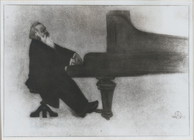
(Photo courtesy New York Public Library Digital Collection)

Moving Image

Moving Image

When I woke up this morning I was dreaming I was snapping a picture. I was a passenger in a moving car, and the terrain we were driving through was like an ancient Chinese painting.

There were human-sized hills, a winding stream and perfectly coiffed trees. There was a sense of scale that made me think I could capture the landscape quickly from a vehicle.

The dream probably augurs nothing. But if it does, could it mean that I’ve become less of a words person and more of an image one? It’s happening to many of us these days.

Of course, there’s the fact that I’m writing about this experience, not illustrating it. And I’m doing it on an outmoded platform that is anything but image-friendly.

Whew! I’m probably safe — at least for the time being.

Night Air

Night Air

Last night the heat slaked off enough to open the windows, so that cool, fresh night air poured into the house. I fell asleep to the sound of a whirring fan.

It was like another place, the house with night air. Like a place that is part of the world it inhabits rather than separate from it.

The cicadas and crickets were singing their songs, and their music contributed to the feeling of aliveness in the house.

In the old days, we almost never used the air conditioning. But it comes in pretty handy these days, and I no longer roll my eyes at it. I accept the comfort it makes possible.

Still, the best sleeps are those without it, the ones when night air fills the house.

Soporific

Soporific

Last November, I took the National Novel Writing Month challenge and produced 54,000 or so words of fiction in 30 days. The idea is to punch out a draft, and punch it out I did. But at the end of the month I tucked it away on my computer hard drive and barely looked at it again.

Until my recent getaway, that is. Curious to see just how bad this thing was, I opened it up, held my breath and started reading. And I learned that, well, it wasn’t as terrible as I thought it would be.  Which is not to say that it’s ready for the New York Times bestseller list — or for any eyes other than my own.  But it has a couple of likable characters.

This morning, I discovered that the novel, which I call For Sale, has another attribute.  I’d been trying to read myself back to sleep for almost two hours without success. But after 10 minutes of For Sale I was out like a light.

Perhaps this could be a marketing tool. Watch out, Ambien, here I come!

First Thing

First Thing

Today, I took an early walk before the heat began building. The sky was full of light but still uncertain. The day did not yet know what it would become.

This is one reason to walk first thing in the morning: the freshness of the air and the sense of possibility.

But there is another. There is the fact that the walking itself shapes the day, makes it more than it would be otherwise.

This doesn’t happen all the time, but it did today. And I’m grateful for it.

(No, I wasn’t walking on a beach, but I was remembering it.)

Holding On

Holding On

What helps the beach state remain? I’m asking myself that question today, as I feel it slipping away.

I was off to a good start on the way home: a plane so empty that each passenger had his or her own row of seats.

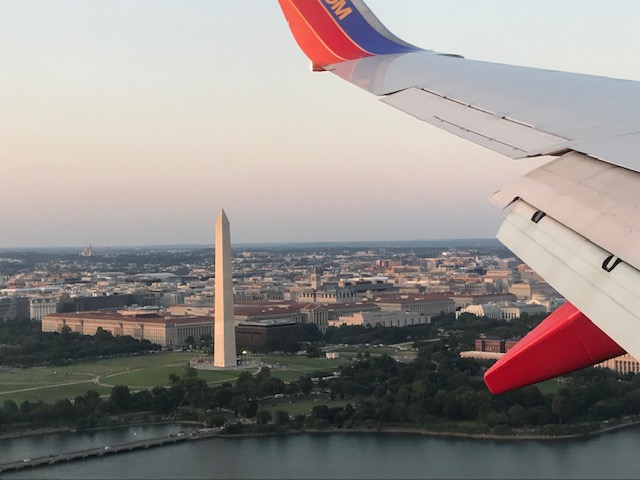
Then a late-day landing that showcased the Washington Monument and the Capitol, the graceful spans across the Potomac, the compact graciousness of the place.

But today there was the long commute into Arlington, the work call that came in before I reached the office, the emails, the to-dos that piled up when I was gone.

Welcome back, they say.  I try not to listen. I hold onto the beach state for dear life!

Beach State

Beach State

Today I leave the beach. That much is indisputable. But I hope to keep the beach state.

The beach state, as you might suspect, is the habit of pondering clouds and palm trees. It’s also the habit of not caring as much about every little thing. It’s the habit of letting go.

Beaches, after all, are receptacles. Onto them is thrown the flotsam of the sea, and from this random collection of shells and plastic bits comes sand both smooth and powdery (depending upon how close it is to the ocean). The beach, in short, is accomplished at acceptance.

This is something I would like to emulate, the beach state of acceptance. So it’s that I would like to take home with me.

It’s easy to think about retaining the beach state with the smell of sun on my skin and a tropical breeze moving palm fronds to and fro. Much more difficult when I’m standing on a crowded Metro train or sitting at my office desk, up to my ears in work.

But that’s when the beach state is needed most of all.

Beach Clouds

Beach Clouds

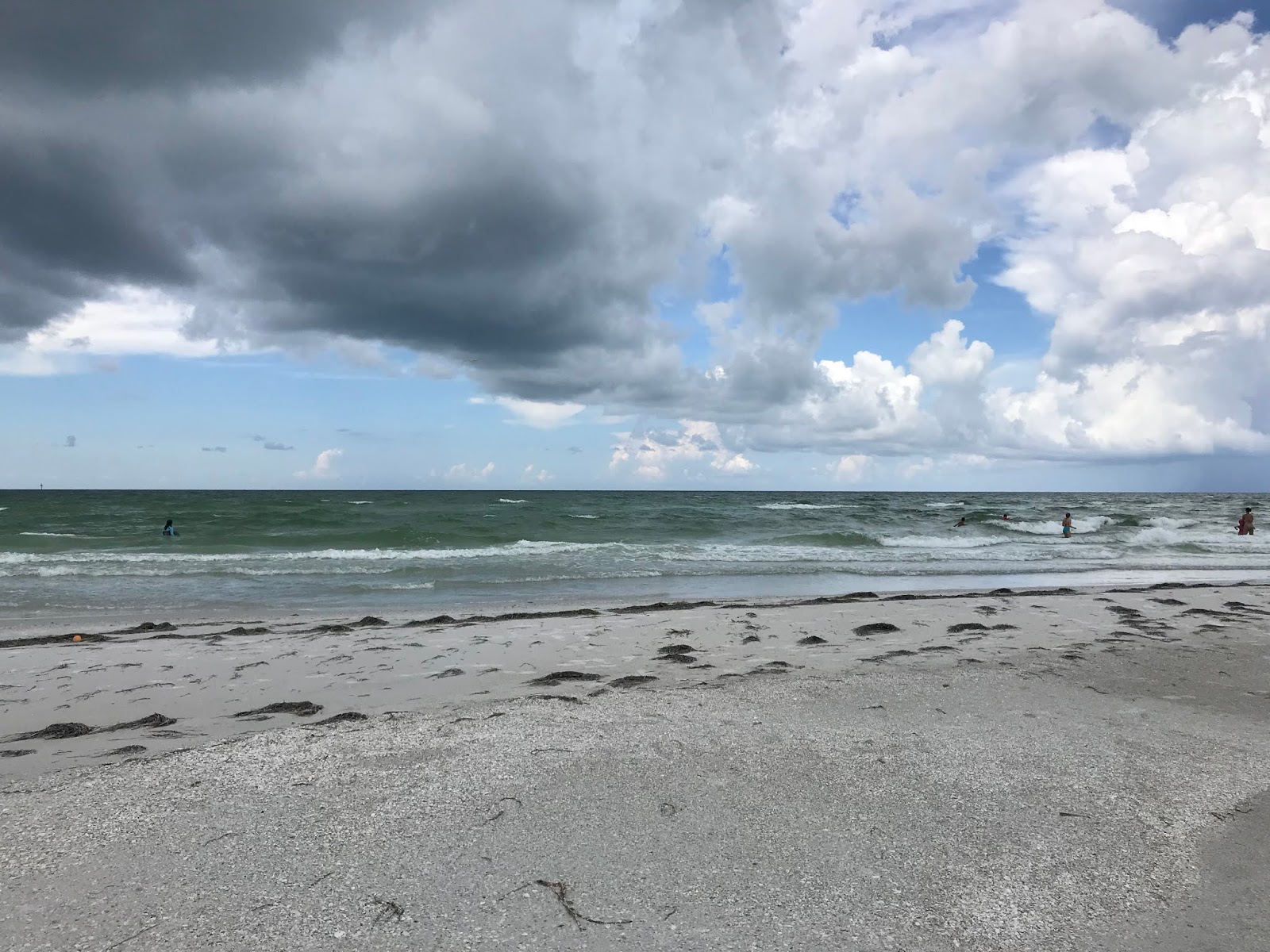
Beach clouds differ from their mainland cousins. They cluster in the distance, looking gray and ugly. They throw down sheets of rain, giving themselves away.

Sometimes they scoot over the beach, leaving just droplets in their wake. We beach-goers take the brief pelting and shrug. We can see the sun breaks up ahead. We know we will have blue skies again soon.

I used to dread clouds at the beach; now I welcome them. They block some rays, cool me down, let me stay a few more precious minutes on the shore.

The Contemplative Life

The Contemplative Life

Shortly before leaving the house on Saturday, I panicked about what books to bring.  I jettisoned the hefty library book, a novel scheduled for September book group. There will be plenty of time for it, and it hadn’t grabbed me yet.

I thought about packing a book I’d already read, a security blanket of sorts. But that seemed too unadventurous.

I ended up with Virgin Time: In Search of the Contemplative Life, by Patricia Hampl. It is part travelogue, part memoir and part spiritual exploration.

The contemplative life is what Hampl is after, but to get to it she takes a walking tour to Assisi, home of St. Francis.  The walking feeds the contemplation, and provides authentic moments like the one when a woman in a kerchief runs out to offer the pilgrims two bottles of her homemade wine, a gesture “a million years old, far beyond courtesy, rooted in ancient communion.”

“Walking allowed such timeless moments, making us slow-moving parts of the landscape we passed through. Maybe the world isn’t, at its daily heart, as modern as we tend to think. As we walked, it kept reverting to an ancient, abiding self.”

And it is in that “ancient, abiding self” that Hampl discovers — and perhaps all of us could find — the lives we are looking for.