Browsed by
Author: Anne Cassidy

View from a Garret

View from a Garret

Over the weekend I stayed with friends in the city and slept in a third-floor bedroom. When I saw the slanting eaves, the bed tucked up by the two windows, I wanted to cry out with delight.

It’s not that I don’t love my own house, my own bed. It’s cozy here, and warm. I like our house and neighborhood.

But that doesn’t mean I don’t crave a garret. To be writing up there would be to channel Jo March, with her apples and her writing smock. A romantic notion? Of course!

From what I gather, the derivation of the “writer in a garret” phrase was the English writer Samuel Foote, who said that an author’s fate was to be “born in a cellar and liv[e] in a garret.” Bohemian poverty has been celebrated in literature throughout the last couple of centuries.

But it’s not the poverty I like about the garret; it’s the combination of coziness and expansiveness. And it’s the view. It’s being able to look out over rooftops and treetops. It’s perspective — something I think all writers (and all people, for that matter) need.
A Place for Everything

A Place for Everything

Sometimes on mornings at home, in what I know is an elaborate form of procrastination, I tidy up before I begin writing. It’s part compulsion. I like to look up from the screen and see some order in the universe — even if the order is only that I moved the covered rocking chairs from in front of the deck door so they don’t block the view.

This morning while putting papers in the recycling bin and tucking a cloth bag up on a shelf where I keep shopping bags … I thought about the phrase “a place for everything and everything in its place.”
I’m a big believer in this. It’s how I keep from losing things (including my mind).

The problem with this method is that I avoid the place where much of the stuff I’m moving should actually go — and that is what we used to call the circular file, the wastebasket.

So much of my tidying is a futile attempt to stem the flow. Until I purge — really purge — my tidying up will only be of the most superficial order. But this morning, like so many others, a superficial order is all I need.

There’s a place for me, too — and it’s sitting on this couch, typing on these keys.

Workday Travel

Workday Travel

Travel has many advantages, one of them being how it shakes me out of my routine. It forces me to take a few risks, talk to people more than I would otherwise. It’s hard to be bored when I’m traveling. Tired, nervous and hungry, maybe. But never bored.

Sometimes, even traveling to work will do that. Today was one of those days.

With the two main subway lines coming in from the west partially shut down due to smoke in the tunnels, I took a bus I’d never taken before.  It was a jolly crew of commuters and travelers crammed together, many of us standing.

I chatted with a young couple from Slovenia. She was model-caliber gorgeous. He spoke excellent English, had a pierced eyebrow and wore a button that said, “Ask me how to lose weight.” (I didn’t.)

“Slovenia is small, but we are mighty,” he said, reeling off names of some of its famous citizens, including First Lady Melania Trump and various sports figures I’d never heard of. But he was so proud of his small country that he made me want to go there immediately!

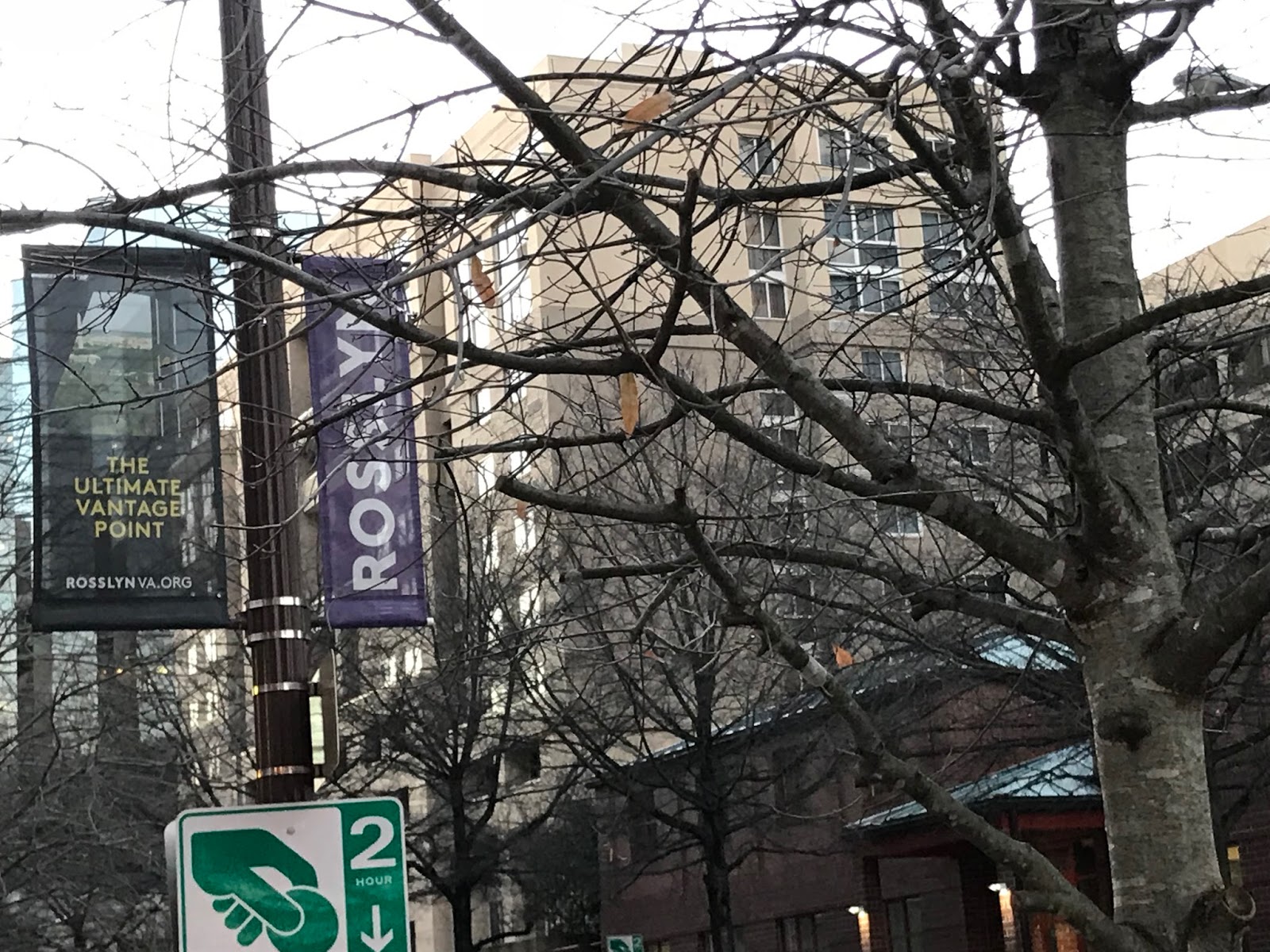
All this is to say that when I got off the bus at Rosslyn, I barely knew where I was.

Lesson in Resilience

Lesson in Resilience

Martin Luther King “ran out of certainty but never faith.” This from an op-ed in today’s Washington Post. In it, Stephen Kendrick and Paul Kendrick remind us that King had become unpopular by 1968. There was a great weariness in him. But there was also resilience. It’s the resilience we need to remember now.

One of the great surprises to me in all the MLK coverage this month is to realize how young he was: only 39 years old when he was assassinated 50 years ago today. Perhaps it was the weight of the weariness that made him look older than his years.

Here’s Kendrick and Kendrick again: “Fifty years later, it would look too familiar to the King of 1968 to see our continued economic inequality, hawkishness, backlash to civil rights gains, and racist violence from Charleston to Charlottesville. His response then was to resist exhaustion from the deluge of issues and to enlarge his work instead, hold firm his insistence.”

King’s insistence, his persistence, his grace under pressure, is a lesson to us all.

The Sacred and the Profane

The Sacred and the Profane

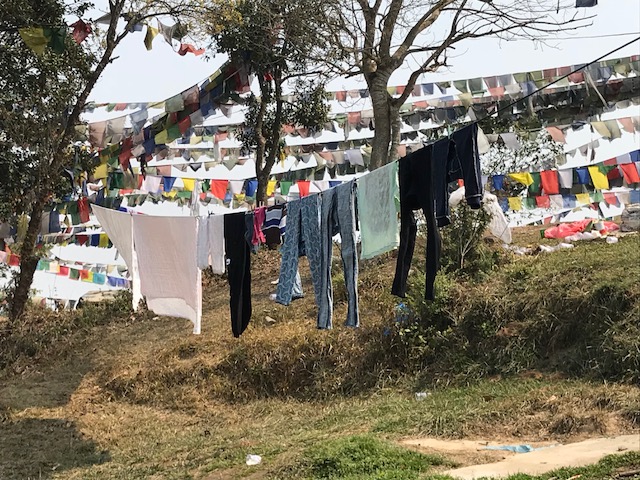
I snapped this photo on a walk around Nagarkot, the hill town on the cusp of the Himalayas. It speaks to me, summarizes the way Nepal combines spirituality and chaos, how it mushes up prayer life and real life until you can’t really tell the difference.

And isn’t that how it should be?

I looked up “sacred and profane” not really knowing the origin of this dichotomy, and learned that it’s attributed to the French sociologist Emile Durkheim. Sacred things are those forbidden and set apart; they represent the interests of the group. Profane things are individual interests, more mundane concerns.

While Durkheim believed that all religions contain this dichotomy, other scholars disagree. It’s a western way of looking at faith, they say.

After visiting the temples and stupas, seeing the Ganesh statues in taxis, and of course, the prayer flags … I would agree with those who disagree with Durkheim.

Easter Monday

Easter Monday

Easter has its own rhythm, different from Christmas or Thanksgiving. Church comes first.

Yesterday, through some miracle of timing, Suzanne arrived only minutes after we did, which meant she could park her ambrosia salad, backpack, running tights and jogging shoes in the car and slide into the seat we saved in the big sanctuary.

The sermon was more honest than others I recall. It was as if the priest was trying to convince himself of the significance of the empty tomb. His conclusion: there must be something to it, because of all the good people we know who are gone, and because of the incompleteness of life.

A cynic — heck, even a realist — could easily counter these arguments. Of course, there are good people in the world, but that doesn’t mean there’s a God and an afterlife. As for incompleteness, that’s why we have irony.

But I was touched at the honest homily. The priest is one I’ve seen for years, and he looked noticeably older this year, walked with a cane. Maybe he’s working out some things in his own mind. Whatever the case, I appreciated his candor.

In the end, he said, it all comes down to faith.

And so it does.


(Detail from the Cambodian monastery at Lumbini, birthplace of the Buddha)

Brain Drain

Brain Drain

I’m up early. Too late for Nepali time. Maybe it’s Dubai time. Speaking of that place … my airline out of Kathmandu was called “Fly Dubai,” and it carried a crazy mixture of tired trekkers and migrant workers headed back to the Middle East.

Ads in the Kathmandu Airport featured the money transfer service “Himal Remit,” with an older man on a tractor waving his hand in glee. The check has arrived! The check from my son or daughter who can no longer live here because there are no jobs.

One issue I heard from all quarters in Nepal (from bank execs to taxi drivers) was the brain drain. It’s difficult to find a family that has not been affected. Two interviews in a row ended with stories of children in college in Iowa or Massachusetts. Will they return?

As the world shrinks and problems grow, populations are on the move. One-quarter of Nepalis live outside Nepal. I’d like to think this country will remain its lovely, spiritual self. But what is a nation but its people? This is a question every world citizen should ask.

Coda

Coda

Jumbo jets are seas of humanity, hundreds of people jammed into tight quarters, each with their own pasts, presents, futures — and languages. Some travel in pairs: old couples with their heads tipped together in sleep; lovers on honeymoons. Others travel in groups: families and babies in the bulkhead. Many travel alone, as I did.

When I arrived home this morning, I looked out the window of the bus taking me to the main terminal to see the craft that had just borne me home. We flew up and over from Dubai to Dulles, crossing eastern Europe and Scandinavia, Labrador and Nova Scotia.

And now, miraculously, I’m home.  The busy boulevards of Bangkok, the dusty thoroughfares of Kathmandu, are behind me now,  alive in photographs and memories. How improbable it all seems, to travel to the other side of the world and back. How very lucky I was to have done it. How grateful I am to be home.

Hospitality and Hope

Hospitality and Hope

Last night we visited Boudhanath. Pilgrims walk three times around the stupa, touching the prayer wheels, burning incense, sometimes even prostrating themselves. We walked three times around, too.

As I prepare to leave this wonderful country, I’m remembering something my colleague and friend Chadani said to me last evening as we were leaving Boudhanath.

“In my culture, we treat our visitors like gods.”

That’s exactly right! I’ve been fed and gifted and given far more than I can ever return.

The culture of hospitality gives me hope. If we can treat the visitor, the stranger, with such loving care and concern, then can’t we ultimately learn to live together in peace?

Consider the Courtyard

Consider the Courtyard

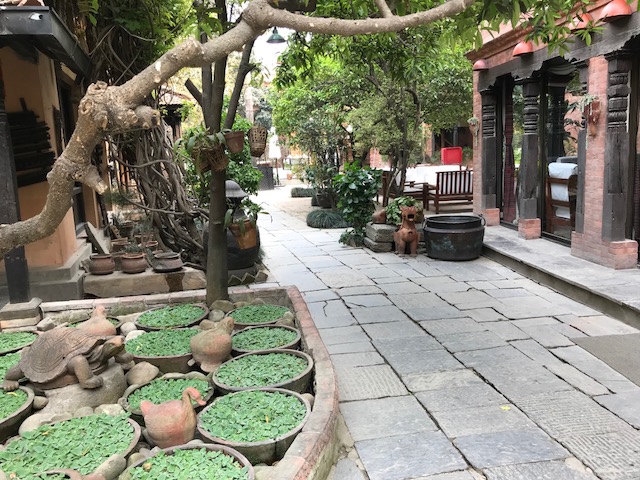
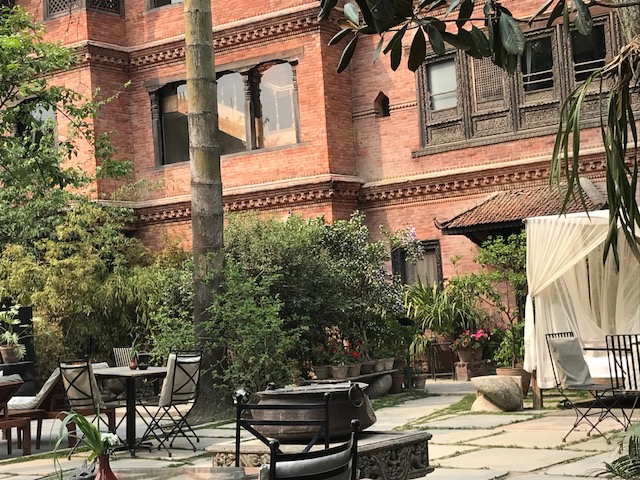
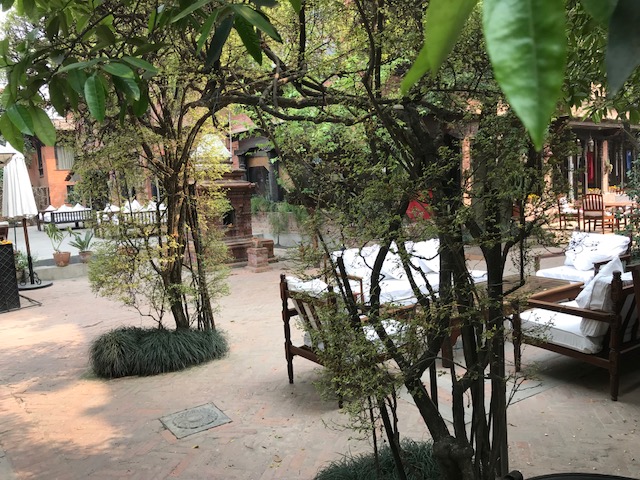
We don’t have these where I live, these vine-draped, sun-splashed oases of calm in the midst of busy cities. But the courtyard at my hotel is, I think,  one of the most enchanting places I’ve ever seen.

Wisteria vines hang heavy over tiled roofs. Something fragrant — frangipani? spirea? — blooms by the pool, which is filled by spouts of cool, piped-in water augmented by a sculpture spring.

A bird I’ve never heard before chatters in the shrubbery. Incense wafts from a small shrine, and water trickles from a quiet fountain.

To enter this courtyard is to feel an ancient spirit, tapping the inner peace of a place designed for tranquility.

Since I’ve been in Nepal I’ve considered the courtyard, the haven it provides, how it soothes the soul. Considered it — and coveted it, too.