Browsed by
Author: Anne Cassidy

Houston Delivers

Houston Delivers

To riff for a moment on a city defined by a sentence amplified by a movie— “Houston, we have a problem” — let me just say Houston had far fewer problems than I expected to see.

While there was evidence of Hurricane Harvey — a boarded-up motel and piles of refuse in neighborhoods (the latter viewed by other wedding-goers, not me) — the city, on the whole, glittered and gleamed.

From the Johnson Space Center to the funky soul food breakfast joint my sister-in-law found to a host of museums on everything from medicine to bicycles — Houston delivered.
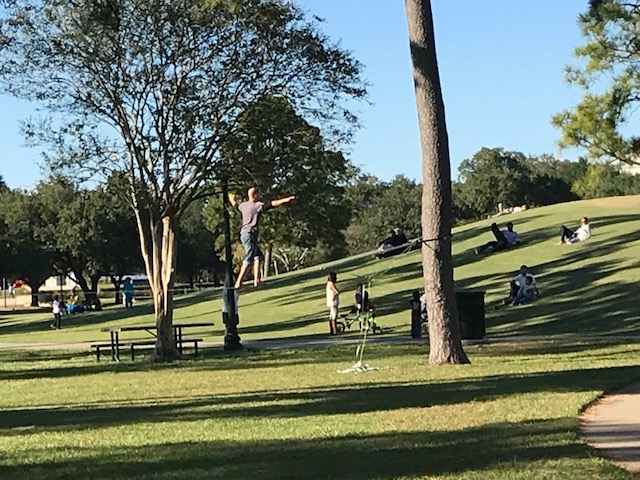
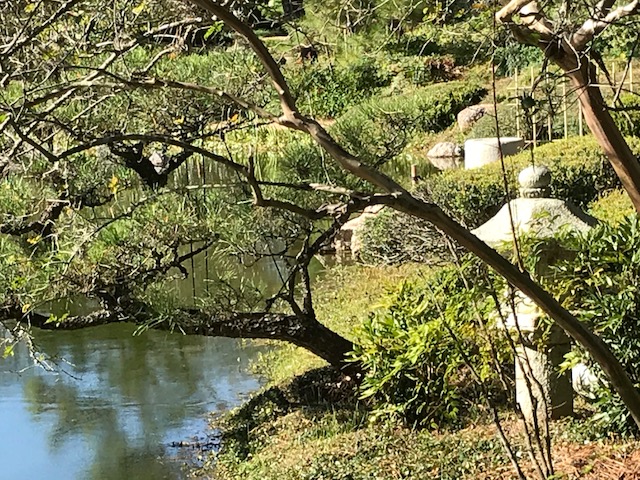
The best part was walking through the parks, past fountains and waving pink grasses and through the studied stillness of the Japanese garden. Dogs and families, girls in ballgowns for their quinceaneras, even a tightrope-walker — everyone out to savor the cool breeze and sparkling low-humidity day.

Observe the Moon

Observe the Moon

On a tour of the Johnson Space Center yesterday I learned that tonight is International Observe the Moon Night, a date set aside each year to look at and learn about Earth’s satellite. I didn’t even know there was such an event, but I consider myself lucky that I learned about it where I did.

Home of moon rocks and interplanetary dust, of an intact Saturn rocket housed in a building as impossibly long as it is impossibly tall, the Johnson Space Center is also where the Orion spacecraft is coming to life. Orion is built for interplanetary travel — and will someday take humans to Mars.

Also on the Space Center campus is the historic mission control center: the place where nine Gemini and all the Apollo missions were monitored, where scientists scrambled to bring Apollo 13 astronauts back to Earth, where cheers erupted when the words came crackling through the monitors: “The Eagle has landed.”

It was the moon they saw, the same moon we can see tonight. Only for the first time in history, a human footprint was outlined in its dust.

Catching the 43

Catching the 43

Sometimes I just miss it, but other times, like yesterday, I look at my watch, think there’s no way I can get there in time, but somehow, with much huffing and puffing, I arrive at the line of people that means the bus hasn’t yet come. Moments later, the ART 43 bus pulls up to the Crystal City stop.

The Arlington bus system is a marvel. It runs on time, is comfortable and pleasant, and the drivers aren’t surly. (I have a low bar for drivers.) Compare this with Metro — dark, crowded, subject to delays for door jamming, arcing, you name it.

The ART 43 runs from Crystal City to Courthouse and back with only one stop in between — Rosslyn. It’s 10 minutes of efficient transportation.  No wonder I’m glad when I catch the 43.

Walking and Living

Walking and Living

As if yesterday’s post wasn’t enough of a paean to walking … here’s this, which I noticed in a day-old copy of the newspaper: “Regular walking may increase longevity, even if you walk less than the recommended amount.”

I hope I walk more than the recommended amount — but even if I didn’t these words would be heartening. The new study analyzed information from nearly 140,000 adults ages 60 and up, people who were followed for 13 years. Even those who didn’t walk the recommended two and a half hours a week still lived longer than the ones who didn’t walk at all.

Apparently, though many studies look at exercise and longevity, not that many specifically examine walking. So although this seems like a no-brainer … it isn’t. And there’s more: Those who walk from two and a half to five hours a week were 20 percent less likely to die of any cause and 30 percent less likely to die of a respiratory ailment. Which raises a question: Could those who walk 10 or more hours a week become … immortal?

I’m getting a bit carried away here, but one thing is certain. Walking doesn’t just clear the mind and inspire the spirit … it actually keeps us going longer. I can live with that!

Pep Walk

Pep Walk

I love the pep talk, whether getting or giving. Those first minutes and hours afterward, lifted on a thin layer of inspiration that I know won’t last but feels permanent at the time, a high born of words and gestures, of understandings suddenly grasped.

But when there’s no one around for a pep talk, a pep walk will do.

A pep walk begins in desolation. The article you’re writing has no focus, the words are cliches. The work load is too heavy, no one can juggle this many projects. The child you raised is having troubles; she’s an adult now but when she hurts, you do too.

The reasons are legion, but the remedy is the same. Lace up the shoes, grab the earbuds, step outside. It’s a whole new world out there. Other people and their problems. Maybe the problems get all jumbled together and cancel each other out. Or maybe it’s just the act of walking, one foot then the other. Forward motion, with all that that implies.

All I know is, the pep walk works. It bolsters spirits, reveals solutions. It inspires.

To the Morning

To the Morning

Thinking this morning of morning’s power, and of one of my favorite songs, which is about the morning. It’s by Dan Fogelberg, and was the opening song on Chicago’s WFMT when I lived there way back when, often the first sound I heard every day. Here’s how it goes:

Watching the sun
Watching it come
Watching it come up over the rooftops
Cloudy and warm
Maybe a storm
You can never quite tell
From the morning
And it’s going to be a day
There is really no way to say no
To the morning
Yes it’s going to be a day
There is really nothing left to
Say but
Come on morning
Waiting for mail
Maybe a tale
From an old friend
Or even a lover
Sometimes there’s none
But we have fun
Thinking of all who might
Have written
And maybe there are seasons
And maybe they change
And maybe to love is not so strange.

In the Open

In the Open

A missing headphone set means that when I listen to music through my phone lately, I do it in the open — not through earbuds. This is a strange yet strangely familiar activity.

It’s strange because for years now the tunes I listen to are only for my ears. A feedback loop of one, a solitary bubble, like all the solitary bubbles around me.

But it’s familiar because I grew up pre i-Pod and pre-Walkman. When I think of summer afternoons at the pool it’s not my playlist I remember (there were no personal playlists in those days!), but Top 40 hits piped through someone else’s portable radio. You could always hold a transistor up to your ear or use those early earbuds (there was only ever one, which was just fine since these radios produced no stereophonic sound), but for the most part, music was out in the open.

In fact, it was a musical free-for-all, and you got what was got. You adjusted. I tapped my feet to soft rock, cringed at country crooners. But I came to enjoy tunes I would never have heard otherwise — and I learned that listening can be a communal experience.

Now when I walk past a neighbor I quickly mute my Bach or Rachmaninoff. I don’t want to impose my choices on them. For all I know they wouldn’t mind. But it’s different now. Dogs don’t run free and neither does music. These are small changes, true, but put enough of them together and you have another world.

Still Life with USB Cords

Still Life with USB Cords

I was thinking today as I pulled a phone charger out of a drawer that I basically live on about one one-hundredth of the things I own. Heck, it may be more like one one-thousandth!

This phone charger was lying on top of a tangle of wires and cables that date back to my house’s Paleolithic Era. On the top are a few USB cables but underneath are old Walkman players, ancient cameras and … a pair of binoculars.  Ah, so that’s where the binoculars are.

It’s the same in my chest of drawers: Three pairs of wearable pants on top of five pairs that are too old or don’t fit. Plainly a purge is in order. But purging takes time.

I don’t get rid of stuff as quickly as I could because I think the stuff may some day come in handy. Those old jeans will be fine for painting and the Walkman could be pressed into service if my iPod breaks … and … well, you get the idea.

So the stuff remains, and I live on top of it. Makes me feel pretty silly, if you want to know the truth.

Around the Edges

Around the Edges

I started to write a post early this morning … then work intervened. I’m writing it now on a 10-minute break between other tasks.  It makes me think about how often my creative work must fit itself into times that are not otherwise occupied.

This means early in the morning, late at night, on the bus or Metro, or on weekends when I’m not doing something else.

This is how it is now. And, truth to tell, the other way scares me. The way of waking up every morning with only my own work to do.  I hope that will change in time, but I’m not there yet.

So for now, it’s this blog … and the writing I do around the edges.

Land Lines

Land Lines

I almost called the old number last night — 253-0163. I didn’t, but I thought of it. My fingers were ready for those digits, itching to play an old tune I once knew by heart.

It was an easy number to remember when I learned it, had a brisk pace and memorable cadence. But 253-0163 had nothing on 266-8078, the land line of my youth. I knew this number when we were both still wet behind the ears — when it was only 68078. It was the number I lisped as a preschooler, the number I called from college (only for minutes at a time, long distance costing what it did in those days).

I’m convinced these numbers will be some of the last things to leave my brain. Which is why I can’t give up on 620-6118. It’s a land line, too, of course. And though you can’t text it, the number has many things in its favor, chief among them being that it belongs to a house and not a person.

An old-fashioned view to be sure, which my resident millennial reminds me of all the time. But I like how it works when cell numbers don’t. I like its continuity through years. And so, even though it’s fashionable to fly solo, I think I’ll keep it.

(Photo: Wikimedia)