Browsed by
Author: Anne Cassidy

Thunder Boomer

Thunder Boomer

There are a few advantages (not many!) to posting later in the day. Today, for instance, in a prefect sequel to yesterday’s post, we are about to have a big thunderstorm here. And it feels like a wonderful catharsis.

I think of yesterday’s heat on the pirate ship, and on the Key Bridge, which I decided to walk across there and back. The shrinking boards, the hot breath of the cars, the scant shade, the quickly melting ice cubes in my cup of iced tea.

All of that is about to be blown away by the wind and rain and rumbling.

Not as easy to write about thunderstorms at 8 a.m. as at 4 p.m.

Thunder on!

(Picture of a place that knows great heat.)

Thinking Cool

Thinking Cool

My body’s set temperature and global warming are trending together well these days.  When the temperature zooms past 90 and the humidity builds, I’m still comfortable. I don’t do as well in air-conditioned buildings. I’m huddled now with one shawl draped around my shoulders and the other spread over my lap.

But … I’m dressed today for an employee cruise outing. Yes, we will be on the Potomac River from 1-4 p.m. on a day when the heat index is expected to be about 105. My heatophilia will be put to the test.

Either we will enjoy ourselves immensely or will be a sodden mess. I’m hoping for ample shade and cool drinks.  But until then, time for some cooling imagery. How about this?

Cloudy

Cloudy

It is not, as I write this, actually cloudy outside. But it was an hour earlier, when I was walking, and it has been cloudy more than usual this summer.

One thing about the Washington, D.C., weather I’ve always appreciated: It doesn’t mess around with clouds. They are purposeful when they’re here. They quickly disgorge whatever it is they have inside — rain, snow, sleet or hail — then scuttle along to their next destination.

This is the most relentlessly sunny place I’ve ever lived. And though one might sometimes find it tiresome — like a frisky puppy that keeps licking you in the face — I love that about it.

Growing up on the cusp of the Ohio River Valley, I had what I realize was more than average cloudiness. This bummed me out. I remember wishing more than anything that the sun would break through — probably so that I could go outside, slather more baby oil on myself and soak up more harmful UVA and UVB rays.

Now that I think about it, maybe the cloudiness was a gift. Bad for the mood … but better for the skin.

The Long Tip-Toe

The Long Tip-Toe

My office is quiet enough that I think twice before I set a key on a metal shelf. The slightest rustle, the faintest clink becomes a car alarm or a fog horn. The only sanctioned sounds are the tapping of computer keys and the whirring of the ventilation system.

Apart from those, we are … silent. We are the hushed stacks of an old-fashioned library. We are the quiet car of the Northeast Regional.

Which is not to say that people don’t meet and talk and laugh here. These things are done. But they’re the exceptions and not the rule. A library stillness rules this place.

For the most part the quiet is helpful, since I spend most of my work hours writing and editing, but it’s also unnatural — as if too many people are holding their breath. And woe to the person who wants a Tic-Tac. Retrieving those hard little mints from their noisy plastic boxes is the aural equivalent of the 4th of July fireworks.

Over time, though, the quiet has become contagious. Since I began working here 14 months ago, I move more slowly in an attempt to move more quietly. I set down my teacup with great care. I close my file cabinets with consideration. The enforced quiet has become a long tip-toe, a slow soft shoe, a mindfulness exercise that never ends.

Two Walks

Two Walks

Rising early has its advantages, chief among them the chance to take two walks before breakfast.

My first was before 6:00 a.m., air still cool, crows still running the place. Their caws say “danger, danger, danger,” but not for me. I hear jays and hawks, too, plus the rise and fall of midsummer cicadas.

The second walk was a purposeful stride from Oakton High School to the Vienna Metro Station. It’s the closest place to park and not pay, so when the morning is luscious and I have the time,  I walk the mile instead of driving it.
The sights and sounds are different: Instead of crows I hear the whoosh of traffic noise, and the hawk’s cry is replaced by the shrill grind of metal-on-metal as a train lumbers into the station. 
But these are quibbles. It’s Monday. It’s morning. And … two walks are better than one.
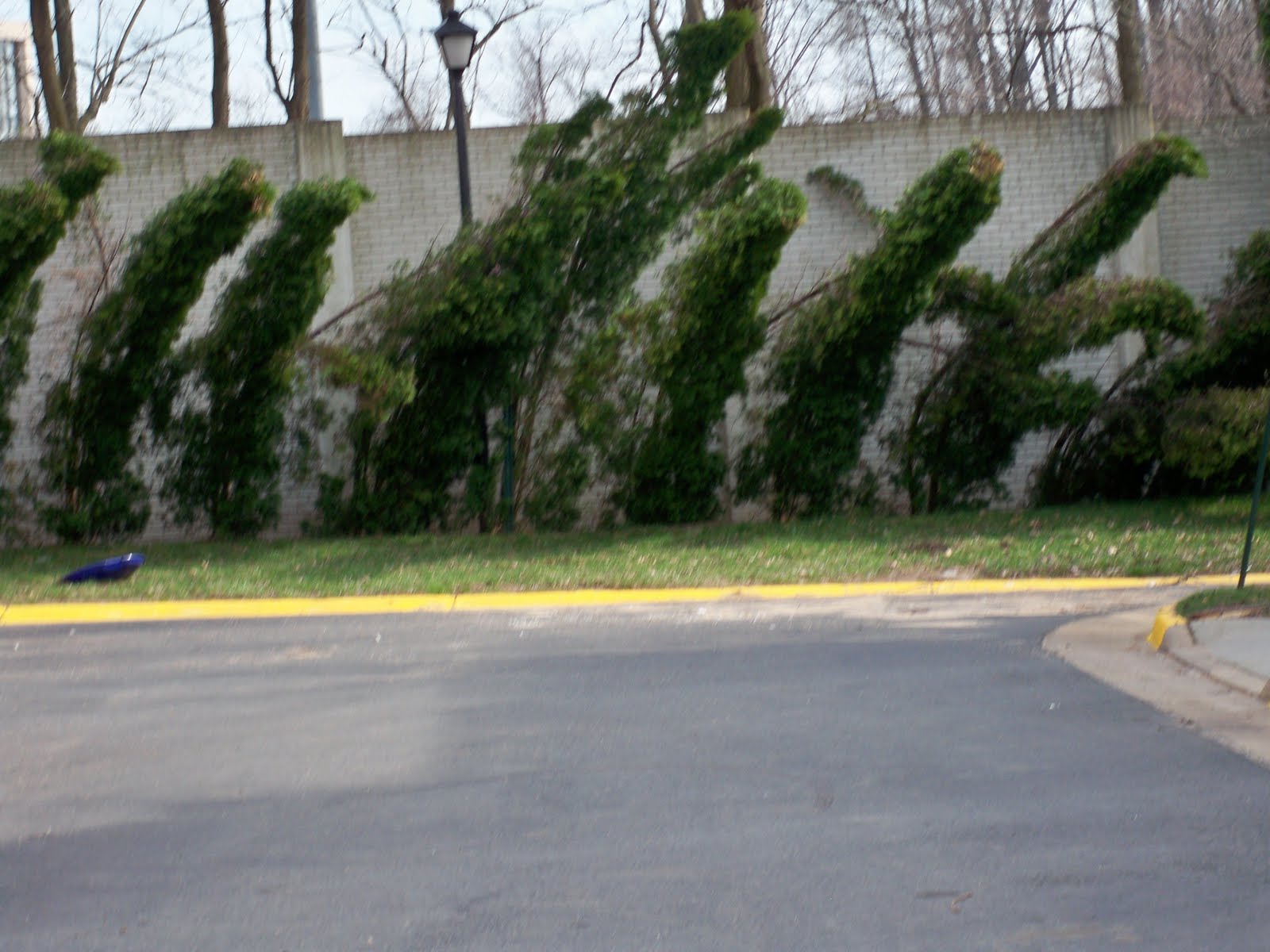
(I took this en route to the Vienna Metro some years ago. The trees look like they’re walking, too.)
Grace, Visible

Grace, Visible

It was early and I was walking, lost in thought, lost in sad thought if you want to know the truth. I looked up and saw a shaft of light piercing the shaggy tunnel of green that this stretch of Folkstone Drive has become.

There it was, brightness distilled and condensed, channeled from the heavens to the earth. Usually we can’t see sunshine because it’s all around us, a blessing we tend to ignore. But when it slants through the greenery as it did this morning, it reminds us of its presence. It comforts, inspires and motivates.

When I was young I used to think that grace consisted of the dust motes that floated through air. I’d heard that grace was invisible but all around us, and dust particles fit the bill. Today’s light shaft is a better candidate. It was, at least for me at that moment, grace visible.

Dutch Wave

Dutch Wave

The headline caught my eye yesterday. “An inspiring green space in the concrete jungle.” Could it be the High Line? And yes, it was.

Gardening columnist Adrian Higgins wrote about the verdancy of New York City’s linear park, its stunning perennials and the way the wildlings (I love that word) mimic the flowers and weeds that flourished on the abandoned train line before it became an urban rooftop garden.

Higgins focuses on the plants themselves and the style of their plantings, as well as the man behind the beauty. Landscape designer Piet Oudolf is a leader of the “Dutch Wave” school of gardening, which is heavy on perennials and herbs and pollinators.

It’s nice to have a name for the pleasing combination of shaggy grasses and delicate flowers. Not that I will try to create it at home but so I can roll it around in my mind as I stroll, recreating the walks I’ve taken on the High Line, a place where plants and people come together so admirably.

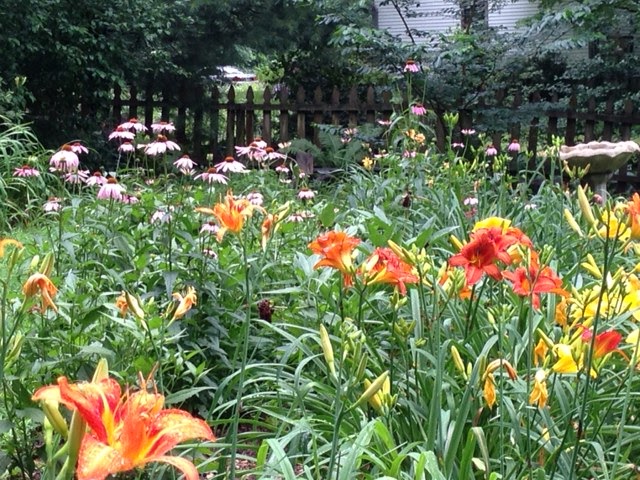
(The perennials in my garden are not Dutch Wave.)

Brian Doyle: An Appreciation

Brian Doyle: An Appreciation

I learned last night of the passing of Brian Doyle, a writer I admired for years, who I read too little of, who leaves behind a body of work that nourishes us all.

Doyle was the editor of Portland Magazine, the alumni magazine of the University of Portland. But that was just his day job. He also wrote novels (Mink River), short stories, prayers (how many writers pen prayers these days?) and essays (which is how I know him best). Doyle’s essays sing and probe and exalt. They make moments matter.

Accessible, joyful, torrential — those are words that describe Doyle’s prose. His sentences, by his own admission, begin on Tuesday and end on Saturday. He’s one of those writers who, when I read him, loosens up something in my own tightly coiled style.

Consider the conclusion to Joyas Voladoras, an essay I discovered in an anthology, wrote about and used to teach the form, an essay that’s yet to leave me with dry eyes. Read this and think a kind thought for its author, dead at age 60 but living on through his words:

You can brick up your heart as stout and tight and hard and cold and impregnable as you possibly can and down it comes in an instant, felled by a woman’s second glance, a child’s apple breath, the shatter of glass in the road, the words I have something to tell you, a cat with a broken spine dragging itself into the forest to die, the brush of your mother’s papery ancient hand in the thicket of your hair, the memory of your father’s voice early in the morning echoing from the kitchen where he is making pancakes for his children.
Testing, Testing

Testing, Testing

It’s July 5, and last night’s revels seem far away. It’s a day of sodden flags, old watermelon rinds, the burnt casings of a bottle rocket. The smoke has cleared but we’ve lost our brilliant reds and greens.

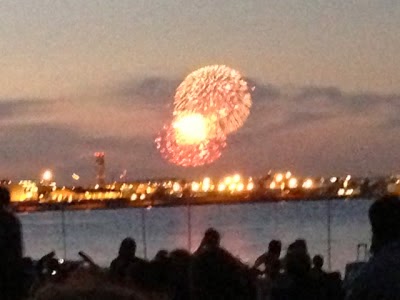
Last night at the block party in Suzanne’s Arlington neighborhood where we watched the fireworks, a man in a tricornered hat read aloud the Declaration of Independence. The mic he was using kept fading in and out, so that he was forced to pepper his recitation with the words “testing, testing.”

It was an interesting interjection as we “test, test” our resolve to become a more perfect union and we’re “tested, tested” by a divisiveness unknown in my lifetime.

Now that I think of it, “testing, testing” isn’t a bad motto to have as we strive to make ourselves heard, to make ourselves whole. Our nation is a work in progress, always “testing, testing.” Seeing it that way is a good way to celebrate July 5.

More Unum

More Unum

The trip from Lexington to my house can seem long, especially when mired in West Virginia, but it is in fact less than one-tenth of the way across the country. And it’s the width of the country that’s on my mind this morning: the roundabouts and the rodeos, the skyscrapers and the silos, the breadth and depth.

I like to think that our strength lies in our breadth, in our differences and how we’ve been able to assimilate them. E pluribus unum — from the many, one. Not just from many states one nation, but from many states of mind one body politic.

We used to have a knack for it. But lately, our differences threaten to overcome us. Lately, we have too much e pluribus and not enough unum. So that is what I wish for our country on its 241st birthday: more unum.