Dim and Quiet
It’s taken a while for the morning to gather itself. Clouds linger; fog does, too. Only a few lights are on in the building across the street.
A quiet morning here, made possible by cloudy skies and sleepy parakeets. (It helps that I haven’t uncovered their cage yet, poor things.)
A cold has kept me inside for days, and I’m feeling the psychic effects of it. Time for an armchair amble.
I walk out the door, slip between the houses across the street and find a familiar path. It’s almost overgrown now but I pick my way along until I come to the road. There I find the familiar landmarks: the horses and the stream, the big house on the hill, the pasture that (if viewed from the right angle) almost seems rural.
Air fills my lungs and my stride lengthens. I’m in the groove now, moving quickly in the chill. How good it feels to be alive and in the world. When I’m in it I often don’t appreciate it. But now that I’m not … well, it’s good to have a reminder.
No time to snap a photo of last night’s full moon, so I tried to snap a “mind picture,” as Suzanne would call it.
I remember when she first talked about mind pictures. It was on one of our family vacations, can’t remember which one. I’d smiled, reminding her that she couldn’t share mind pictures the way she could real ones and that her mind wouldn’t always be as clear as it was then. That there might come a time when it would be as jumbled as mine — mind pictures tangled up with old phone numbers, Associated Press Stylebook comma rules and all the other bits of information and trivia I’ve remembered through the years.
But I have come around a bit. As long as you don’t take too many, as long as you are mindful when you snap that lens open and closed … who’s to say that, in the end, mind pictures aren’t better.
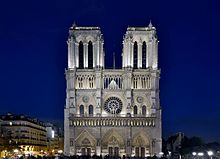
I can still remember with great detail a mind picture I took more than two decades ago. I was visiting Kay in Paris, and had forgotten my camera. It was April, early evening, and as I walked along the Seine, the towers and spires of Notre Dame were set off against a perfect late-day sky.
I’ve taken tens of thousands of photographs since then. But that’s the one — without film or any other form of capture — I remember best.
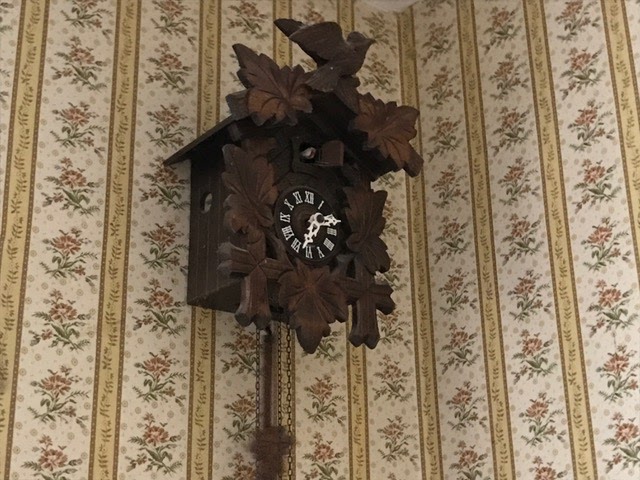
The house is as quiet as my house can be, which means that in addition to the blood rushing through my ears I’m also listening to the twitter of parakeets and the steady tick-tock of the cuckoo clock.
The “cuckoo” part of the clock has been long since been disabled, but the ticking mechanism remains. The metronomic beat of this timepiece is the soundtrack of my life.
On the rare day when the clock’s not wound, the stillness is deafening. I can hardly hear myself think.
Which raises the question: What has all this ticking done to my brain? Has it weathered it with pockmarks? Or has it smoothed and polished it, eroding those pesky irregularities that often stand in for real thought?
I recall a line from a poem by James Clarence Harvey: “Oh, the saddest of sights in this world of sin/Is a little lost pup with his tail tucked in.”
Since Friday, we have been in the deep freeze, with temperatures in the teens or lower. I’m remembering all over again why I no longer live in Chicago. There, the deep freeze was the norm. Here it’s the exception.
Working in Crystal City, though, I have a secret weapon: the Underground. One of its passageways leads from Metro to the building across the street from my office. It’s a little longer as the crow flies, but ever so much warmer.
I notice now a definite uptick in the number of Underground pedestrians, people like me, scampering in the warmth, eschewing the wind and cold.
There we were, dressed for the chill in boots, scarves and gloves — walking down what is essentially a hallway. Are we shadow commuters, or the real thing?
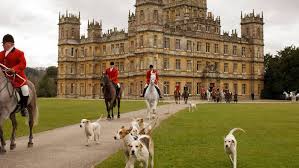
It would have happened last night, had it happened. But there was no seventh season of “Downton Abby” — and so I start this week without Lady Mary and Bates and Anna and all the crew.
Instead, I begin the week with “The People Vs. O.J. Simpson,” an excellent mini-series that just won a Golden Globe. But it did not take me out of myself and plop me down in the English countryside. It did not transport me to a place of elegance and ease.
For six years, there was Christmas, there was New Year’s — and there was Downton Abby. I don’t know if the scheduling was intentional, but it always seemed the perfect show for easing into the new year. It took the sting out of reentry.
Luckily, we live in an era of such television bounty that I couldn’t even be bothered to leave the house for a first-run film like “La La Land.” I needed screen therapy, and I got it — without venturing outdoors. But I didn’t have Downton. And that’s what I needed.
(Photo: PBS.org)
Last year’s Epiphany I came across a bevy of colorful scarves draped on trees and banisters and railings. It was a “scarf bombing,” part of an organized effort to help those who have no way to come in from the cold.
It was, I thought, the perfect expression of the day, a moment of revelation in wool and worsted.
Today, nothing so epiphanous. Today, a typical work-at-home day, the views and contours familiar and unsurprising.
By definition, though, sudden revelations can happen at any time. So while I may not be cleansed by clarity now, I may be later today or tomorrow or sometime next week.
In other words, I’m trying to live as if inspiration is just around the corner.
There are days in D.C. that bring a bright sun and mild feel to our winter, that air it out like an open window on a chilly night.
Yesterday was such a day, when a 30-minute walk took on grand proportions in the landscape of the hours, and made my afternoon significantly peppier than my morning.
There were bicyclists on the path and runners shedding layers. There were the familiar take-offs and landings at National Airport. There was the monument ahead of me and all the promise of a new year.
I was on a path, moving forward.
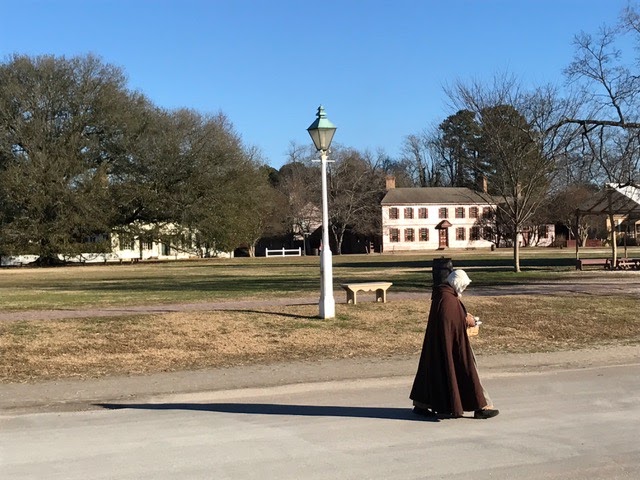
I’m thinking back to last week’s trip to colonial America. In eighteenth-century Williamsburg, most people walked. They walked to the fields to work, they walked to the Capitol to debate the Stamp Act. They walked to the tavern and the milliner and the tinsmith.
Yes, they had wagons and carriages, and sometimes they rode in them. But mostly, they walked.
I think about the walking and the silence, the combination of the two. Then I think about my own noisy, clattery world.
Yes, I enjoy antibiotics and flush toilets and central heating. But oh what I would give for the walking and the silence, for the time it would give to collect thoughts and mull over the future.