Browsed by
Author: Anne Cassidy

Suburban Density

Suburban Density

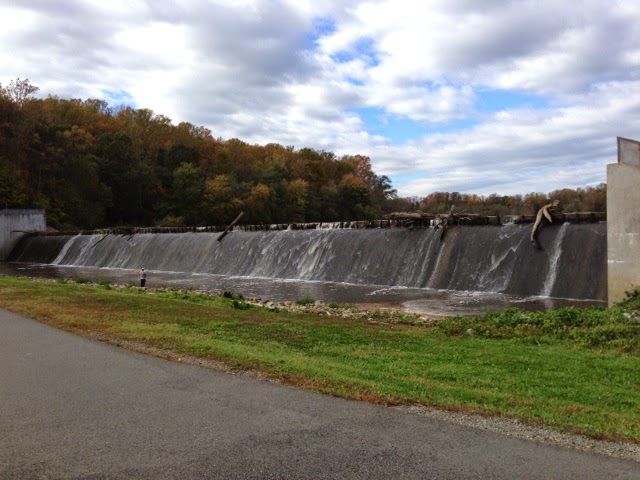
Each time I’ve visited Lake Accotink Dam (which is only twice but feels like more), I’ve spotted people exercising here, running up the stairs
beside the spillway, and, most recently, a man rolling back and forth on the
asphalt stretching his quads and hamstrings, totally oblivious to the others
walking here. I practically had to step over him on the trail. 
I think about
how, even though I’m not in a city but in the suburbs, there
is still the trademark of city life: an obliviousness to the lives of those
around us. A resolute self-centeredness (or is it self-preservation?) that is perhaps bred in the general irritation engendered by close proximity
to neighbors. 
Which is why I’m not sure this urban density thing will work in the
suburbs. Clump people together, save space for hiking and boating and picnicking.  A lovely concept,
until you have to step over a grown man stretching.
To what extent do we need our suburban space? Haven’t many of us moved here to have it?
November Reds

November Reds

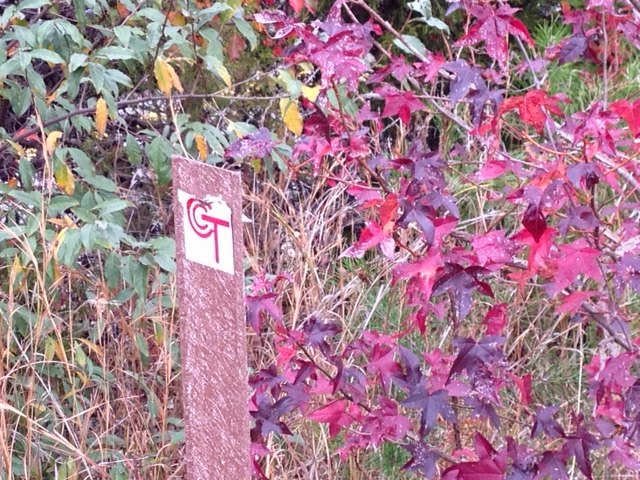
I could tell with eyes half open that it was November. It was morning but not bright. Changing leaves are the brightest thing in the landscape. We must enjoy them and shuffle through them now.

Already some trees are skeletons, pale gray and shimmery.

The reds, when you see them, stand out like beacons.

Happy Halloween!

Happy Halloween!

The candy is hidden so there will be some left for tonight. There’s a plump pumpkin for carving. And the yard is covered in crisp brown leaves.

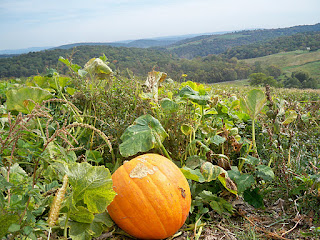
I took this photograph at a pumpkin patch Suzanne and I visited three years ago. I remember even then the preciousness of time with her. (Peace Corps was already in her plans.) The preciousness of that time, telescoped as it was then, and especially as it is now during her leave, is just a compressed version of all the precious times we spend with those we love.

The ripe fruits of autumn remind me how important it is to store up those times. Store them up as a plant does, capturing sunlight, soil and rain.


Dancing Bones

Dancing Bones

Advanced beginners’ tap is, at least for me, more about the advanced than the beginners. There’s a lot of fancy footwork, quickly executed. Balance is required. The kind of balance you have in your 20s or 30s but not — ahem — later in life.

Relax your toes, teacher Candy said last night. You need to relax your toes inside your shoes and then you’ll be able to move more smoothly. She broke one complicated step down into its components, told us the movement was like a ribbon unfurling.

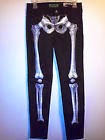
There were other suggestions —jump down not up, take smaller steps. But the one said most often was “keep smiling.” That wasn’t hard. The woman next to me was wearing dance tights with skeleton bones. Suddenly I saw a parade of dancing, prancing skeletons, out for a night on the town.

How to Live? Walk.

How to Live? Walk.

I’ve been reading about the 16th-century writer Montaigne, who invented the essay, from the French essayer, to try. The idea of “writing about oneself to create a mirror in which other people recognize their own humanity has not existed forever,” says Sarah Bakewell in her book How to Live or A Life of Montaigne: In One Question and Twenty Attempts at an Answer. “It had to be invented. And, unlike many cultural inventions, it can be traced to a single person: Michel Eyquem de Montaigne.”

“Unlike most memoirists of his day,” Bakewell writes, “he did not write to record his own great deeds and achievements. Nor did he lay down a straight eyewitness account of historical events.” Instead, he used ordinary topics — friendship, names, smells, thumbs, wearing clothes — as a way to explore the question “How to live?”

Here are some of his answers, according to Bakewell: Pay attention; read a lot; wake from the sleep of habit; see the world; reflect on everything and regret nothing and, finally, let life be its own answer.

I’ve been taking notes, as I often do, and there are many passages I’ve recorded to reflect on later. Here’s one of my favorites:

Montaigne did not brood in his tower, Bakewell writes. “He liked to be out walking. ‘My thoughts fall asleep if I make them sit down. My mind will not budge unless my legs move it.'”

Every hike, saunter, amble, walk and run I take tells me he’s onto something there.

Trail Thoughts

Trail Thoughts

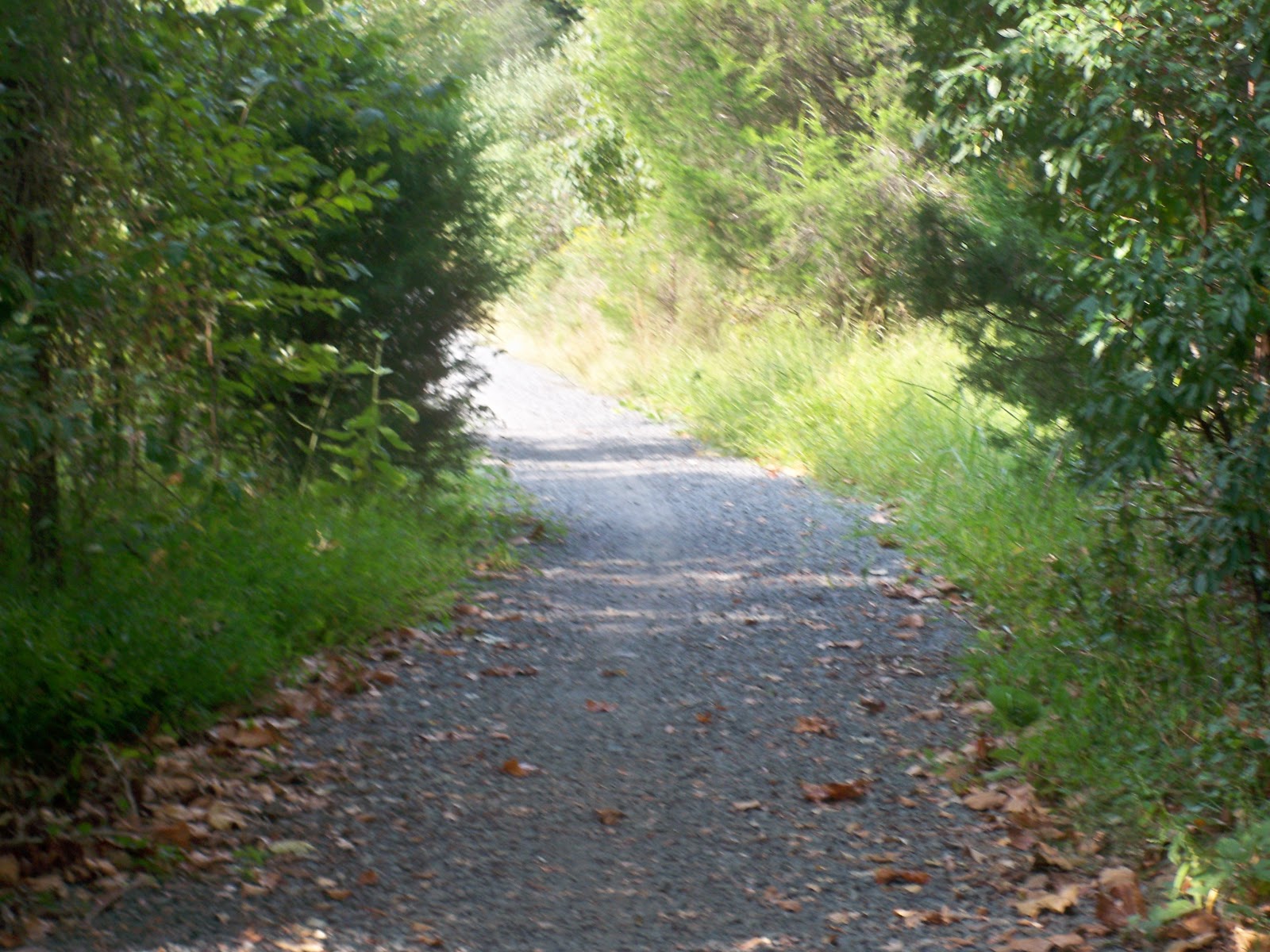
Yesterday’s trail hike took me from Lake Accotink to Byron Avenue Park, almost to Old Keene Mill Road. This is true terra incognita. I could as easily be in Maryland or Delaware or Pennsylvania as Fairfax County.

The trail has its own rites and its own rhythms. It mesmerizes. There is the creek gurgling in the distance, the sound of a distant mower, a faint cricket chirp. My feet rustle through the leaves. I pass a few people, not many on a Monday. A gaggle of school children, a couple of lone mountain bikers, exercisers sprinting up the stairs near the dam.

But for the most part, I’m alone, notebook in hand, writing down the thoughts when they surface. Because out on the trail, they always do.

Decoration Inflation

Decoration Inflation

It used to be a pumpkin beside the door. But the ante has been raised and now more houses than not feature dangling skeletons, inflatable jack-o-lanterns or witches that have flown — splat! — into trees. Some neighbors string orange lights or garland their mail boxes with autumn swag.

I enjoy these tokens of the season — because they’re fun and they add variety and texture to life — but I bristle at decoration inflation, at a decorating season that stretches from October 1 through mid January.

So I’ve established a modest compromise. A few fall tokens (all of them souvenirs of when the girls were young), an autumn wreath and, come mid-December, colored lights around the door and on the front bushes. It’s decoration without inflation.


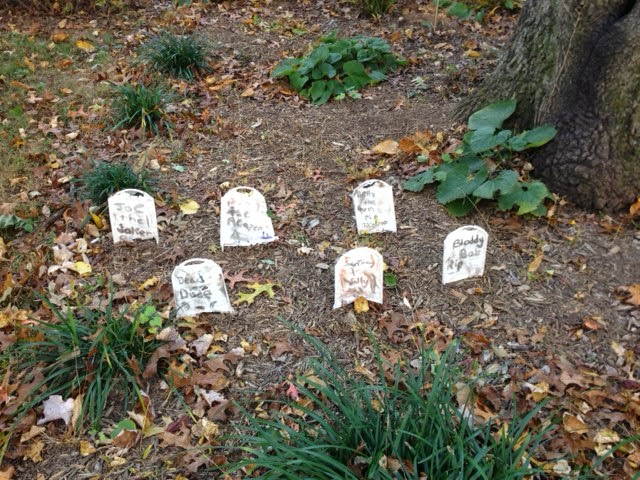
(Claire made these tombstones from paper and croquet wickets when she was in fourth grade. )

Outside In

Outside In

It’s cold enough that the heat came on, and hot air ruffles the leaves of the peace plant. I had to look up the name of this plant. I’ve had a smaller one for years, but never knew what it was. Now that I have a large one (given to us at Dad’s funeral), I feel a greater responsibility to it, am working harder to keep it healthy, to coax its airy white flower — which shoots up, seemingly out of nowhere — in bloom.

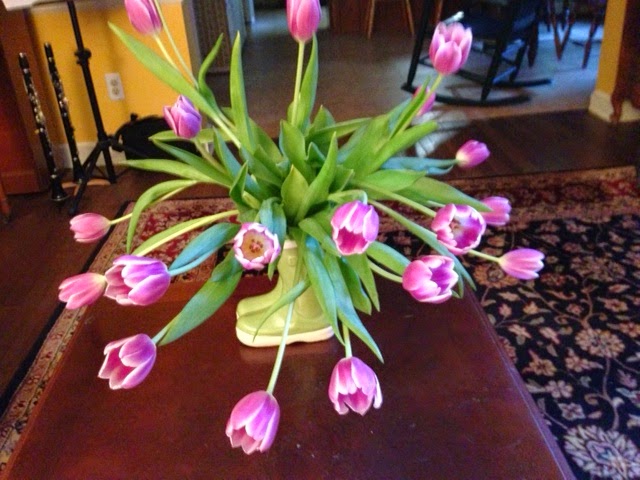
In from outside is the cactus, the large fern and — new this year — a hardy, happy thyme plant. (We’ll see how long it’s happy inside.) They join a profusion of cut flowers — bouquets from Suzanne’s arrival — all making the house cheerful.

As flowers fade outdoors they bloom indoors. I’d rather have the profusion of summer, but when that’s not possible this is the next best thing.

Seasons of Hope

Seasons of Hope

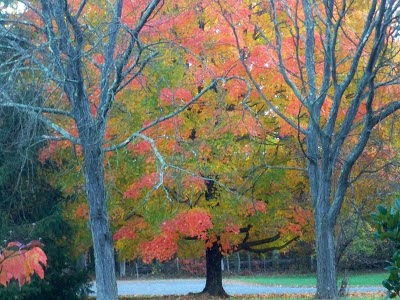
I spotted these trees on a walk two years ago and have never forgotten them. The way the living tree flames out behind the dead ones. The promise of new life hidden in each glowing leaf.

As leaves fall it is easy to be melancholy, but I remind myself that until they do, the new ones cannot grow.

What this tells me is that each end is also a beginning. That there is no season without hope.

Familiarity

Familiarity

Suzanne was born 26 years ago today. It’s the first birthday I’ve spent with her in three years. Not that one expects to be with an adult child on every birthday, but after having her so far away from home these last three years having her here feels pretty darn good.

I think today as I always do about the moment I first saw her — and the feeling is as clear today as it was then. It was a supercharged familiarity. “I know you,” I said to myself the instant I glimpsed her face. “Of course. It’s you.”

And even though she lives in Africa now, and has been independent for years, I still have that feeling about her — and about Claire and Celia, too. There they are, I think, as I watch them grow up and enter their own lives, the children I was meant to have. As unmistakable as blood or water.