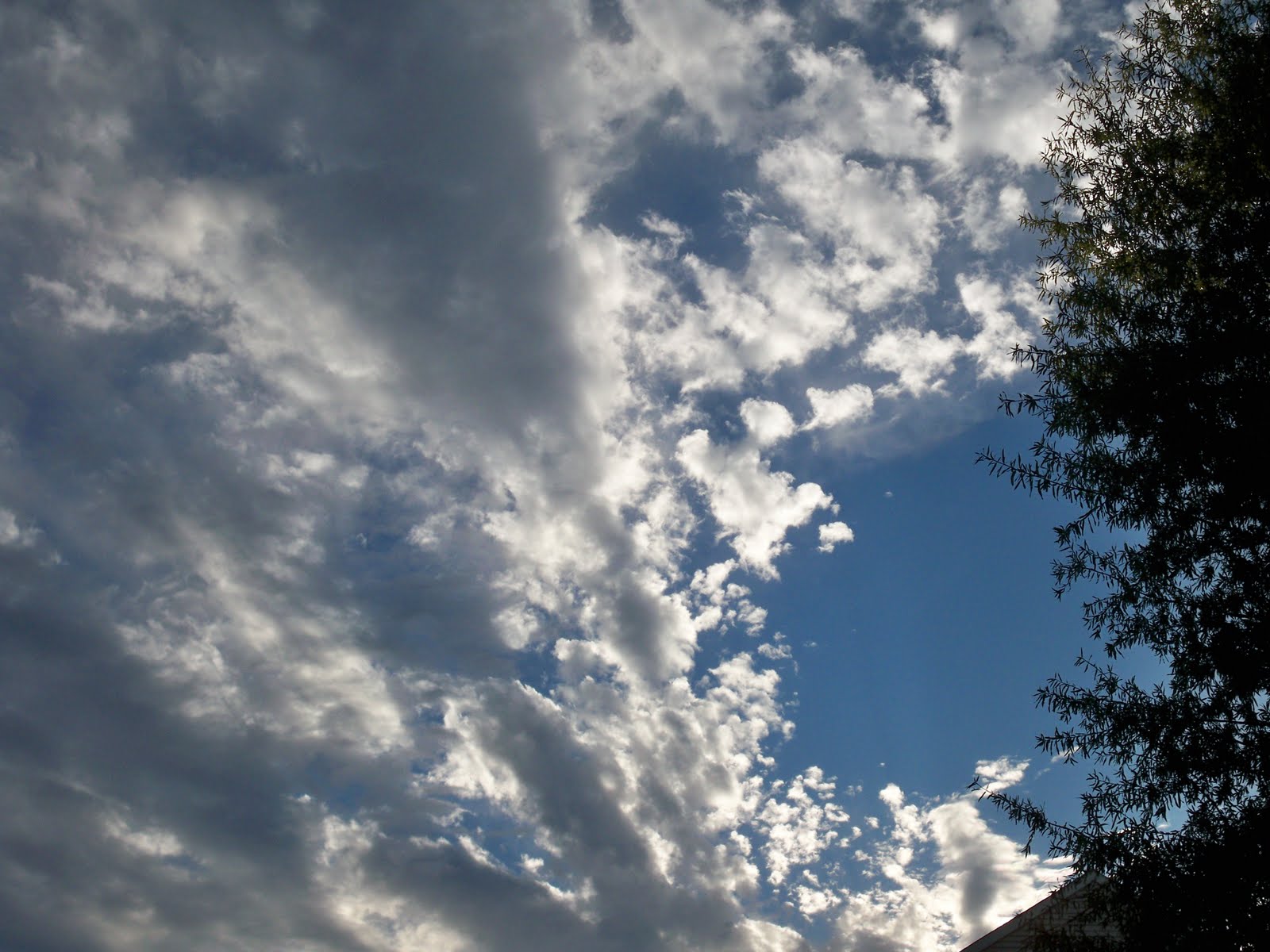
There is a special quality to the day that has been cloudy and ends with a last-minute parting of the clouds. The sun, of course, is low in the sky, and so those first rays are a bit disorienting.
Is it just selective memory, or does the sun set more grandly, more expansively on those days? It makes sense that it might. Banks of just-parted clouds pile in heaps on the horizon and add drama to the sun’s steady slipping.
And on the ground, people who have been inside all day rush out to walk before darkness falls. The streets that were clammy and silent are suddenly peopled again. There is an unusual briskness at day’s end. And a hopefulness for the morrow.
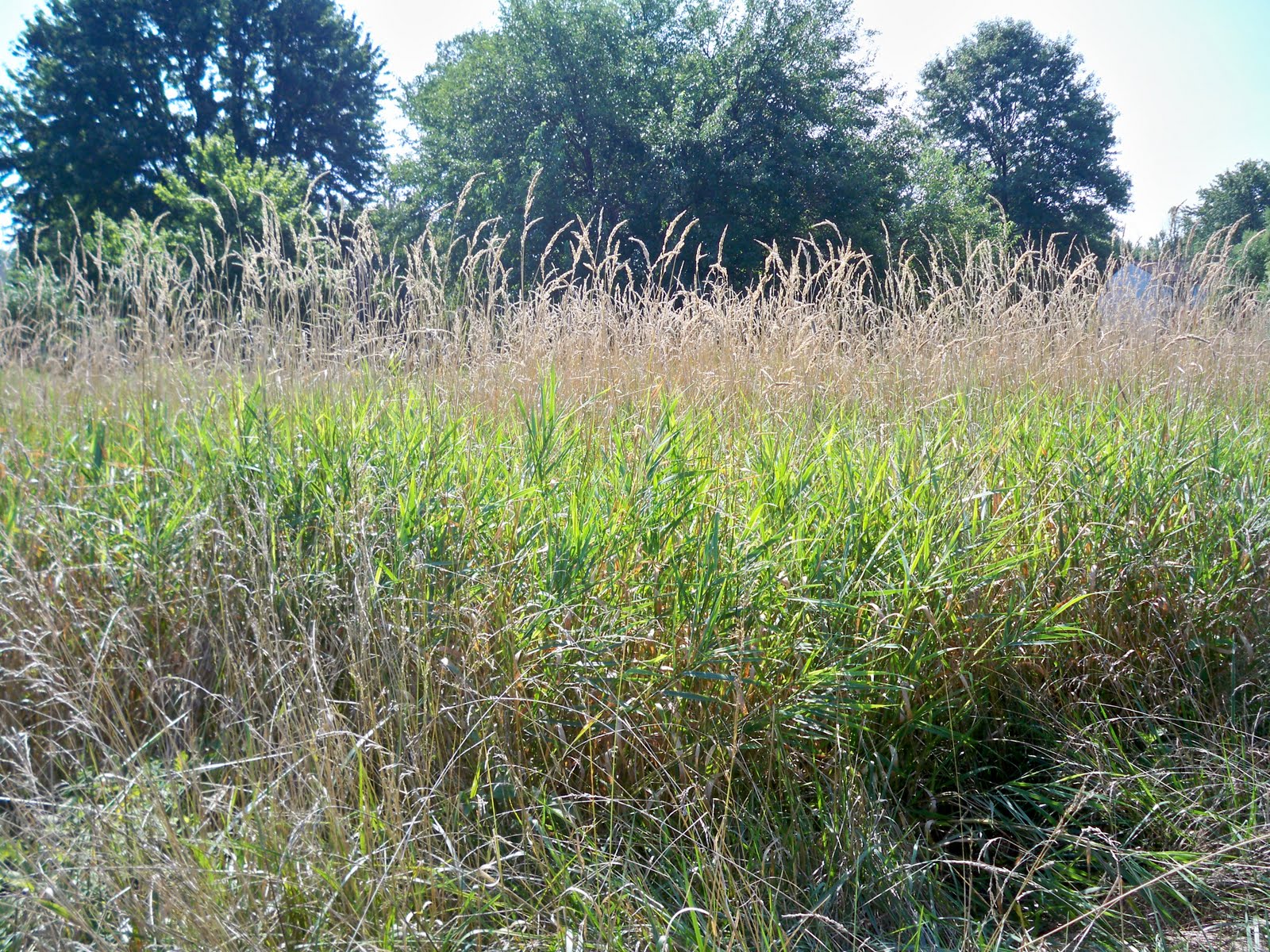
On Friday’s walk I spied two monster tractors motoring back and forth across what remained of a meadow quadrant, cutting down everything within reach. It was a brisk, efficient business, abolishing in minutes what it took months to build: the waving golden rod, the spindly stalks of Queen Anne’s lace, the nettles, the Virginia creeper and the chicory.
It is haying time in Franklin Farm, which means not the cutting, drying and bundling of grass to nourish animals through the lean months, but rather a tidying up of the suburban landscape. Franklin Farm is a subdivision, after all, and this is not the mowing of a lawn but of the common land, a place set aside for recreation and beauty, a tip of the hat to the dairy farm that was here before, and as such, a place I like to walk because (despite the paved paths and center-hall colonials), it has some sense of the genuine about it.
I’m almost afraid to walk past the meadow today. Will the entire swath of grass-carpeted land have fallen to the blade? If it has, we will all be the poorer for it. We will miss the beauties of first frost on tangled briars, a seasonal transformation made possible only by negligence, by leaving alone the delightful chaos of nature.
This morning I notice the stillness. In the fog of a new day, I hear what has become mere background noise, the fluid chorus of chirping crickets, which passes for silence this time of year.
“By September, the day breaks with little help from birds,” writes the conservationist Aldo Leopold in A Sand County Almanac.
Leopold’s line makes me notice the truth: The day dawns quietly now, without the raucous morning chorus of cardinals and robins and jays. “The disappointment I feel on these mornings of silence perhaps shows that things hoped for have a higher value than things assured,” Leopold writes, explaining how he feels on days he does not hear a covey of quail.
I am not disappointed by the lack of bird call, but I am made pensive by it. There is something in the dawn chorus that does my heart good. Birds are onto something; they sense hazards before we do. When they quiet down, I listen up.
When I was a full-time freelance writer I wrote often for Working Mother magazine and became familiar with the theory that multiple roles are healthy for working women.The theory goes something like this: When work goes well, it inoculates us against the stress of home and family life. And when home is crazy, the office provides another avenue for achievement and satisfaction. Of course, sometimes both work and home are demanding, but that’s another story.
Last night I missed class to go to Celia’s back-to-school night. I’m glad I made the choice I did, but I missed the camaraderie of the class, missed the two hours I would have spent thinking and talking about ideas.
So after I came in, I spent a few minutes thinking about choices and the multiple roles equation (or my vastly simplified memory of it). The equation is missing a number, I think. There’s a part of me (a part of every person, I imagine) that is not about work and not about family. It is the “third shift,” that which we do for ourselves alone. And often that’s what gives, what falls behind.
For me it’s the thinking self — the reading and writing and pondering self — that has, as the children have grown older, become ever more important. This is the self that has been parched for years. Now that I’m starting to quench it, I don’t want to stop.
There are some spectacular stretches of scenery on Interstate 64 between Beckley, West Virginia, and Lexington, Virginia, but the rain and fog made it difficult to capture them this time.
Looking at the snapshots this morning, I think of the Proust we’re reading for class, selections from Swann’s Way. I think about how Proust would be able to parse the fog for us, take us into the cloud banks and out again with memories as sleek and silvery and slippery as a fish.
What may seem obscure, remote and impenetrable is, upon reflection, packed with meaning. The difficulty lies not in the absence of material but in the abundance of it.
Proust’s meaning is never superimposed, though. It is organic; it grows out of repetition and early familiarity. It accumulates, layer upon layer, as a result of daily living — fully conscious daily living.
An element of modern life that we tend to discount is the amount of travel we undertake. I often think of this after one of my quick trips to Kentucky, a quick trip that takes eight hours each way.
But even the distance conquered by each suburban commuter, moving daily from one realm to another, can be 50 miles or more round trip.
Once, when Mom and I were traveling together in Ireland, we asked a shop woman for directions to a manor house that we knew was less than 10 miles away. She pointed us down a stretch of highway. “It’s lovely that way, I’ve heard,” she said.
It took us a minute to realize that the woman had never been there. What was for us a short jaunt, just one tiny leg of a many-legged adventure, was for her terra incognita.
And so it goes with traveling. We learn not just from the distances we traverse but from the people we meet along the way. People who show us another way to live, the way of staying put. Staying put is our terra incognita.
Last night I went for an after-dinner stroll. People were entertaining at a house nearby. White twinkle lights glittered in the trees and a red carpet covered the walkway. There was a football game going on and Kentucky had not yet lost.
Earlier in the day Ellen and I had walked around the neighborhood admiring the knock-out roses and the loamy soil that produces them. This is our hometown but not our home neighborhood, so there is much to learn.
But there are also the familiar sights, the field stone, for instance. Many old walls around here are made of it, and I grew up hearing these stone fences were built by slaves. I later learned it’s more likely they were built by Irish immigrants who had come here with the railroad and stayed for the horses.
This lamppost gives a hint of the artistry required to build a stone wall. I like the rough weathered look of the thing, how it seems both solid and light at the same time. It is free of manufactured precision; it is forgiving and free.
Betty Leet Bell is my Dad’s first cousin, which makes her my second cousin, or my first cousin once removed. One thing she is without question is a genealogist. She has spent years researching the births, deaths, marriages and deeds of those who can no longer tell their own stories.
Yesterday we went to visit Betty and she told us about a cousin who danced in the dream sequence of the movie “Carousel,” a great-grandmother (above) who died of the measles after giving birth to her tenth child, and another relative whose pet was a talking crow.
One of Betty’s stories concerned two store-front lots in Lexington. When she was researching the ancestors on her mother’s side, she learned that in the 1790s her great-great grandfather bought these two parcels of land for a hatter’s shop.
A couple years later, when Betty was researching her father’s side of the family, she learned that these were the exact same lots that her dad purchased in the 1930s when he was looking for a place to build his furniture store. One hundred and forty years (and several intervening owners) separated these purchases. It was one of those historical coincidences that Betty says is not that uncommon when she’s digging into the past.
Maybe it was just the commercial potential of these lots that spoke — generations apart — to these two very different men. Or maybe there was something about that spot, the way it looked in the morning light, or smelled after a good, hard rain; maybe there was something about that place that spoke to each of them.
Today I’m in Lexington, about to go for a walk in a neighborhood that is not my own but which has meaning for me because my parents live here. In class the other night we talked about whether you can know a place without knowing its history. The consensus, if there was one, was that a place is shaped by its history, but you don’t necessarily have to know that history in order to be shaped by that place.
This house was where my Great Aunt Sally died more than 80 years ago. We drove by the house the last time I was in Lexington and Dad told the story of going with his father to his Aunt Sally’s wake in this house when he was a little boy. Dad also spoke about a racetrack across the street from the house, a track that preceded Keeneland, Lexington’s current track. I couldn’t resist taking a few photos of the house. It is quite different from all the other houses on the block. It looks like a castle.
A few weeks after my last visit to Kentucky there was an article in the Lexington Herald-Leader about this very house. It was home to Courtney Mathews, an African-American horse trainer who probably trained 1902 Kentucky Derby winner Alan-a-Dale. Mathew’s funeral was held 13 years later in the same house where my Aunt Sally’s took place. It’s a house that may soon be named to the National Register of Historic Places. The same house I photographed on a muggy June day 71 years later.
I guess this shows which side I take in a discussion on history and place.
Our road west begins with Route 66. Not the “Route 66” of “Kingman, Barstow, San Bernadino,” lines from the song Nat King Cole made popular, the song we sang as kids when we were heading to California the first time. And not the “Route 66” of the iconic 1960s television show, with its haunting theme song. And not the real Route 66, the road that wound through red rock canyons and high pine forests, a road mostly bypassed now but not forgotten.
Our Route 66 runs from D.C. to Front Royal. It passes through Vienna and Oakton and Fair Oaks and Gainesville and Manassas. From it you can reach Great Meadow or Skyline Drive. And rather than seeing the Rockies at its western horizon you can spot the subtle line of the Blue Ridge. Route 66 is our road west. It is a short interstate, and often clogged with traffic. But from its crowded lanes the road west begins. We will take this direction any way we can.