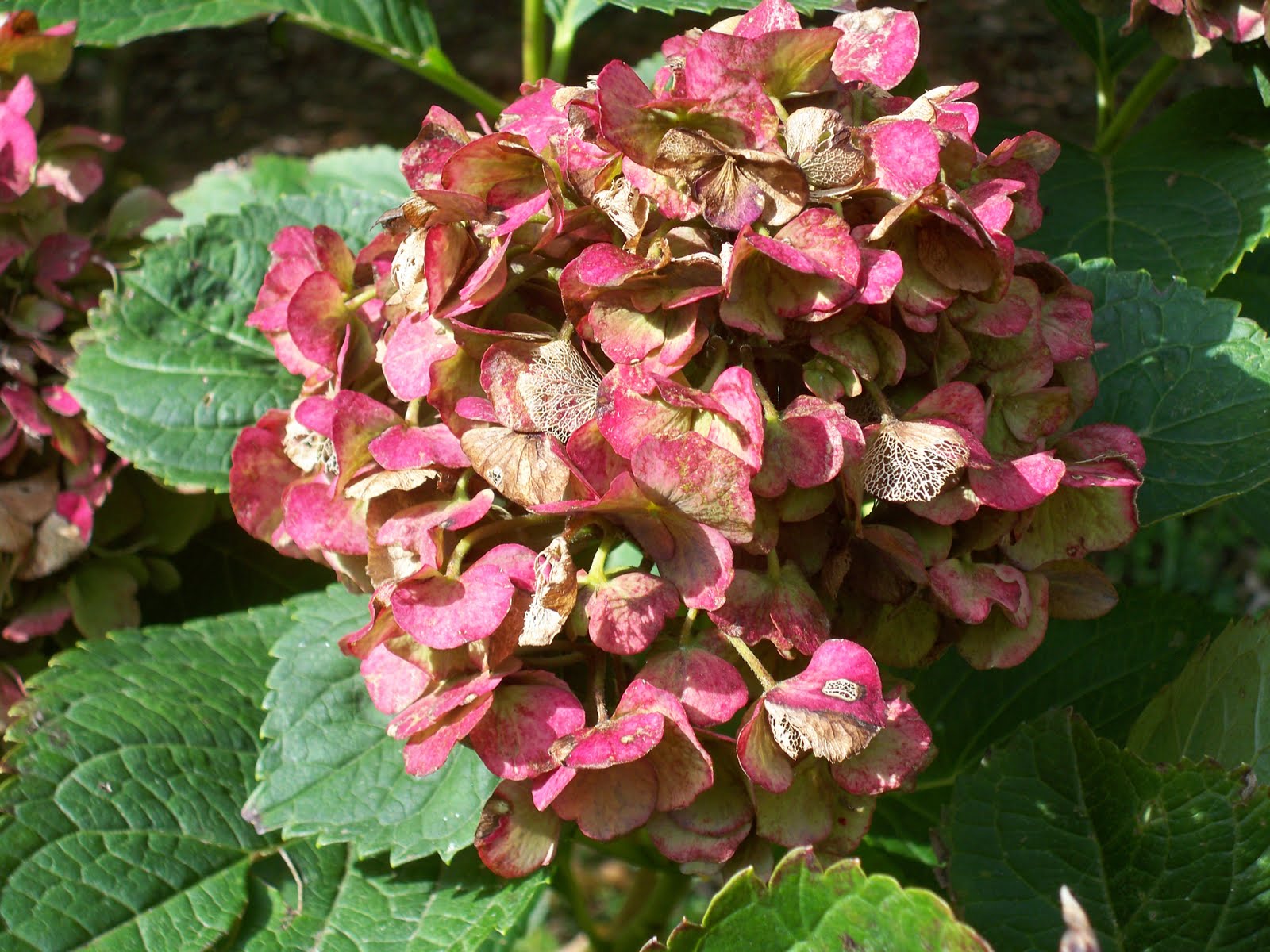
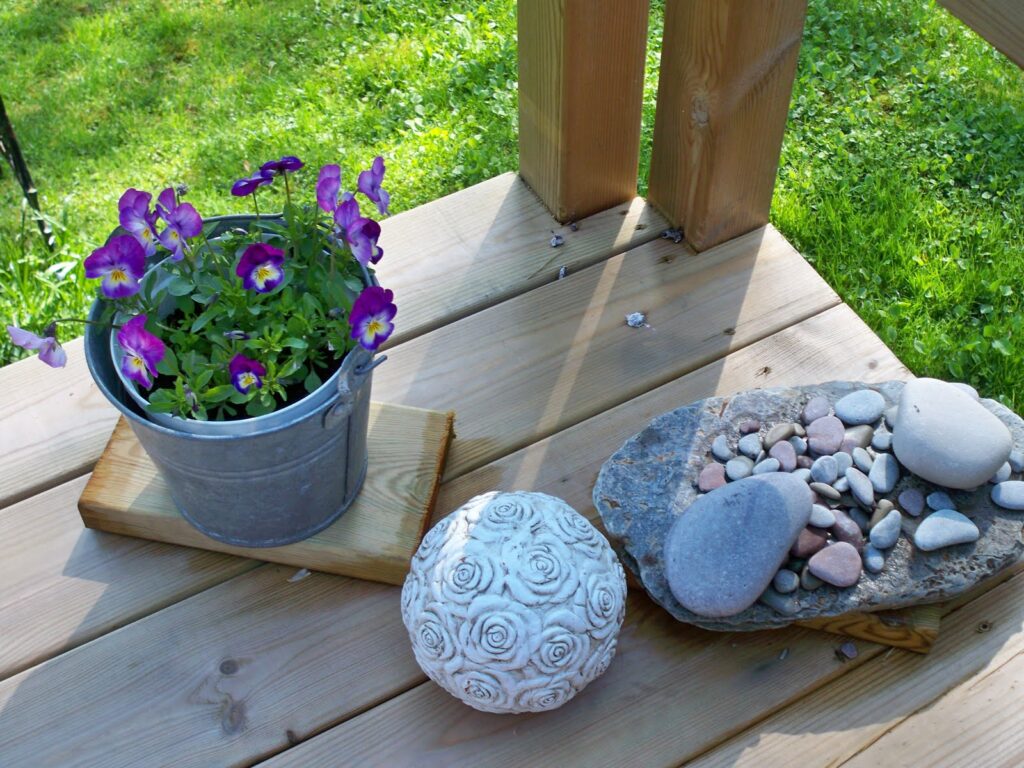
There is a shade that appears this time of year in leaf and twig and flower. It isn’t russet or rust; it’s more of a rose. Not the vivid rose of spring but the faded rose of fall, a purplish rose. It’s an elegant hue, subtle enough to show up on a runway or in a fashion magazine. But not pretentious either. It’s a quiet color and you won’t see it first when you gaze at a stand of trees. But go for a woods walk as I did yesterday, or do some weeding in the flower beds, and you’ll find it.
A few weeks ago, at back-to-school night, I saw the list of books our high school sophomore will read for English this year. I had to bite my tongue not to say “Oh, we have those, somewhere…” — because usually I can find every other book but the ones we need. Someday we will discover a box in the basement containing every missing selection on the high school curriculum: All Quiet on the Western Front, The Jungle, The Scarlet Letter.
Meanwhile, the books that I do find are distressingly yellowed and priced at 69 cents. You must open them carefully, so that their bindings don’t crack and their pages fall out. Along their margins is such English major scrawl as “obsession with the body shows the importance of the physical” and “dichotomy of city and country echoes Romantic themes.” But I’m proud of these books, and of the occasional comments the girls have reported back to me from their English teachers: “I used to have that edition when I was in college” or “I can see your family holds onto things.”
The late Susan Sontag said of her library of 15,000 books: “What I do sometimes is just walk up and down and think about what’s in the books, because they remind me of all there is. And the world is so much bigger than what people remember.”
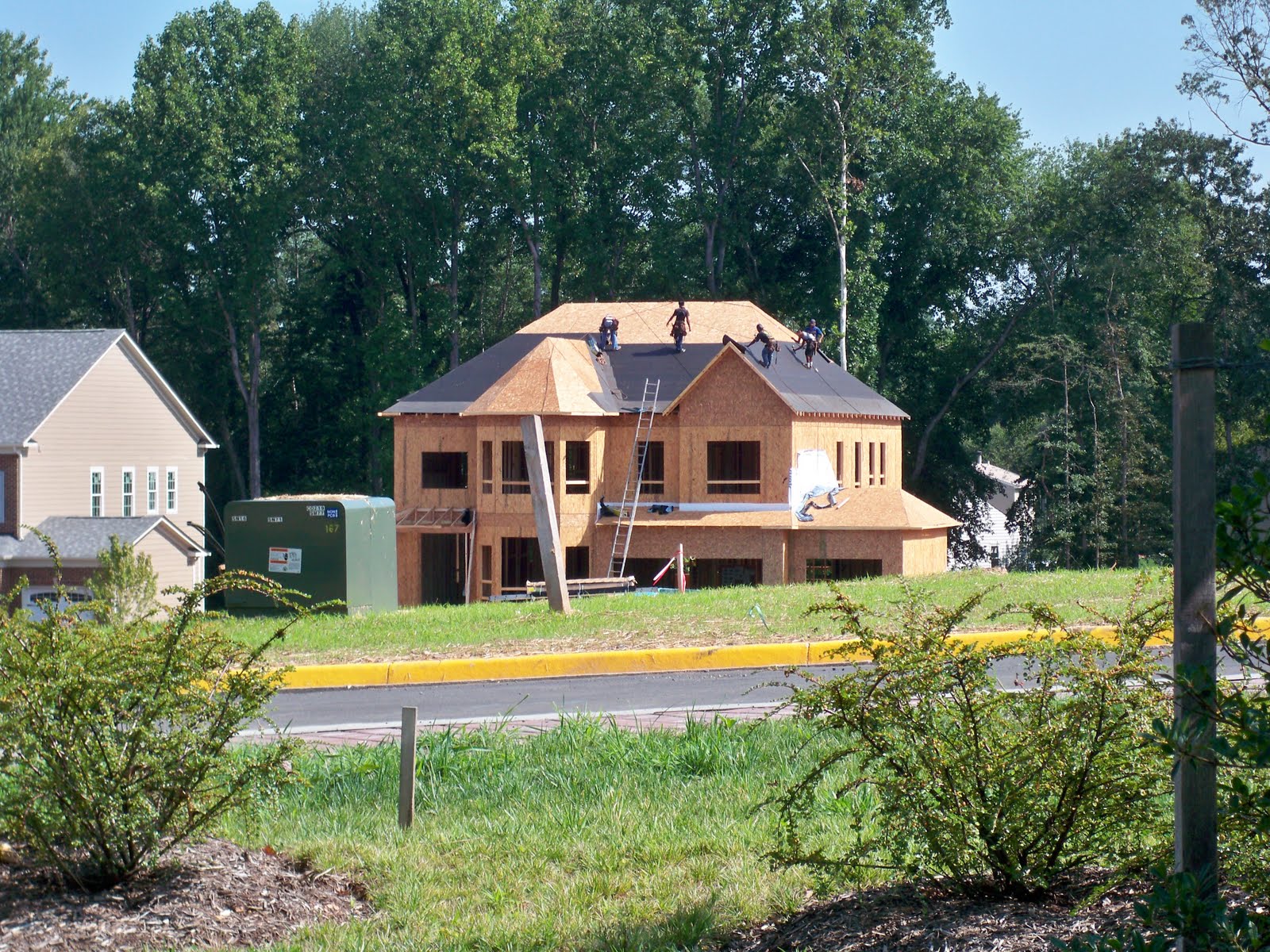
I read today that Builder magazine has come up with its concept home for 2010. It’s called a “Home for the New Economy,” and it’s 1,700 square feet. Previous concept homes have been as large as 6,000 square feet, so this is quite a departure. The article goes on to say that it will take time before homeowners embrace the smaller-is-better concept of this concept home. And certainly where we live, McMansions still rule (see above).
But the “Home for the New Economy” makes me feel vindicated. We live comfortably in a 2000-square foot house with a room for every child, a cozy former dining room that long ago became our ersatz family room and a kitchen where we —— and most people who visit us —— spend most of our time. There isn’t as much house to clean or pay for and, best of all, the small house keeps us together. Where we belong.
Yesterday I met a 98-year-old man who is still practicing law, the fifth generation of his family to do so in his North Carolina hometown. He and his (slightly) younger wife had driven five hours to attend a reunion, and after a luncheon for 50-year (and 50-year-plus!) graduates, the man took the microphone and sang the Georgetown fight song in a strong, clear baritone.
As it turns out, the man is the great grandson of Stephen A. Douglas, of Lincoln-Douglas debate fame. My recall on this being a bit shaky, I just read the Wikipedia entry on these debates. There were seven of them, held in various towns in Illinois, as Lincoln challenged the incumbent Douglas for the U.S. senate seat. The debates covered big topics, especially slavery, of course, and they were so important that newspapers sent stenographers to take down every word the men said. But the newspapers that were for Douglas edited his words and left Lincoln’s in rough form — and vice versa for the newspapers that supported Lincoln. After he lost the election, Lincoln cleaned up all the text of the debates and published it in a book. The book’s popularity helped lead to Lincoln’s nomination as Republican candidate for president of the United States.
And just to think, I learned all this because of a little old man at a luncheon.
The woods are balding and purpled. Trees are thinning. I can see farther now into the thickets, which are no longer as thick. I bounce on the trampoline (Bouncer in the Suburbs? nah!), and when I’m tired I lie down on it and watch the leaves fall. So slowly, spiraling down, taking their time, an eternity of empty air beneath them. They fall singly or in pairs. Sometimes they are caught on an updraft, and then they soar. At this point, a falling leaf is still a novelty. I can observe it and think poetic thoughts about it. Soon leaves will fall so fast and in such number that I won’t have that luxury. I will be too busy to notice their progress through the sky. I will be raking.
We have no vivid reds and oranges here yet (maybe we won’t at all). What we do have is an autumn glow, a gradual shading of our leaves from green to lighter green to burnished copper. The trees are tired and thirsty. It’s been a rough summer for them; maybe they don’t have the energy for a full display.
We still have time for a fall worthy of New England. That’s what I always hope for. But if this is all we get, this polite curtsy of an autumn, this thinning and deepening of color, that will be fine, too.
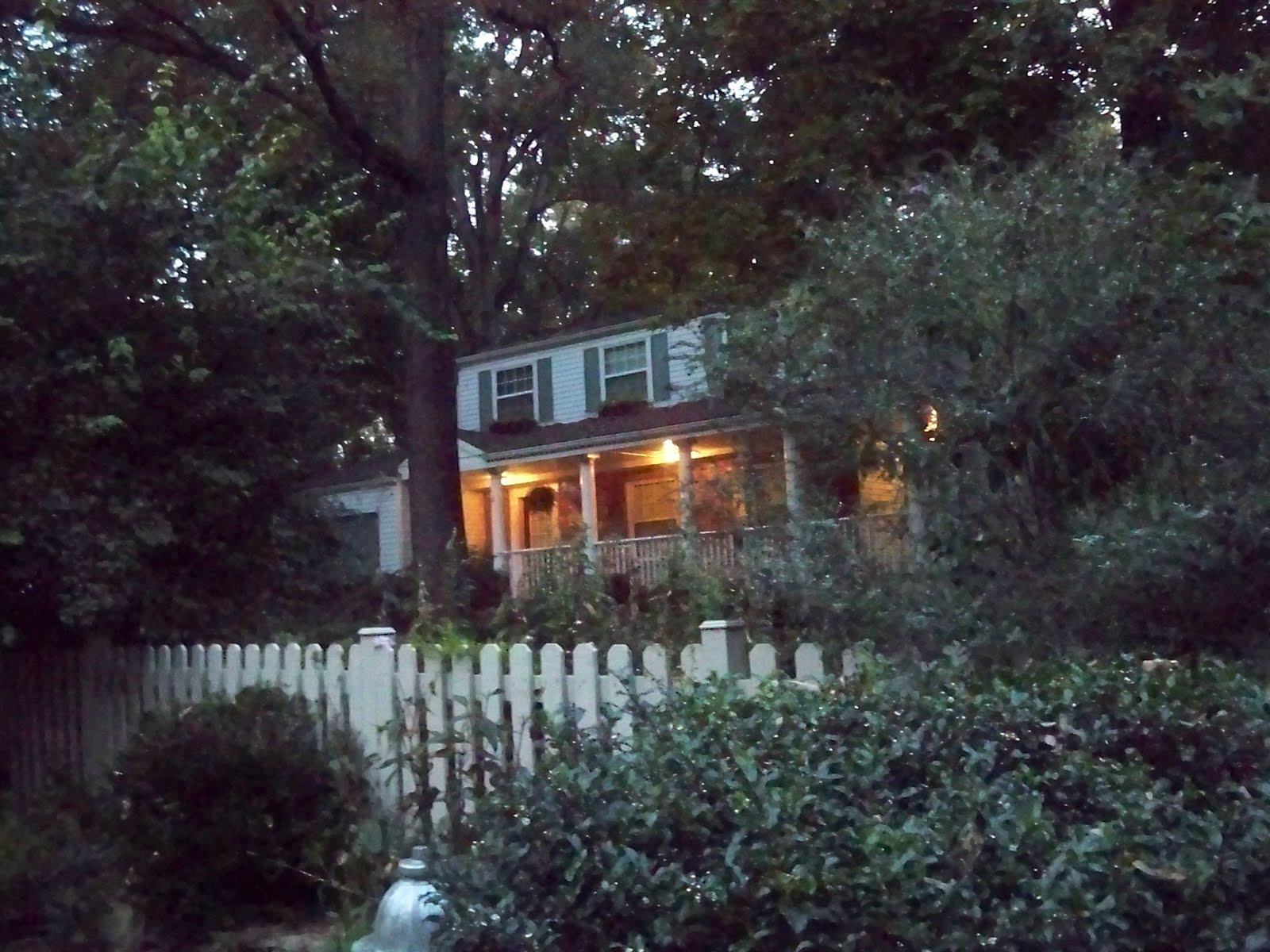
Last evening I walked by this house. It’s my favorite in our neighborhood and, as I just learned from a real estate circular, it “SOLD in 7 Days!” It’s one of the smaller models in our subdivision and has an ordinary lot. What makes this house special are the window boxes, the white picket fence, the wrap-around porch and the English cottage garden. In other words, details. Put enough of them together, though, and you have a place that is charming and comfortable and old-fashioned. Ah yes, I have a crush on this house.
Six years ago today I went to work in an office again after a 17-year freelance career. It was 2004, the girls were all in school (grades, 4, 8 and 10) and I needed a change. Some people can spin stories out of their imaginations and never need the rough and tumble of the world to push them along. I do. Plus, the steady income was a definite lure with college tuition looming on the horizon. So when I heard about a writing job for a university alumni publication, I signed on.
Some days I know I did the right thing; other days I’m not so sure. It would take more than a single blog post to explain how much I’ve analyzed this decision and its impact on our family and my career. In moments when I’m ruminating about this a little too much, I call to mind the last lines of that famous poem by Robert Frost:
Two roads diverged in a wood, and I– I took the one less traveled by, And that has made all the difference.
Dr. James Ferguson of Hanover College, my favorite professor of all time, said it is the dash that makes the poem great. The dash, which stands for the hesitation, for all the decisions of life when we do not know, cannot know, if we did the right thing.
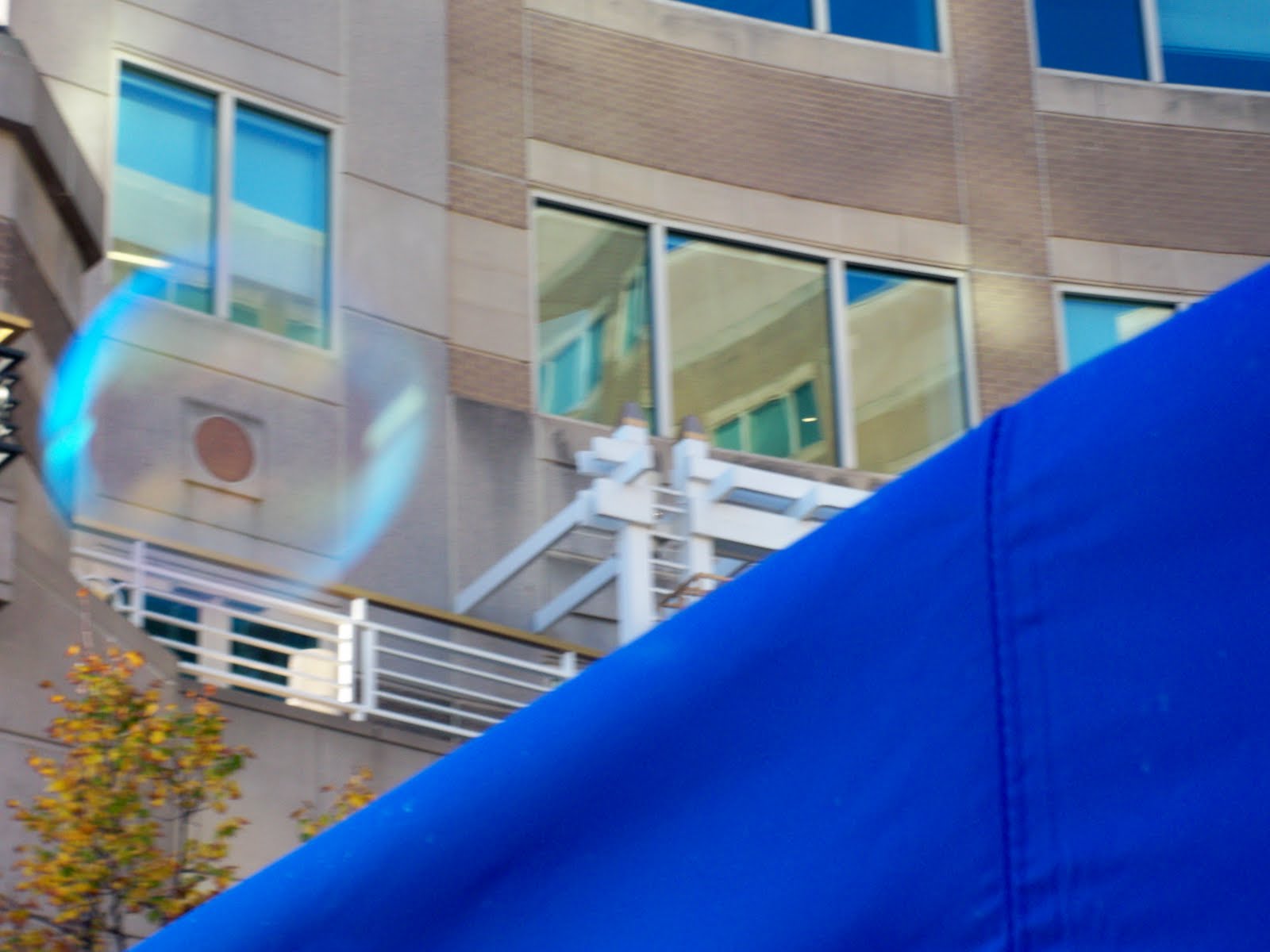
Yesterday we went to an Oktoberfest celebration at Reston Town Center, where I tried (with very little success) to photograph the bubbles that were flowing out of a bubble machine at one of the booths. In the process a security guard stopped me. “You’re not allowed to photograph the buildings,” he said. I told him I wasn’t shooting the buildings but the bubbles. He didn’t care. The bubbles were in front of the buildings. That’s all that mattered to him.
Bubbles are difficult to capture for other reasons, too. They flow and float and, worst of all, they pop! They are winsome and ephemeral and fickle. Photographing them is perhaps best left to the experts. But I had fun trying.
A brief post on numerology: There are scads more weddings today than there were on this equivalent Sunday last year. The reason, of course, is the date — 10/10/10. Not only a perfect 10, a series of them, but when the digits are added up (1+0+1+0+2+0+1+0), they equal 5, which stands for love.
But don’t believe me. Consult any numerologist. I heard a numerologist interviewed on the “Today Show,” which I watched this morning to see my friend Carla interviewed about hypochondria and her book Phantom Illness. (Go, Carla!)
The numerologist was on earlier in the show and she suggested that on this auspicious day, we should light a white candle and meditate on what we still hope to achieve this year.
I have a stub of a white candle on my kitchen table. I think I’ll give it a try.