Browsed by
Category: animals

The Word on the Trail

The Word on the Trail

The word on the trail yesterday was the fox napping on a big, flat-topped rock in the middle of the stream. He was having a lazy day, his tail hanging almost into the water.

I heard about this from a fellow walker: “Did you see the fox?” she asked, as her small, black, unleashed dog ambled beside her. “He’s sunning himself in the creek.”

This isn’t the only animal sighting I’ve heard about from a fellow walker. I’ve been tipped off to deer and birds, too.

Usually, we trail-walkers acknowledge each other with a nod, smile or wave, seldom exchanging words. But a fox on a rock in the stream — that’s worth a quick conversation.

(Alas, no pictures of the critter. I was walking without phone or camera.)

Double Crown

Double Crown

Over the weekend, Kentucky Derby winner Golden Tempo added the Belmont Stakes to his win column. He skipped the Preakness, so he could not win the Triple Crown. But winning two of the three races means he wins the “double crown,” which is not a designation I’ve heard mentioned but is worthy of note.

Yesterday I watched a replay of the the colt’s come-from-behind victory. As the thoroughbred made up a seemingly impossible amount of ground, I thought about the heart of a horse who can achieve such a feat.

What is it that fires up the winner, that pushes an animal to run faster than the others? What role does temperament play? Anatomy? Training?

I learned this morning that Golden Tempo is a descendant of Secretariat, a horse with a 24-foot-11-inch stride. I remember seeing markers demonstrating this stride at the Kentucky Horse Park years ago. It seemed an impossible foot (hoof) fall.

But mechanics are only part of the equation. A horse must want to come from behind to win, must respond to track and rider. How much of this is a mystery, something we’ll never know or understand? Quite a lot, I think.

Waiting for Scouts

Waiting for Scouts

Hummingbirds typically reappear in these parts around the end of April. Often on April 28th. Which is not to say that you can set your calendar by them, but close.

This year, feeders have been in place for more than a week, installed during one of the hot days in this on-again, off-again spring. But I’ve yet to see one of the early arrivals, the so-called scouts, male birds who fly into an area a week or two before the females to search for food.

I look at the feeders, notice that one has lower levels of nectar than the other. Maybe I’ve missed a few birds, but I doubt it. Just to be sure, though, I’m writing this post from the deck.

Bunny Hop

Bunny Hop

In my neighborhood, we have squirrels, chipmunks, fox and deer. We have owls and hawks, too. But rabbits have always been scarce. I imagine that the fox, owls and hawks have something to do with that.

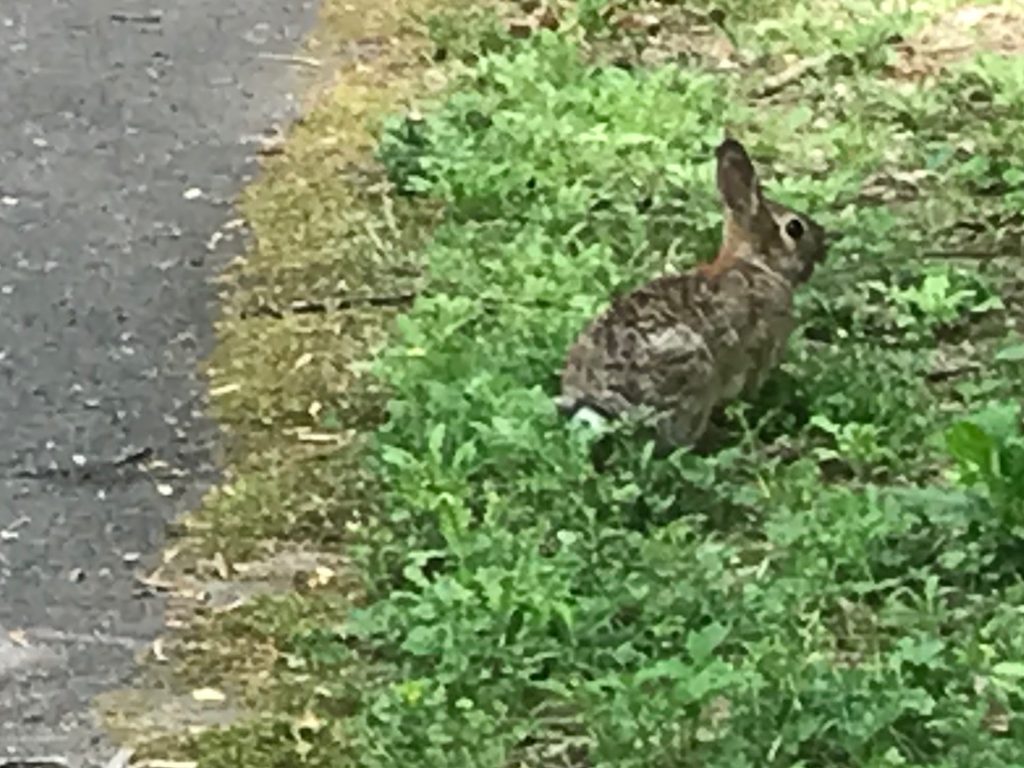
Yesterday, while ambling the Lake Anne trail, I spied this bunny, which hopped right in front of me and posed (froze in fear) in hopes I didn’t see her. I had time to snap this shot before the critter reversed course and vanished into the underbrush. Was she off to feed her young? Was her zigzag path an attempt to throw me off the scent?

I just read about cottontail nests, which are hidden in plain sight, in tall grasses or piles of leaves. I wonder how close I was to this bunny’s nest.

When I was 9 or 10, my father disturbed a rabbit nest when he was mowing. Thinking the mother had abandoned it (which she most likely had not) we took two babies inside to care for them.

I thought I’d died and gone to heaven. I fed the wee creatures with an eye dropper, cuddled and nurtured them. One of them escaped from its box, leading us on a merry chase throughout the house, jumping out from under the skirt of an arm chair and scaring my mother half to death.

It was an adventure that became part of family lore. And thanks to the bunny that hopped in front of me yesterday, it was top of mind again.

The Redder the Better

The Redder the Better

We are flush with cardinals here in my corner of Virginia, but the male at the feeder yesterday was one of the most vibrant I’ve ever seen. He practically glowed.

I did a little research, and sure enough, male cardinals are at their most vivid in late winter and early spring. Diet determines color, and females want a partner with a seed stash. The redder, the better.

You might wonder how such an outlandishly bright bird manages to be one of the longest lived, up to 15 years old in some cases. Male cardinals certainly aren’t hiding from predators.

The answer, according to the Cornell Bird Lab, is that cardinals avoid the stress of migration, and staying put gives them a longer breeding season. They are “habitat generalists” who can nest in a variety of locations, and the females of the species are far less conspicuous than their mates. They camouflage themselves in tangled shrubs (of which we have plenty).

It’s easy to be ho-hum about cardinals, given how many we have. But their springtime brilliance reminds me how lucky we are to have them in our midst.

(I snapped this photo during a late-winter snowstorm several years ago. This fellow was already an eye-popping scarlet.)

Young Fox

Young Fox

The young fox skitters across the yard, angling along the diagonal path that his family has followed for years. He slips between pickets as if they weren’t there. Proof that our yard is a passageway, a corridor between woods and meadow.

How do I know he’s a juvenile? His long, coltish legs give him away. That and his antic energy.

Two weeks ago, I saw two kits in the yard, leaping and playing. Two days ago one of them was limping. These are harsh days for injured animals.

I tell myself he had a clump of ice embedded in his paw, that it melted and he is fine. That he is the very fox I just saw galloping atop the ice-crusted snow.

(Wrong season, wrong fox. This is one of the few fox photos I have on hand. I haven’t snapped a shot of the little guy)

Like a Hawk

Like a Hawk

The small birds of winter are much on my mind, the sparrows and chickadees and downy woodpeckers, in part because it is winter and in part because a new suet block has them flocking to the deck.

The large birds of winter have found their way here, too. Which drives the small birds away. If you’re looking for an avian party-killer, just invite a hawk to lunch.

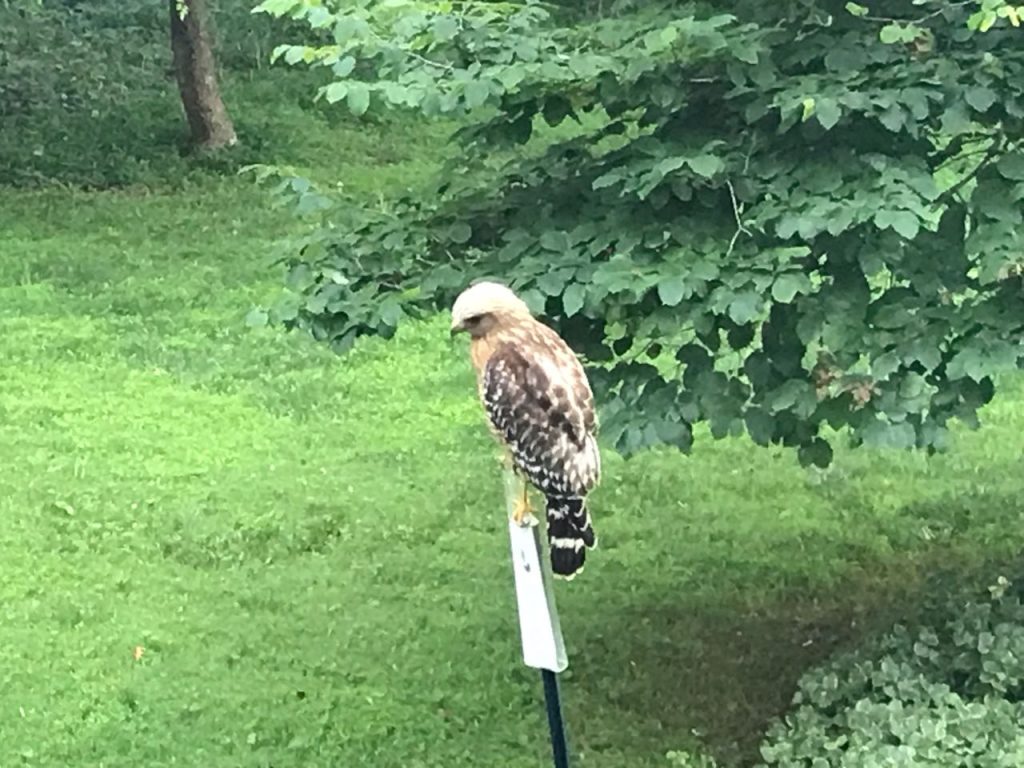
This robust fellow showed up yesterday, as I was munching on a salad. I knew he was looking for the meat-eater’s special so I kept my eye on him as I finished my greens.

The hawk was seeking prey, of course, watching the small birds like a … well, like a hawk. But he wasn’t the only one laser-focused yesterday. While he was watching the small birds, I was watching him.

Two Eminent Beings

Two Eminent Beings

Today we celebrate the birthdays of two eminent beings: Ludwig von Beethoven and Copper the dog. One of them the classical composer whose works revolutionized western music … and the other a mixed-breed canine.

How dare I compare these two? First of all, I love them both. Beethoven is not my favorite composer but he’s definitely in my top ten. His music will be blaring from the radio today, and I will be listening. Copper, though gone almost three years, will always be precious, a dog who filled our lives with joy.

But there are similarities beyond these. Beethoven’s music is powerful; it shakes its fist at fate. Copper was powerful, too. A dog who didn’t know how to stop barking or begging or running away. Isolate the traits that made these similarities possible and I see a mutt of unrealized greatness.

By all reports Beethoven was cantankerous. Copper was, too. While we celebrate Beethoven’s birthday on December 16, we only surmise he was born on this day in 1770 based on his baptismal record. Neither do we know Copper’s date of birth. We celebrated it on the day we acquired him, 12/16/2006.

Beethoven blazed new trails in music, moving us from the Classic into the Romantic period. Copper blazed new trails in the woods. And then there’s the most notable similarity: both Beethoven and Copper went deaf in later years.

Copper did not leave behind some of the most sublime music ever composed. But he did leave memories. I’ll be savoring those today.

Hummingbirds’ Farewell

Hummingbirds’ Farewell

In 2024, September 19th was the last day we spotted hummingbirds at the feeder. But so far this morning I’ve seen no sign of the tiny birds. We had two days of rain, which may have chased them off, or maybe they were following that mysterious call that sends them from suburban backyards to tropical rainforests.

They fly hundreds of miles, winging their way south over the Gulf of Mexico to their winter home in Central America. The calories they consume will help them make that journey.

On Tuesday, before the rains came, a hummingbird left the feeder and hovered right in front of me. Birds have done this before, almost buzzed me. They seem to be checking me out — or maybe they’re thanking me and saying goodbye.

I answer them in a soft voice, as I do to the parakeets inside. “You’re welcome,” I say. “Please come again next year.”

Birthright

Birthright

I woke up the other day to a deer grazing in the yard. She was munching on what passes for grass, a mixture of weeds but pleasing to her, it seemed. At first, I only saw the doe. Then a small shape moved close to her, a still-spotted fawn. It must be the baby born here in June.

We’ve tried sprays and powders, gates and fencing. Neighbors have set up a sonic system to deter them. But the deer are hungry; they eat whenever and wherever they can. And there are many of them.

Used to be I’d run out in the yard and wave my arms when I saw deer, anything to banish them. But it was early; I was half-asleep. Resigned, I watched the pair as the doe stared straight at me. My child was born here, she seemed to say with that plaintive look. Doesn’t she have as much claim to this place as you do?