Browsed by
Category: events

My Kingdom For …

My Kingdom For …

Downton Abby’s fifth season ended Sunday night with a Christmas celebration at the Earl of Grantham’s manor house. Lords and ladies, cooks and valets — everyone joined in the holiday spirit. And that’s been the theme of this season — everyone joining in, boundaries dissolving.

The likely departure for America of Tom Branson, the chauffeur who married Lady Sybil and is raising their daughter after his wife died in childbirth, is being mourned by the family even though they once could hardly stand to have him at their table.

The cook’s assistant Daisy is filled with book learning and Mr. Molesly the footman enjoys sharing his love of history with the girl. We continue to hope for a happily ever after for Anna and John Bates — if the couple can stay out of prison long enough to find it. And finally, Carson the butler has made his feelings known to Mrs. Hughes the housekeeper. And she said yes!

I know it’s a soap opera, but it’s a wonderfully done one. I turn off the set each Sunday night wishing I had a ladies maid to untangle my necklace and a footman to serve the sweets and savories that the cook, in some magical, other-side-of-the-rainbow kitchen, has lovingly prepared.

Eleven months till Season Six!

On Surprises

On Surprises

In the end it’s not about which movie won or lost. (Or at least it isn’t to me; I’m sure it is to the producers and directors!) It’s about seeing the movies beforehand, keeping my own little tally. It’s about settling in to watch the festivities and see what the evening has in store.

Of course, what it has in store is pretty much the same from year to year — bright lights and gorgeous gowns, highly scripted performances. And then there are the acceptance speeches, our best hope of real human emotion. Last night didn’t disappoint. There was J.K. Simmons telling us to call our mothers. There was an excited Eddie Redmayne sharing his award with ALS sufferers. And then there was the director of “Ida,” the Polish film about a nun discovering her Jewish past, which took the award for best foreign language film.

Pawel Pawilkowski told his Polish film crew to have a drink. He mentioned his late wife and parents, who were very much a part of the film, and his children, “who are still alive.” He fought against the music that was trying to drive him offstage. But his words stuck with me:

“We make a film about silence and withdrawing from the world and the need
for contemplation – and here we are, at the epicenter of world noise
and attention. Fantastic — life is full of surprises.”

Life is full of surprises, and sometimes even the Oscars are.

Thanksiving Table

Thanksiving Table

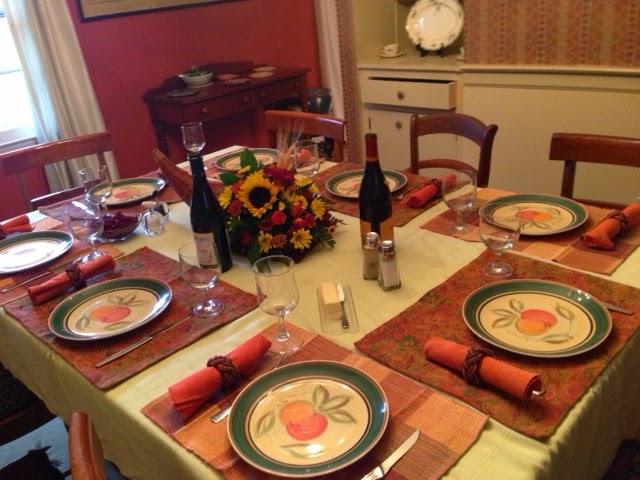
The Thanksgiving table before the bird, before the whipped yams with candied pecans, before the oyster stuffing and the mashed potatoes and the broccoli with capers. Before the pumpkin praline pie.

Before the wine and the “cheers” and the conversation.

Before the Black Friday sales, which had not yet started when I snapped this shot, which I’m happy to say we did not attend.

Before the day we leave for home, which (sigh) we will do soon.

The Thanksgiving table is behind us; the gratitude remains.

Eating Crow

Eating Crow

Yesterday, for the first time in several years, I took a yoga class. Yoga is one of those activities I am theoretically for — until it comes time to actually do it.

I knew I was in trouble when I couldn’t do the first pose — sitting cross-legged on the floor. My knees don’t like that anymore. I quickly adapted a faux cross-legged position, one that put my legs farther out in the floor than the other students gathered in a circle around the instructor, John. And it went rather steadily downhill from there. When it came time to learn the crow or Bakasana position —balancing on arms with bent knees — I had to laugh.

I had taken a class with John before and remember it as challenging but fun. This time it was only challenging. Which raises the question, who has changed — John or me?

Both, I’d say. This was a more advanced class and John was subbing for it. But I’ve been ossifying, too, hardening into position. One hour of yoga didn’t do much to dispel muscle stiffness, but it did help me see how much I need to strengthen and stretch. And this morning — ouch! — it’s an easy lesson to remember!


(Crow position courtesy yogaoutfitters.com.)

The End of Sanctuary?

The End of Sanctuary?

When I wrote of barbarism yesterday I didn’t yet know about the slayings in Jerusalem. This time terrorism has reached much farther than Indiana. It has reached into the sanctuary itself.

It is difficult to measure grief and outrage, but this incident is striking in its brutality. The piousness of the victims, their vulnerability, the contested city in which these slayings took place — a city riven by religious violence.

I looked up how often murders occur in places of worship and found a Christian Science Monitor article reporting that as of last June there had been 780 deadly attacks in U.S. churches in the last 15 years, according to Carl Chinn, a church security expert who was himself a victim of church violence. Such violence was almost nonexistent before the bombing at the 16th Street Baptist Church in Birmingham, Alabama, in 1963, Chinn said.

The numbers worldwide are much bigger and more horrifying, I’m sure.

Religious-based violence is nothing new. But the ironies are too great to ignore. That a force intended for good has been hijacked for evil. That a place built for sanctuary has become a killing ground.

Barbarism Comes to the Midwest

Barbarism Comes to the Midwest

When I chose Hanover College as a shy, bookish 18-year-old, it was mostly because of its beautiful Georgian style buildings, its stunning views of the Ohio River, the long wooded drive to the bluff where the campus clusters. Only later would I come to appreciate the school’s fine teachers and midwestern modesty.

But one thing that was true all the time — and still is, I hope — is that like many small liberal arts colleges, Hanover was set apart from the world. I remember once as a prank someone set up a sign at the beginning of that long, winding drive. It said: “You are leaving reality.” And you were. Hanover was a bubble where your only job was to study, make friends and learn to live on your own.

Yesterday I received an email from Hanover College. I already knew what it would say:  Abdul-Raman Kassig, formerly known as Peter, and a former student at Hanover, was executed by ISIS two days ago. His father, Ed, was at Hanover the same time I was; he lived a few doors down the hall from Tom. Peter Kassig was working to help the people of Syria when he was captured last year. He converted to Islam only recently; his name means “servant of the most merciful.”

Sheltered by tall trees and cornfields, sitting serenely above the Ohio River, Hanover College seemed the last place terrorism would reach. If it’s here, then it must be everywhere.

Catch a Falling Star

Catch a Falling Star

Who knew a comet could be lassoed and landed? Who knew a comet could be stalked and studied, pursued and parsed, its every movement charted and filed, honed to such precision that its whereabouts could be predicted with certainty 300 million miles from earth?

A comet has always seemed a quicksilver thing to me. More light than substance, even though I know it has rock at its core.

Now this rock hurtling through space — the ultimate moving target — has become a laboratory. It may yield the secrets of our solar system, the scientists tell us. It is a “cosmological dream,” the Washington Post says.

A dream not just for cosmologists, I’d say, but for us all.


(Photo: Curiousread.com)

My Favorite Veteran

My Favorite Veteran

Until March 20, 2014, World War II was for me a living entity. A part of history, yes, of course. But because my father was a tail gunner in a B-17 bomber and flew 35 raids out of East Anglia, it was also a part of family lore. I grew up hearing tales of London during the war, meeting girls under the clock in Victoria station, coming back to base to find empty bunks and chairs after a raid.

Since Dad died, the personal part of the war is by and large over me for me. It’s there only in a sepia-tinged way. Not my memories but someone else’s.

On the other hand, Veteran’s Day has taken on new meaning. Mom and I went to the cemetery on Sunday, left flowers by Dad’s headstone. I looked for a small American flag to plant there, but small American flags are in short supply in November.

I stood for a minute in the wan autumn sun, looked out at the rolling hills, the grazing cattle in the distance. Dad would like this spot, would probably make a joke about it — hey, not bad for a grave.

The optimism and jauntiness that served him well in wartime kept him going throughout his long life. And it spilled over to others, too; it certainly did to me.

So Veteran’s Day is no longer a musty, creaky holiday. It’s about doing one’s duty with a wink and a quip. It’s about grace under pressure. It’s about Dad.

Familiarity

Familiarity

Suzanne was born 26 years ago today. It’s the first birthday I’ve spent with her in three years. Not that one expects to be with an adult child on every birthday, but after having her so far away from home these last three years having her here feels pretty darn good.

I think today as I always do about the moment I first saw her — and the feeling is as clear today as it was then. It was a supercharged familiarity. “I know you,” I said to myself the instant I glimpsed her face. “Of course. It’s you.”

And even though she lives in Africa now, and has been independent for years, I still have that feeling about her — and about Claire and Celia, too. There they are, I think, as I watch them grow up and enter their own lives, the children I was meant to have. As unmistakable as blood or water.

The Dentist

The Dentist

On Monday I went to the dentist for what was supposed to be a routine extraction. It was a wisdom tooth, not impacted, and I was assured that I didn’t need to consult an oral surgeon.

Wrong! The routine quickly became difficult and I experienced two hours of what can only be described as medieval dentistry — with gloves.

As I reclined there, hands clasped tight, mouth pried unnaturally wide open, the young (key word) dentist experimented with tool after tool. (I was waiting for him to try a come-along!) And I kept imagining those old illustrations of medieval dentists. I’ve seen this kind of art in modern dental offices; it’s supposed to be a humorous nod to how far we have come.

After Monday I would say we haven’t come far. Because now I know that underneath all the equipment, all the whirring, spinning bells and whistles of modern dentistry, there is still just the dentist and the tooth. It’s a contest of wills. In my case the dentist won. But just barely.

Johann Liss, Farmer at the Dentist, 1616-17 from Wikipedia