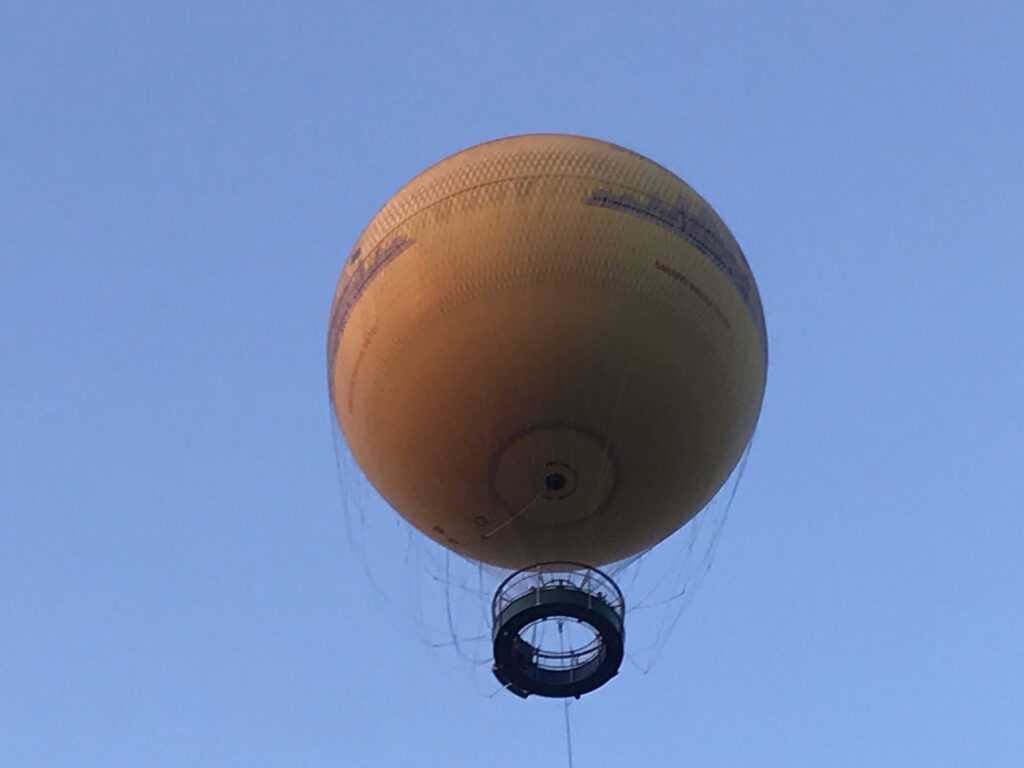
The solar flare did not disrupt airplane travel or satellite communication, but it did create enough gravitational pull to allow our broom to stand up on its own. I missed seeing the real thing, had to content myself with this photo that my family took yesterday mid-afternoon.
It brings to mind the movie “Fantasia,” the dancing broom that Mickey used to help him fill the well. His broom becomes manic, demonic, as it spins and dances to the music of Dukas’ “Sorcerer’s Apprentice.” I can hear the melody in my mind now, its accelerando and crescendo, its sense of abandonment, of spinning out of control.
Our broom didn’t dance. But it did stand. That’s “Fantasia” enough for me.
It comes only once every four years, this bonus day, this leap day, this tag-along. What can I do with its extra minutes and hours?
I don’t need to ask myself this question. I know what I’ll do. The same thing I do with all the others. Work, family, reading through the long commute, a walk if I can work one in.
The key is not to make this day special. It’s to make this day make all the others so.
As any parent knows, a child’s second birthday is not quite as big a deal as her first. And so we come to February 7, 2012, the second anniversary of A Walker in the Suburbs. It’s a more low-key event than last year’s celebration, but I can’t let it go unsung.
There are 612 posts here — that ‘s about 600 more than I thought I’d write when I began this blog during “Snowmageddon,” the great blizzard of 2010.
As it begins year three, A Walker in the Suburbs continues to ripple ever so slowly into cyberspace. I know I should gussy up the old template, add some bells and whistles to attract more followers to the site. (And speaking of followers, I accidentally erased that feature last year and haven’t found a way to add it again.) But adding followers (though delightful when it happens) is not my only aim.
I started the blog as an exercise in daily writing, a way to look beneath the surface of the suburban world I live in to the channels and eddies and springs underneath. Sometimes I do this by walking and reflecting upon what I see. Sometimes I do it by writing about what I’ve read or noticed in the course of daily living. Sometimes I get to the place I’m seeking; other times, I miss it by a mile.
It still seems an act of extreme hubris to post my thoughts in a forum for everyone to see. That I do so is either proof that I’m learning to embrace technology — or the opposite, that I can’t imagine my words going beyond the screen of my laptop.
Whatever the case, they do, and you’re here. I’m glad we found each other.
The perihelion is the day that earth is closest to the sun. This year it occurred on January 5.
That we are closest to the sun in the winter throws my nonscientific mind into a tailspin. If we are closest to the sun, then why is it cold? Because earth’s distance from the sun is not what causes the seasons. It’s the tilt of the earth on its axis that does that, and in winter the northern hemisphere tilts away from the sun.
Ahh, I get it. Sort of. Anyway, it’s the metaphorical aspect of this that strikes me most. That all through the cold, dark months we’re closest to the star that gives us life — I like to think about this. It gives me comfort.
The balmy temperatures of the last few weeks mean that cherry trees are blossoming and daffodils are peaking through the soil. Worries about global warming aside, it’s a nice way to greet the new year — with new growth, new life.
As I write, sun pours through the kitchen window making rainbows through a prism. We still have the holiday place mats, candles and poinsettia on the table and the Christmas tree lights up a normally dark corner of the living room. There is, then, a feeling of fullness.
I just came in from a brisk walk through the neighborhood. Resolutions are wafting through my head. I’m surrounded by people I love. So all is well this first morning of 2012.
Yesterday at lunch I walked to the Botanical Gardens to see the garden train display. The trains were cute — and the children there to see them were even cuter — but what captivated me most were the replicas of the Capitol, Supreme Court and other monuments and presidential homes made of acorns, pine cone scales, mosses, lichen and grapevine tendrils.
It was a magical, miniature world, full of “fairy flats,” “critter condos” and other whimsical structures. It made me want to drink a shrinking potion and clamber right in. It made me want to be a kid again.
But the beauty and wit of these tiny structures also reminded me that there are worlds we cannot fathom — and that in itself is something to celebrate.
Photo by Paul Jean. Captured from Roaming the Planet blog.
Japanese planes bombed our fleet at Pearl Harbor and the United States entered World War II.
Today, my favorite veteran hosts a showing of Twelve O’Clock High at the Kentucky Theater in Lexington.
Here’s what the newspaper (and my dad) had to say about the event:
Meanwhile, the Kentucky Theater, 214 East Main Street, will mark the anniversary with a free screening of Twelve O’Clock High, the Academy Award-winning 1949 movie about the U.S. 8th Air Force fliers who bombed Germany in 1942-45.
It will begin at 11:30 a.m. Wednesday with the introduction of several 8th Air Force veterans. The movie, which will follow, was arranged by Lexington’s Frank Cassidy, who flew 35 missions as an 8th Air Force tail gunner.
Cassidy said he hopes the Twelve O’Clock High screening will help today’s Lexingtonians understand what World War II fliers went through.
“This date, Dec. 7, 1941, changed the lives of many young men, me included,” he said. “I was still in high school when Pearl Harbor happened, and the next thing I knew, I was headed into the Air Force. Everything was different after that.”
Unlike many war films, Twelve O’Clock High explores not just the heroism of the fliers, but the psychological scars that many suffered in facing death day after day.
The 8th Air Force veterans will meet the public and answer questions after the movie.
On a walk in Lexington, I spotted these pink plastic flamingos looking for all the world like turkey wannabes. So I tiptoed up to the front door and snapped a photo. I don’t know the birds’ owners, but I thanked them silently for making me smile.
As we drove home yesterday, east over the mountains, I thought of many things, but from time to time I would remember these “turkeys” and laugh to myself. Such can a single sight loosen the mood, set the mind to spinning happily.
It’s a good way to enter the holiday season. With a bit of levity.
I had another blog post simmering in my mind when I read on this morning’s Writer’s Almanac that on today’s date in 1863 Abraham Lincoln delivered the Gettysburg Address.
Since my visit to the Lincoln Cottage a few weeks ago I’ve had a deepening appreciation of our 16th president, of his greatness and humility. The cottage on the ground of the Old Soldier’s Home in northwest D.C. is where Lincoln wrote much of the Emancipation Proclamation. I don’t have time this morning to research his writing of the address. Though reports of his dashing it off on the back of an envelope on the way to Gettysburg have, I believe, been discredited, he didn’t have much time to write the speech.
The verifiable information I did learn today was that Lincoln’s two-minute speech followed a two-hour oration by Edward Everett, that many in the audience were not aware that the president had spoken because it happened so quickly, and that afterward Everett said to Lincoln: “I wish that I could flatter myself that I had come as near to the central idea of the occasion in two hours as you did in two minutes.”
Brevity is always the harder path to take. I’d like to imagine that Lincoln got to the heart of the matter because he was living with the war, living with it at the White House and living with it at his summer retreat at the Soldier’s Home, where as many as 30 fresh graves a day appeared in the president’s back yard.
Twenty years ago we visited Gettysburg and I lamented that I had forgotten the words of the address I had to memorize when I was a kid. I could probably recite less of the speech these days than I could even then. But I appreciate it more now.
Virginia was only one of four states to hold legislative elections yesterday, and when I reached the elementary school that serves as a polling place, an ethereal pale moon was rising in the sky.
Because there were no national races, experts predicted a low turnout. It was anything but the case in our precinct; I had to wait in line even to use a paper ballot. (For the first time ever, I wrote in a candidate’s name — for the soil and water conservation board!) And polling officials said it was a steady stream of voters all day.
From a glance at this morning’s paper, it’s not clear whether our candidates won. What matters more is seeing how many people vote. I said hello to neighbors I hadn’t seen in months.
I don’t want to romanticize this too much. But sometimes on election day our precinct feels like a village, with small-town manners and courtesies and generosities. I wonder if, in different circumstances, on a different scale, we might be like this every day — a true community.