Browsed by
Category: place

Yard Signs

Yard Signs

It seemed to start with the pandemic, with the chalk art and the concerts on balconies, the way we felt during those first few weeks of the ordeal when we thought our sheltering time would be more like a long blizzard than a new way of life. 

Pundits ponder how many of the changes we’ve made over the last 18 months will become permanent fixtures. Let me add one to the mix: the proliferation of yard signs. 

Before the pandemic I don’t remember seeing many that weren’t advertising a house for sale or a renovation taking place. Politics are too hot right now for people to use yard signs to advertise their candidate of choice — at least in my neighborhood. 

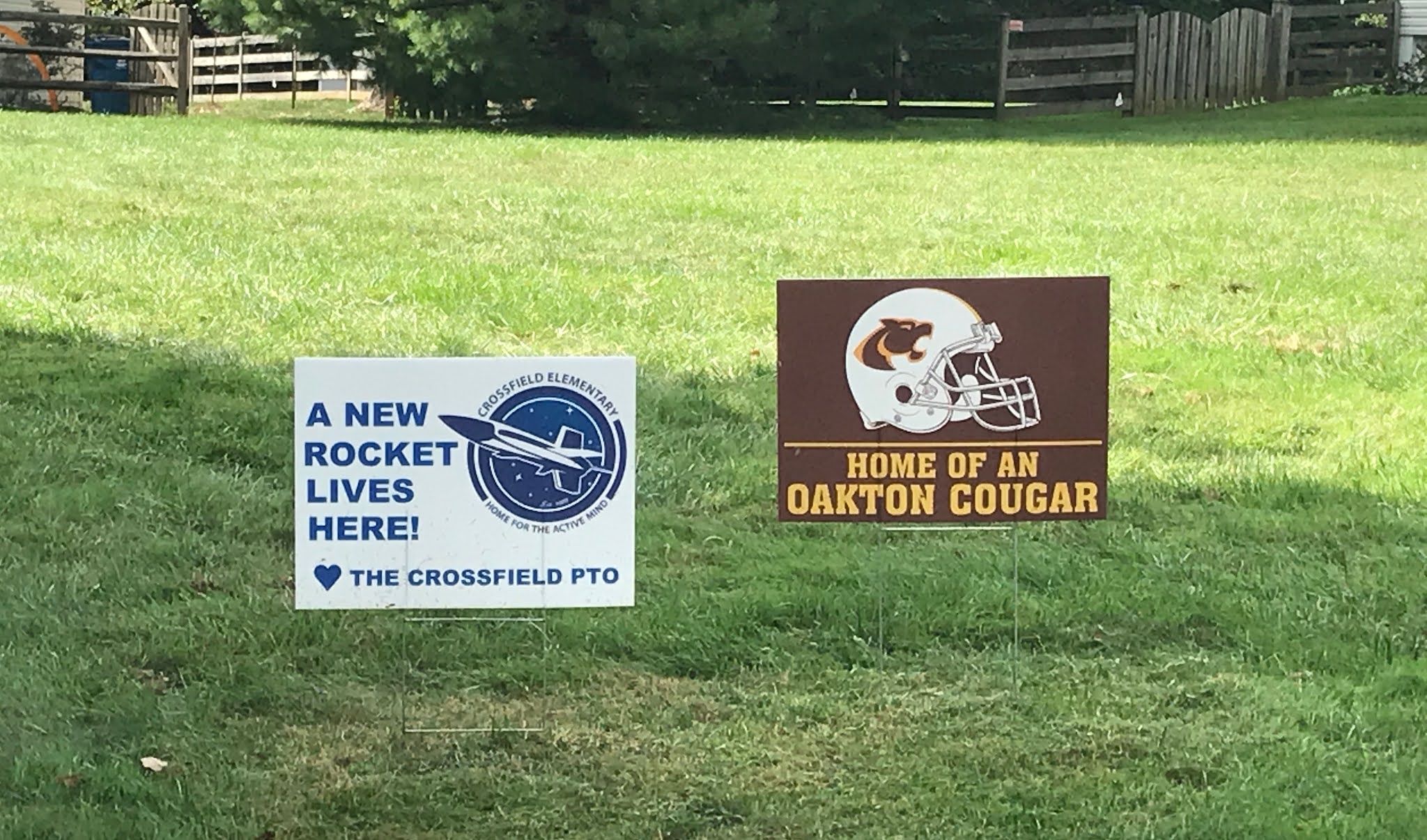
Now there are signs welcoming kindergartners and high-schoolers, banners for birthdays and even notices with desperate requests. The latter includes one from a family in the neighborhood that used the back of their PTO’s grade school welcome sign to scrawl their own heartfelt message: Open The Schools!

At least that one is down now, but I think people are catching on to the potential of yard notices in an era when more of us are at home and walking around. 

Yard signs … bring ’em on. 

The Birds

The Birds

They swooped, they swerved, they filled the sky with their acrobatics. I first spotted them as I was stopped in traffic on Key Bridge, but could only snap a faraway shot. 

It was later, once I’d reached the Car Barn Building terrace, that I saw the birds again. I’d stopped to look at the river and the towers of Rosslyn across into Virginia (how cool that I leave my state for class) — and there they were, circling and swirling, making their presence known. 

Were they up to no good? It was hard to tell at the time. But when I looked at the (top) photo later … well,  you be the judge …

Twenty Years

Twenty Years

When I visited Lexington last month, Phillip drove me through the University of Kentucky campus. He  wanted to show me that the twin towers were gone. Not those twin towers, though Phillip saw those come down, too. He was working in New York at the time, his office less than two miles north on Hudson. But it was the absence of the Kirwan-Blanding Towers he wanted to show me, two 23-floor dormitories that housed students for almost 50 years and that came down carefully, a floor at a time.

Not so with those other towers, of course, which pancaked to the ground 20 years ago today, taking the lives of almost 2,700 with them. As is so often the case, we hadn’t known what we had until we lost it. We also hadn’t known that terrorists with fake IDs were learning how to fly planes — but not to land them. There was ignorance within our innocence. Perhaps there must always be.

In the days and weeks that followed 9/11, I cooked up a storm. I made bacon-and-egg breakfasts, chopped vegetables for stews and soups. I drug out the crockpot and pressed it into service. I was making food for the bereaved and serving it to my family. It felt like a way to heal.

But that was long ago. Our problems have metastasized. The terrorism is still present but now we also have a pandemic, climate change disasters, and an ignominious end to the war we started to avenge the 9/11 attacks. So many challenges … and so little consensus on how to deal with them.

Ten years ago, I wrote that our children grew up in a different world. Now my children have children. What kind of world will they inherit?

Tranquil Contemplation

Tranquil Contemplation

When 19th-century statesman Henry Clay needed a respite from his life as the “Great Compromiser,” he retreated to the shady groves of Ashland, his Kentucky estate. There, as the sign tells us, he walked the trails of his beloved farm, using them for “tranquil contemplation” of the issues at hand.

For Clay, as for many of us, walking and thinking went hand in hand. Maybe these strolls reinvigorated the legislator after the rigors of rough-and-tumble politics. Maybe they inspired some of his signature moves.

But even if they didn’t, the paths Clay created remain for current-day walkers to explore. When I strolled them two weeks ago, I felt the hush of the giant oaks and sycamores. They stilled my buzzing brain. 

Harvest Time

Harvest Time

A day’s drive out, a day’s drive back and three days in my hometown leave me in a state of addled contentment now that I’m back home. Throw in some nostalgia and amazement — from visiting with folks I haven’t seen in 10 or 20 years (numbers we toss around as we used to the single digits) — and you have a lovely way to end the summer.

Or is it ending? It will be 90 again today,  the cicadas are crescendoing and the humidity is creeping up as I write this post on the deck. 

Given the opportunity, I’d probably keep traveling and keep sweltering another month or two, but September is almost here — September with its call to purpose and purchase. It’s time to harvest what I’ve sown. 

(Joe Pye weed in a Jessamine County, Kentucky, field)

Walk Across Kentucky

Walk Across Kentucky

This morning, I walked across Kentucky. Not the 370 miles from Ashland to Paducah, or the 180 miles from Covington to Williamsburg. But the two miles around the Kentucky Arboretum trail, which promises to compress all seven of the state’s geographical regions into one stroll. 

I saw conifers representing the Appalachian Plateau, dogwood and coffeetree for the Knobs and tall grasses for the Pennyrile Region.

The Bluegrass Region, where Lexington is located,  is the most extensive, with bur and chinquapin oaks, several types of ash tree and outcroppings of shaggy limestone. 

Ambling through the Arboretum warmed me up, wore me out and educated me, too. After just one visit I can tell it will be one of my regular hometown routes. 

Ashland Park

Ashland Park

There are places I visit so often in my imagination that I need to recharge the memories as you would a battery. I did some recharging today when I strolled through Lexington’s Ashland Park neighborhood.

There was Woodland Park with its baseball diamonds and picnic tables, then my old place on Lafayette, the first of several former houses I would visit today (the others I drove by rather than walked past).

I ambled down South Hanover and Fincastle, letting my mind wander, fantasizing what it would be like to live in some of these places, the grand brick colonials, the charming round-doored tudors.  

Till I reached Ashland itself, the home of 19-century statesman Henry Clay, which stopped my reveries in their tracks. Ashland with its shaded walks and formal garden. Ashland with its historic pedigree and bountiful acreage. Even in fantasy, Ashland is out of my league. 

Corridor H

Corridor H

The climb started as soon as I exited Interstate 81. The flat land became scarcer, the tree tunnels more abundant. My little car felt the difference but handled it better than I’d hoped. 

The first stretch was road I’ve known and driven for years, Routes 33 and 55, which I wrote about years ago. But instead of chugging through Moorefield and Seneca Rocks, I cruised the top of the ridge along Highway 48, which I learned today is part of the Appalachian Development Highway System’s as yet incomplete Corridor H. (Sounds more like a UFO site than a federal roads project.) 

Incomplete might be seen as a disadvantage, given the two-lane stretches in between the four, but not when it takes you to places like this, a pull-off viewing spot I almost missed since it had no sign or build-up. What I found were mountains beyond mountains, Queen Anne’s lace and bumblebees, the quiet of a land out of time.

Going Home

Going Home

In the waning days of summer, I sandwich in one more trip — this one back to Lexington for my high school reunion. It’s been 10 years since I’ve seen most of these folks and three years since I’ve been in my hometown, a record I don’t want to duplicate. 

I’ve written about trips to Kentucky since I started this blog, describing the drive there and the drive home — even my old high school building makes a cameo appearance

There’s a reason for this, of course. It’s because once you’ve grown up in a place like Lexington, it never leaves you. It’s why, even though I’ve lived in this dear house for decades, raised my children here and treasure it beyond measure … when I go to Lexington, I still say “going home.” 

Back to the Bus

Back to the Bus

The buses are rolling again, yellow school buses not yet matching the color of autumn leaves but rolling just the same. In their rolling I see hope and normalcy.

Yes, the delta variant is abroad in the land. Yes, some of us, too many, are unvaccinated. But in this (now August) ritual (it was always in September when my children were in school), I see a bid for real life with all its prickliness and uncertainty. 

So even though the buses about ran me off the road on my morning walk, even though conditions are not ideal, I’m glad students are heading back to the bus. And from the gleeful look I see on parents’ faces, I think they feel the same.