Browsed by
Category: trees

The Survivors

The Survivors

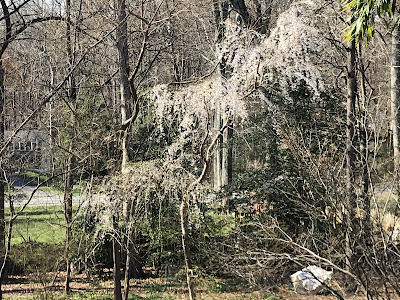
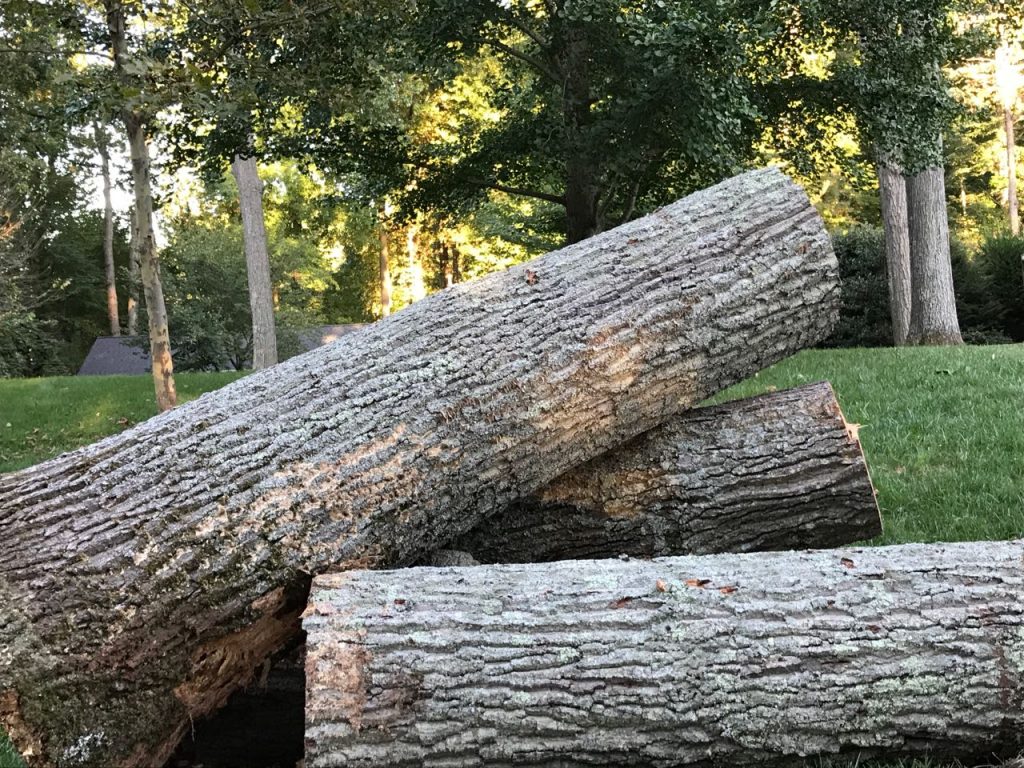
The weeping cherry has grown taller this year. I notice its height as it blooms in the very lightest of pinks. It wouldn’t be here if Tom hadn’t cabled it back to life after the big storm of 2018, the fierce winds that toppled two giant oaks and pancaked the trampoline.

When I look at the backyard now, I see the survivors: the poplar, the sassafras, the witch hazel. I try to forget the stumps, the ghost trees, the ones I see only in memory.

The survivors are what count. They have beaten the odds. Soon their leaves will unfurl to create the canopy that shades us all summer long. Their trunks will support the hammock that lulls me to sleep on warm, drowsy afternoons.

But these scenes are yet to be. All I can say now is that these trees have survived the winter. We all have.

A Mast Year

A Mast Year

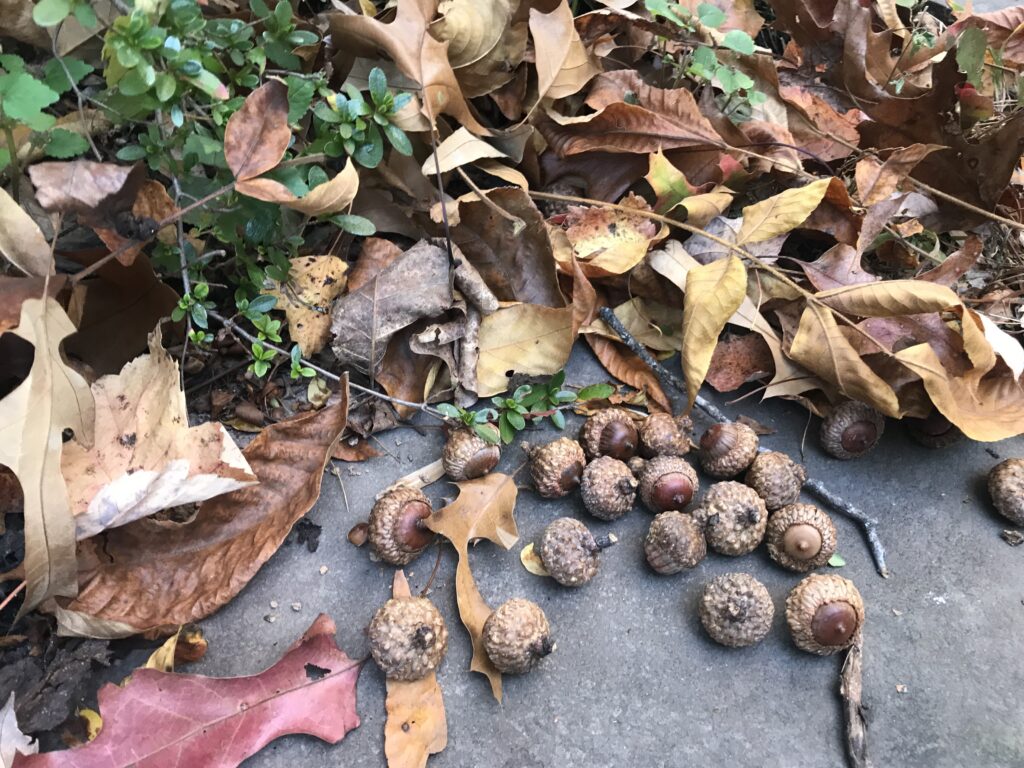
Acorns are falling. They hit the roof and the siding. They pile up in the yard and on the driveway. When a stiff wind blows, they sound like a burst of hail. On the ground, they slide under the feet, making for a crunchy or even a treacherous passage. When I’m walking under an oak tree, I consider myself lucky if I’m not beaned in the head.

My yard is not alone. All up and down the street and throughout the area, I’m seeing a bumper crop of acorns. Which leads me to believe it’s a mast year in Fairfax County.

Masting is when a plant produces an abundance of fruits, seeds or nuts. Theories abound for why this happens, but animals are the beneficiary. Squirrels, deer, and even blue jays, which I just learned eat them, too.

The marvel of the mast year is how it affects all the trees in an area. “Not one tree in a grove, but the whole grove; not one grove in the forest, but every grove; all across the country and all across the state,” writes Robin Wall Kimmerer in Braiding Sweetgrass. “The trees act not as individuals, but somehow as a collective. … All flourishing is mutual.”

Volunteer Forest

Volunteer Forest

During a celebratory bounce on the trampoline yesterday I noticed (not for the first time) that I didn’t plant most of the trees in which it’s nestled. Most of them are volunteers. They landed in their spots from errant seeds and saplings, and our careful mowing preserved them in their infancy.

In fact, I don’t think it’s too much of a stretch to say that most of the trees in the back yard are scrappy survivors — the tulip poplar, weeping cherry and sassafras tree. They remind me that, as I mentioned a few days ago, you never know.

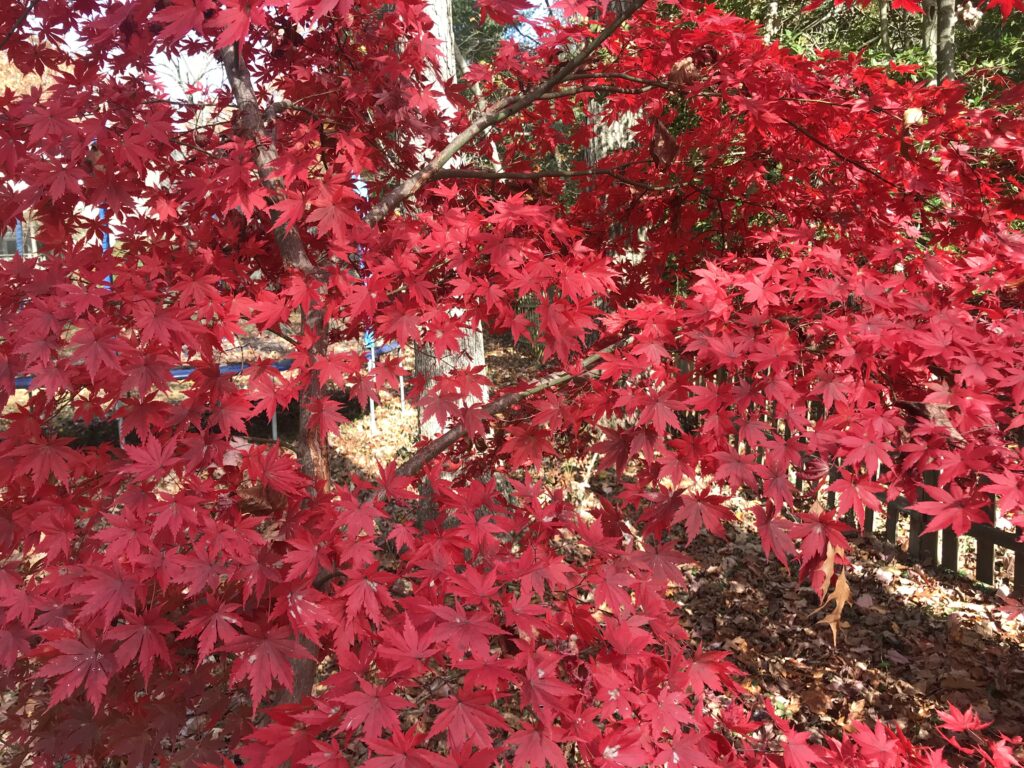
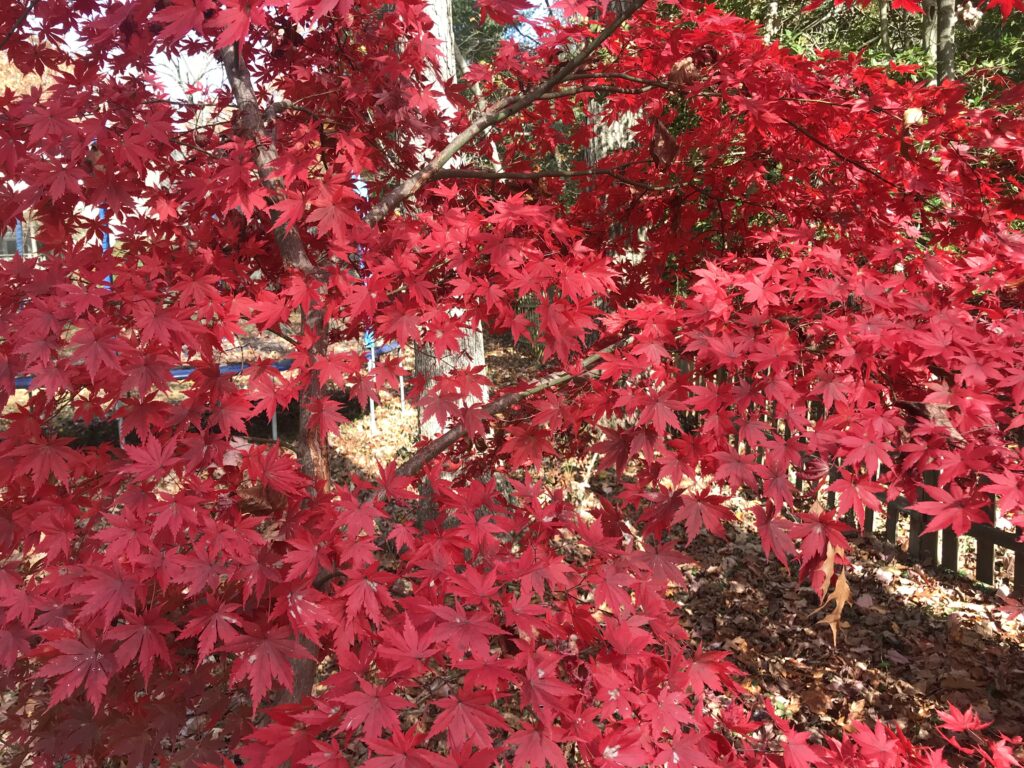
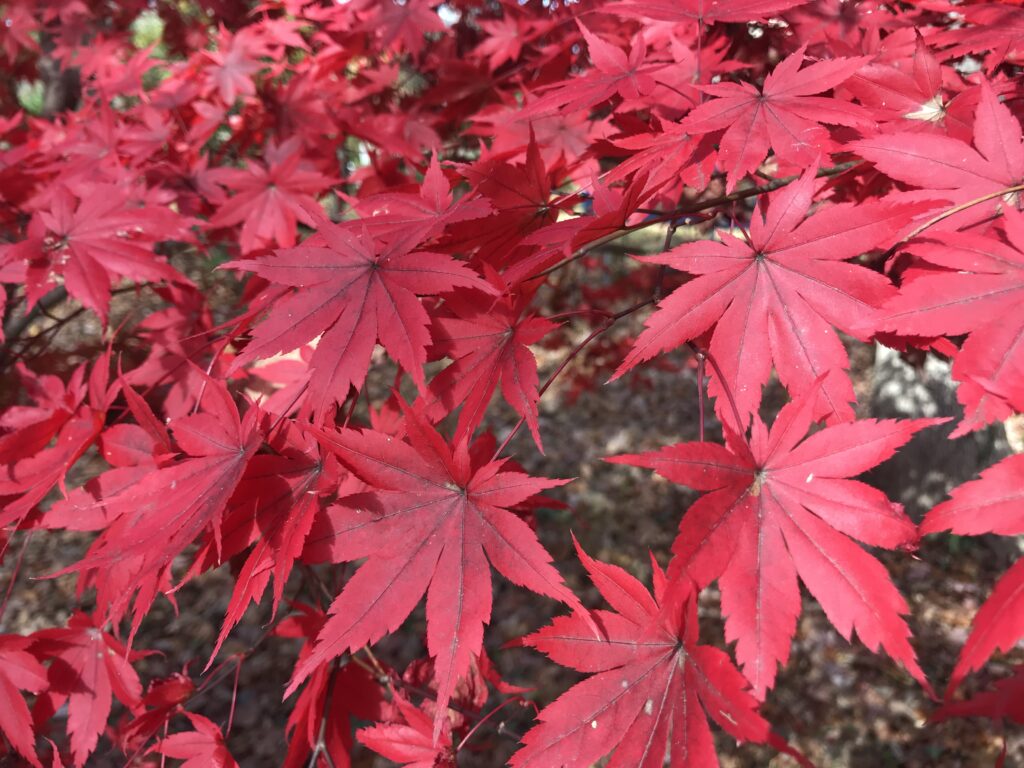
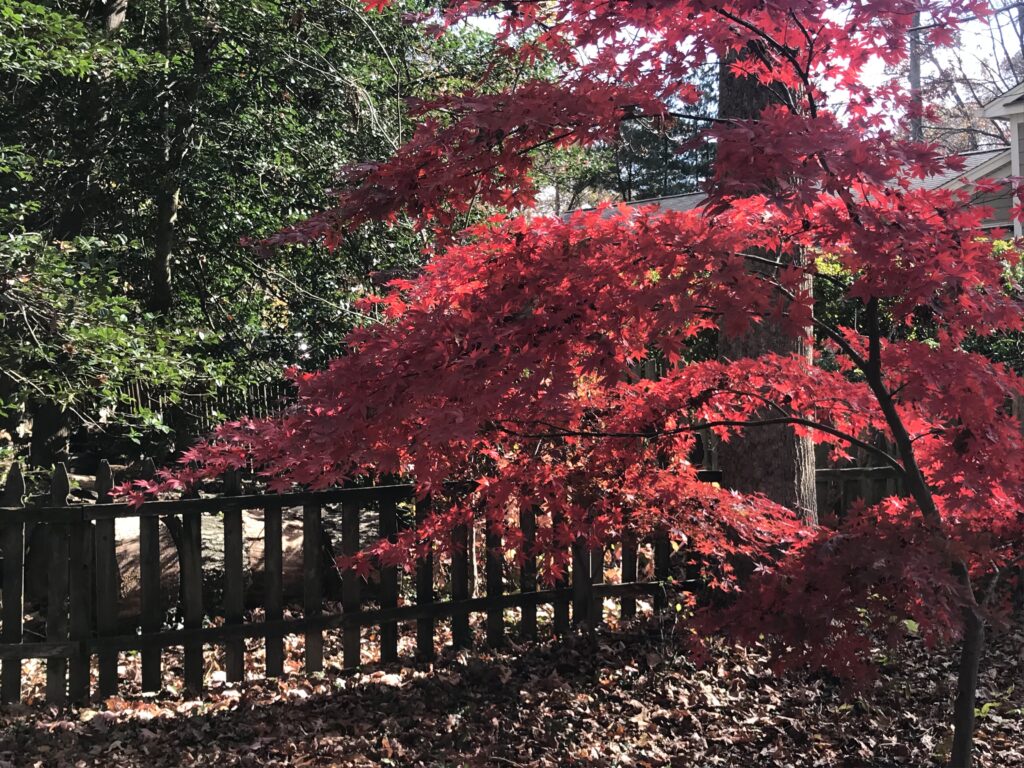
One of the most beautiful volunteers is the Japanese maple. Early next month its leaves will turn scarlet, lighting up the leafless yard.

Are “accidental trees” hardier than their planted cousins? Seems to me they are. Perhaps they hold lessons for us all.

Japanese Maple

Japanese Maple

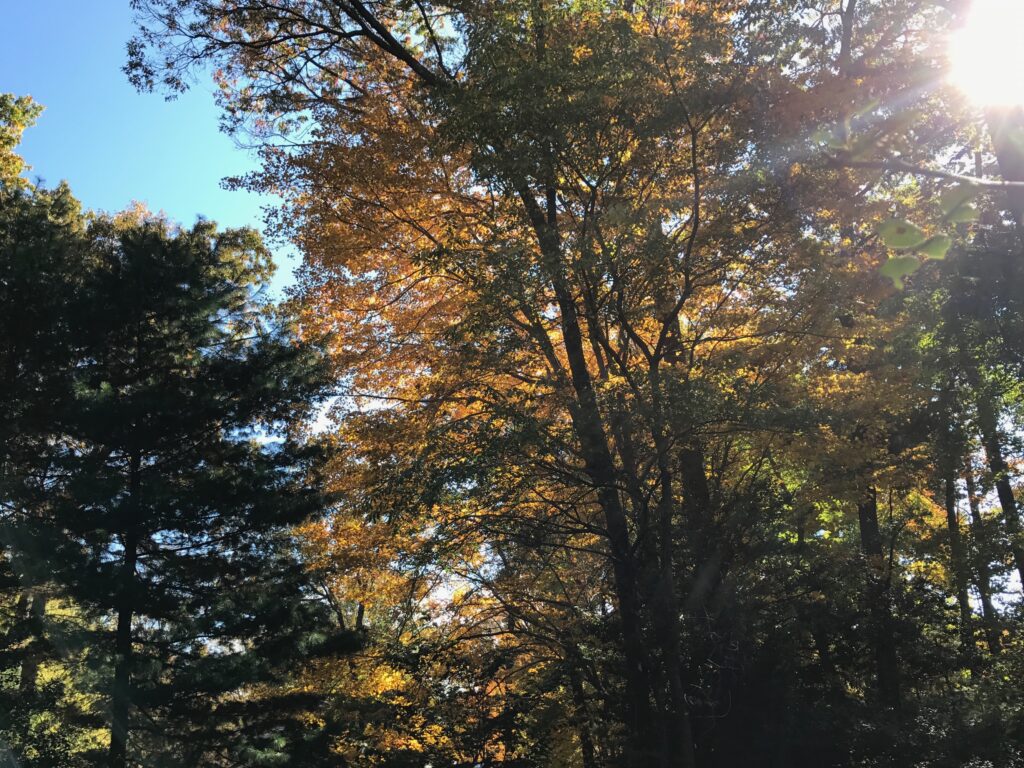
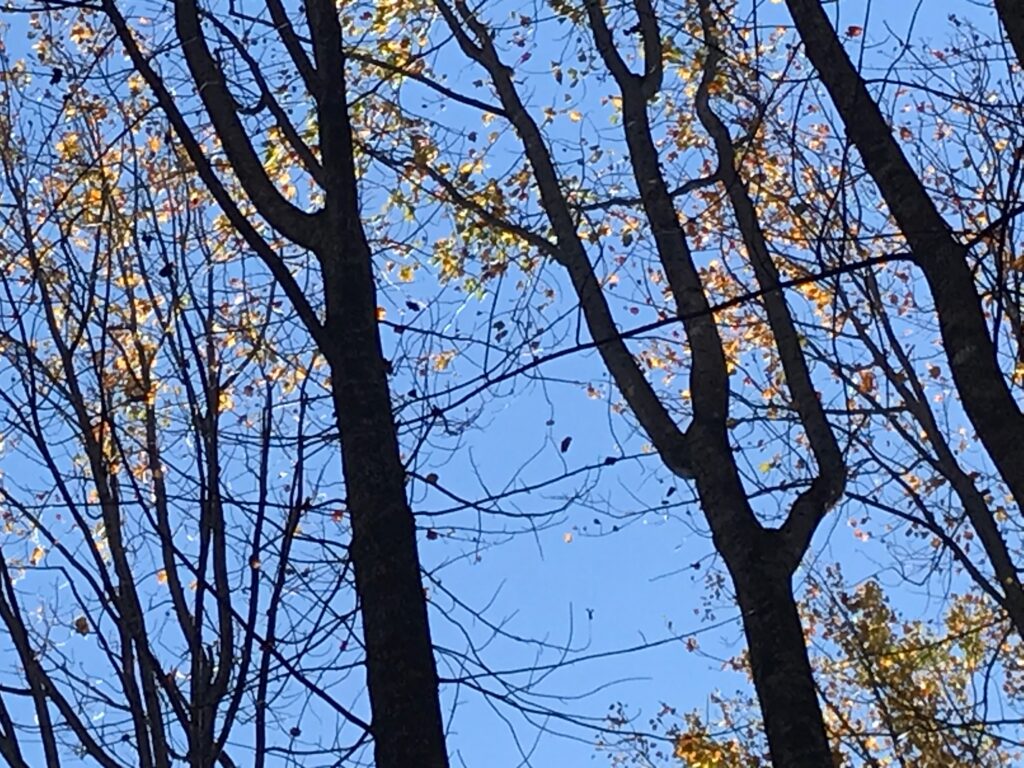
These days I wake to November grays. Most backyard trees are stripped of leaves, except for one: the volunteer Japanese maple. It waits until the other trees are done to strut its stuff.

This is how it’s done, kids, it seems to say. With these scarlets, these jewel tones. With this patience and this grace.

Am I reading too much into the timing of this turning? Of course I am. I always do.

Catch a Falling Leaf

Catch a Falling Leaf

On a walk this afternoon I spent more time than I intended trying to photograph leaves in flight. So many of them are swirling around that it seems I should be able to capture at least one or two mid-journey.

But either the light isn’t right, or they’re eddying about frantically rather than gently floating to the earth. Just as often, I spy the perfect slow-descending leaf but by the time I pull out my camera, it’s too late.

It’s a delicate business, like capturing a single snowflake or the down of a thistle. Perhaps it’s best left to chance.

Inheriting the Sun

Inheriting the Sun

It took a poison ivy search to bring them to light, a careful combing of the backyard in preparation for a children’s party here this weekend. At first I didn’t know what they were, saw only the fallen petals, tiny blossoms in the grass.

Then I looked up, saw the bent boughs of the crepe myrtle shining in the sun. It’s my $2 tree, one of the stock I purchased from the Arbor Day Foundation years ago and planted without much hope. It’s 20 feet tall … and it’s blooming. 

Vibrant pink flowers are weighing down the spindly top of the unpruned tree, blooming earlier than the other crepe myrtles in the yard, which are, unfortunately, planted in the shade. 

But this little guy inherited the sun, grabbed the rays when the big oaks came down. He is reaping the harvest. We all are.

Shades of Green

Shades of Green

How many shades of green do I see in a day at the beach. There is the dark forest of the mangrove, its roots in water, clustered in wet spots along the road. 

There is the purplish-green of the sea grape, its leaves catching light, making tunnels of shade as I exit the strand.

There is the striated green of the palmetto, wagging in the wind. 

And sometimes, in the morning, there is the green of the sea.

Aloft

Aloft

Wind whips the leaves off the witch hazel tree, sets them spinning down into a pile of gold. 

Wind bends the tulip poplar and the bamboo, which is taking bows outside my office window.

Wind sets the jets on an alternate course, sends them scudding, like the clouds, over this house. 

Trees, planes, clouds — may all that belongs aloft … stay that way. 

The Zucchini

The Zucchini

The world is in turmoil. Winter is right around the corner. Time for some positivity, which comes today in the form of a vegetable.

I’ve mourned the trees as they’ve fallen. Now to celebrate the sunniness that has come in their wake.

There’s no better proof of this than the plump zucchini that managed to thrive in the back garden. In fact, it became so large that the only palatable way to eat it will be grated in bread or pancakes.

Still, this is a milestone. I’m not yet rushing out to plant a vegetable garden, but I’ll begin to think of the backyard not as a shady place … but as a sunny one.

Rosy Glow

Rosy Glow

There are stands of ancient hemlocks in New Germany State Park, an oasis of green trails and lofty heights. A cathedral of a forest.

And then… there are the streams, and the late day sunlight slanting on them.

In some spots the light struck the creek at such an angle that it gave the water a strange, rosy glow, as if it were blushing or bleeding. As if it were lit from within.