Browsed by
Category: walking

To the Corner and Back

To the Corner and Back

After weeks of wimpy walking, nursing a case of plantar fasciitis, trying not to go too far or too fast, supplementing the strolls with 20 minutes on the basement rowing machine, I’ve realized something I’ve known all along but recognize more clearly with each passing week.

And that is … I’m not just walking for my health.

Even a slow stroll stimulates thoughts and ideas more than the most energetic rowing session. When I’m rowing, all I think of is, when can I stop. When I’m walking, I never want to stop.

This link between mind and feet is something I’ve written about often, and I’m not the only one. A New Yorker article lists fact after fact about how and why we think more clearly and more creatively when we’re ambling along a city street or woodland trail.

So if I have to raise my heart rate on the erg, I’ll do it. But walking will remain — even if it’s just to the corner and back.

August Greens

August Greens

Who would think it possible that in this typically dry and dusty time of year we would have such a bounty of green?

On today’s walk I tried to revel in it, appreciate it. I tried to ignore the light rain that was falling even as I ambled.

It’s not the kind of summer I’m used to, but it’s the kind of summer we’ve got.

And so are the August greens.

The Walk Talk

The Walk Talk

Yesterday, a walk through Arlington. A walk while talking, which is one of the best kind of walks, though you wouldn’t know it by the kind of solo walks I often describe here.

The walk talk is wonderful when it’s done with someone with whom one is simpatico — even if that someone is on the other end of a phone line, which was the case yesterday.

The walk talk makes the miles vanish and the heat dwindle. It’s not until you find yourself in a cool Metro station that you realize that yes, it was a warm afternoon for a charge up Clarendon Boulevard.

But by then it’s too late. The walk is over and the talk is too and though you are indeed rather wilted you are also super-charged by the movement and the conversation.

(Scenes from an Arlington walk, in another season.)

Grounding

Grounding

I had no sooner written about Japanese forest bathing than I read about “grounding,” which is … walking outside barefoot. Grounding, also known as “earthing,” is a way of touching base with the essentials. Those who favor it say that it might help prevent chronic diseases, and research shows that it can improve sleep and lower stress.

Sounds touchy-feely (in more ways than one!) … and yet, consider this: One theory that explains the positive effect of grounding is that earth’s negative charge neutralizes the free radicals that can damage our cells. Antioxidants not from fruits and vegetables but from the earth itself.

And then there is the circadian rhythm aspect of grounding, the fact that touching ground can help regulate our autonomic nervous system, our breathing out and our breathing in.

The article in the Washington Post explaining this research ended with suggestions: Walk barefoot on ground or sand (something I’ll be doing in a few minutes, as a matter of fact!). Garden in the earth, or even lean against a tree trunk.

We are only beginning to understand how connected we are to the natural world around us.

Forest Bathing

Forest Bathing

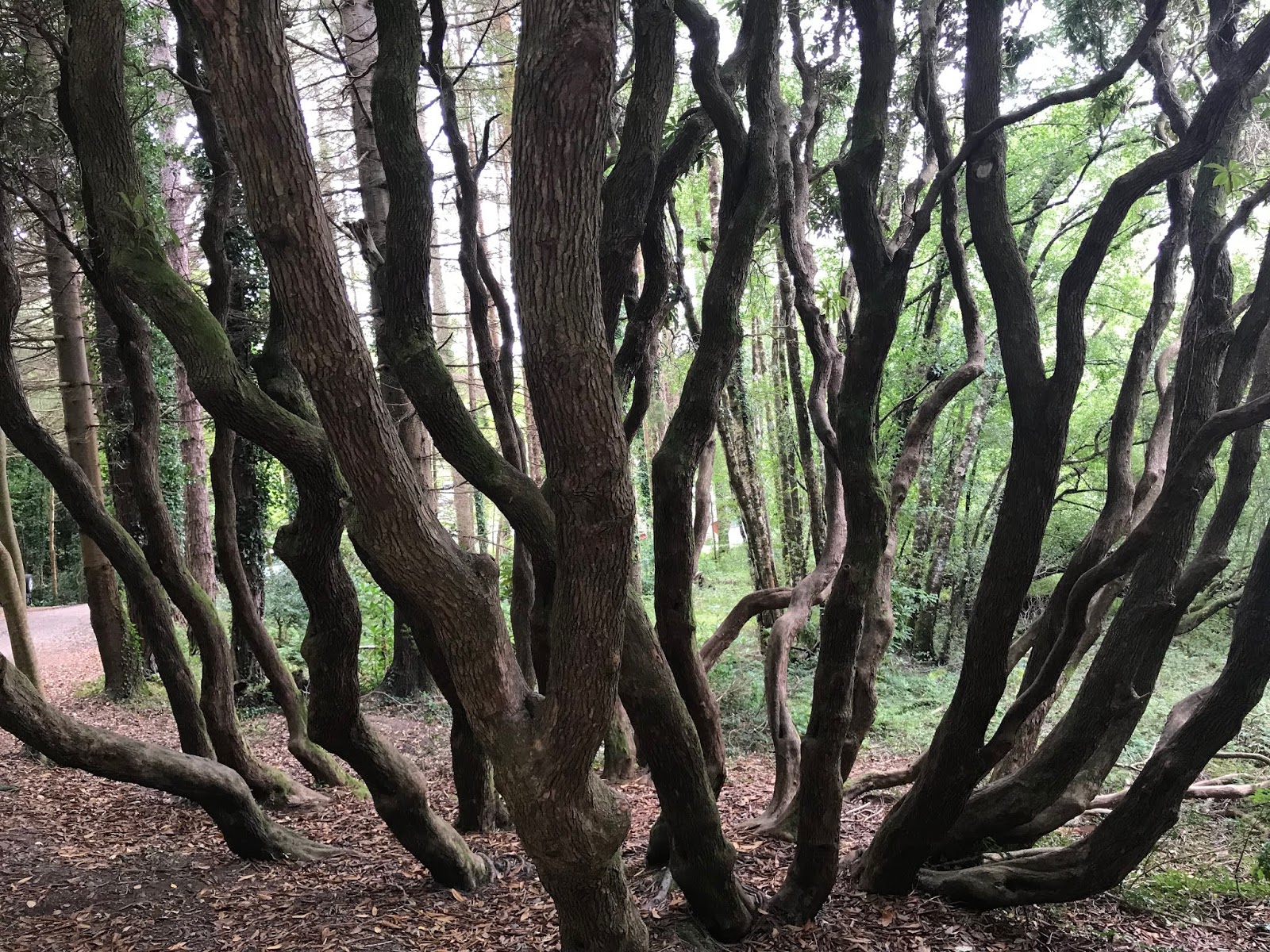
Shinrin yoku — Japanese for forest bathing — is the practice of immersing one’s self in a forest or other natural environment to relieve stress. Practitioners walk slowly through the woods, marveling at the shades of green.They aren’t there to bike down a hill or hike up a mountain. The journey is their destination. It is enough simply to be outside, to inhale the scent of pine.

I like the imagery involved, the idea that one can slide into a forest as if into a tub of warm water.  That its beauty will surround and calm and lift up.

A walk in the suburbs is not always a bath in the forest. It’s too fast, too purposeful. Often, there are no forests involved.

But even the briefest and most cursory stroll works its magic. I leave the house with fists clenched, brow furrowed. I return renewed and refreshed, reminded that we are not just creatures of rooms and screens. That after all, we are born of earth and will return to it, that every visit there is going home.

Natural Cool

Natural Cool

We leapt from a rainy June to a sizzling July, and are now measuring the heat index instead of the precipitation.  On my slow walks this weekend I sought the relative cool of the shady stretches that line Folkstone Drive.

Is there any cool better than natural cool? I know what the air conditioning devotees will say. Of course there is. It’s the cranked-down chill of a 72-degree office or living room. And don’t get me wrong. On days when the mercury climbs toward 100, it’s mighty nice to step inside a well-chilled house.

But there is also something to be said for the deep woods, for ferns waving in a slight breeze, for soil that is still a bit moist from last month’s downpours, for a creek gurgling in the distance.

For sections of road where tree branches lace overhead and spread their shade to the pavement below. For old houses with thick walls flanked by tall oaks.

There is something to be said for natural cool.

Slow Gait

Slow Gait

This morning’s walk was more an amble than a trot. I was afraid it would be boring; it wasn’t. Thoughts flowed much as they do when I walk fast. But they were deeper, had pooled longer in the mind before bubbling to the surface.

When I was a little girl, I remember Mom explaining the five gaits of saddlebred horses. There’s the walk, trot and canter, the natural gaits, she said. But saddlebreds have two additional, special gaits — slow gait and rack.

At the Junior League Horse Show, which was held every summer at the Red Mile Trotting Track in Lexington, prim matrons with smooth blond chignons sat ramrod-straight in the saddle as their mounts pranced their way around the track. When it was time for the fifth and final gait, the announcer said, “Rack on.”

I’ll “rack on” another day. For me, today, it was slow gait.

(Photo: Wikipedia)

Drizzly Day

Drizzly Day

Copper and I are having a hard time getting out this morning. Neither one of us wants to brave the rain. And since I was counting on a walk to provide the inspiration for this morning’s post … I’m late here, too. The doors are open, but the bodies aren’t moving.

What I’ve done instead: write, edit, prepare a story to publish Monday, try to finish one I started earlier this week. And in between: tidying up, doing laundry and making beds.

It’s the kind of day I’d like to spend reading a book straight through from start to finish. Or organizing a closet. Or maybe even napping.

But there are errands to run, an article to finish and, if it ever clears up, a walk to take.

Whistle Them Home

Whistle Them Home

It was after 6:00 p.m. yesterday and the children — two boys, one  girl — were angling for some park time.  “You can play outside for a while, but you have to come in when I whistle for you,” said the mother. Maybe she was in the middle of cooking dinner, or had just changed from her work clothes. Or maybe she works at home, as I did when the girls were young.

But the whistling, that was unique. No texting, no agreed-upon time to be home. Just wait for the whistle. A bit canine,  to be sure. But deliciously old-fashioned.

Where I grew up in Lexington, only one family had a dinner bell. Other parents just cupped their hands around their mouths and yelled for their kids to come home in the evening. “Johnnnnny! Sallllly!” (Children had primary reader names back in those days.) These ersatz bullhorns are the original communication device, are they not?

And they did the job.  The kids came running home.

(These tunnels — I call them “snake eyes” — are near the park where the kids were playing.) 

The Journey

The Journey

Walking has its charms, many of which I’ve detailed here. It is good for the body and the soul, a moving meditation.  It is also, I thought on an early stroll this morning, a reflection of the inevitable changes we endure.

I use the word “endure” because so many of these changes are not ones we seek or desire. They are just life, with its comings and goings, its highs and lows. Colleagues leave, jobs change, bodies falter and fail.

Walking is all about moving through space, about not getting too attached to any viewpoint or position. It’s about the journey and taking what we can from it.