Browsed by
Category: walking

Flow in Motion

Flow in Motion

“It is normally easy and actually quite pleasant to walk and think at the same time, but at the extremes these activities appear to compete for … limited resources,” writes Daniel Kahneman in his book Thinking Fast and Slow.  “My experience is that I can think while strolling but cannot engage in mental work that imposes a heavy load on short-term memory.”

Without going into the nuances of Kahneman’s theory (in large part because I’ve just started the book and am still figuring them out!), what he’s saying here is fairly straightforward: There is only so much energy to go around, and it’s difficult if not impossible to expend great mental and physical effort at the same time.

In my experience, walking promotes thought. The mental briars that entangle me when I’m sitting still aren’t present when I’m skimming along a trail. Motion accelerates thought, enlarges it, shakes it free.

The explanation is, in part, speed. Were I to run I would think a lot less. But the answer also lies in something Kahneman discusses a few paragraphs later,  the concept of flow, “a state of effortless concentration so deep that [people] lose their sense of time, of themselves, of their problems.”

What happens when we walk (or at least when I walk) is flow in motion. Which sounds redundant. But actually isn’t.

Escape Route

Escape Route

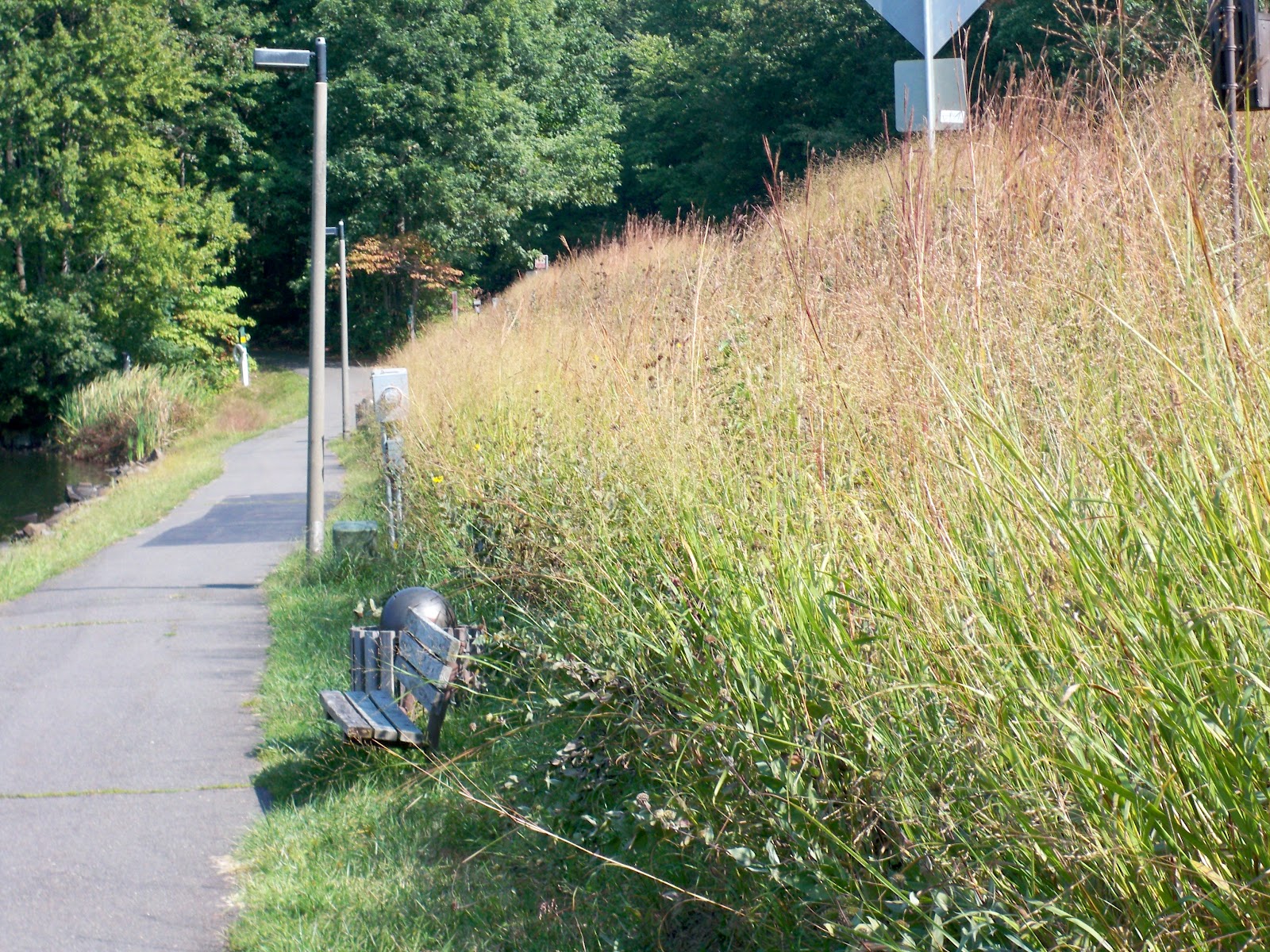
A few days of blissful low-humidity weather mean that at the highest point of my favorite walking route the foothills of the Blue Ridge swing cleanly, clearly, briskly into focus. I like to think of this as my “escape route,” the one that gives me, better than any other, a glimpse of a world that lies beyond.

For the longest time the route — and for all practical purposes the view — didn’t exist. The road was curvy, two-lane and treacherous. You walked it at your peril. And even if you did, you wouldn’t have seen the mountains. They would only have been visible from the ridge above — and probably not even there, since the trees that grew along the brow obscured the horizon, too.

But when a new housing development shoved out the few remaining homes and a preschool, the view emerged. And the sidewalk supplied by the property developers opened it up to all.

I had to stop griping about progress then. For once it was on our side, the side of the walkers, the side of those who like to be reminded where they are in the world. The side of those who like their escape routes.


(This is not exactly what I see. My view is of the same mountain range, just farther east.)

Birds Take Flight

Birds Take Flight

“Every day,  I walked. It was not a meditation, but survival, one foot in front of the other, with my eyes focused down, trying to stay steady.”

This is from Terry Tempest Williams’ new book When Women Were Birds. A few pages later, Williams writes: “I am a writer about place who is never home.”

I link these two passages. The walking and the writing about place.  Each essential to the other. One to prime the pump, the other to fill the jug with cold, clean water.

So where do the birds come in? Williams meets her husband at a bookstore, as he’s buying a bird guide. Williams finds her voice through a special teacher who reads to her about the winter owl. A peregrine falcon once slit the corner of Williams’ eye. Another time, Williams sees a painted bunting that arrived in a wintry Maine on the cusp of a fierce winter storm.

“When dawn struck his tiny feathered back, he ignited like a flame: red, blue and green. … I have not dreamed of white birds since.”

When I finished Williams’ book I flipped through the pages with my thumb — and saw the birds that illustrate the outer edge of each page fly back and forth as if alive.

Birds take flight. So do words.

Long Evenings

Long Evenings

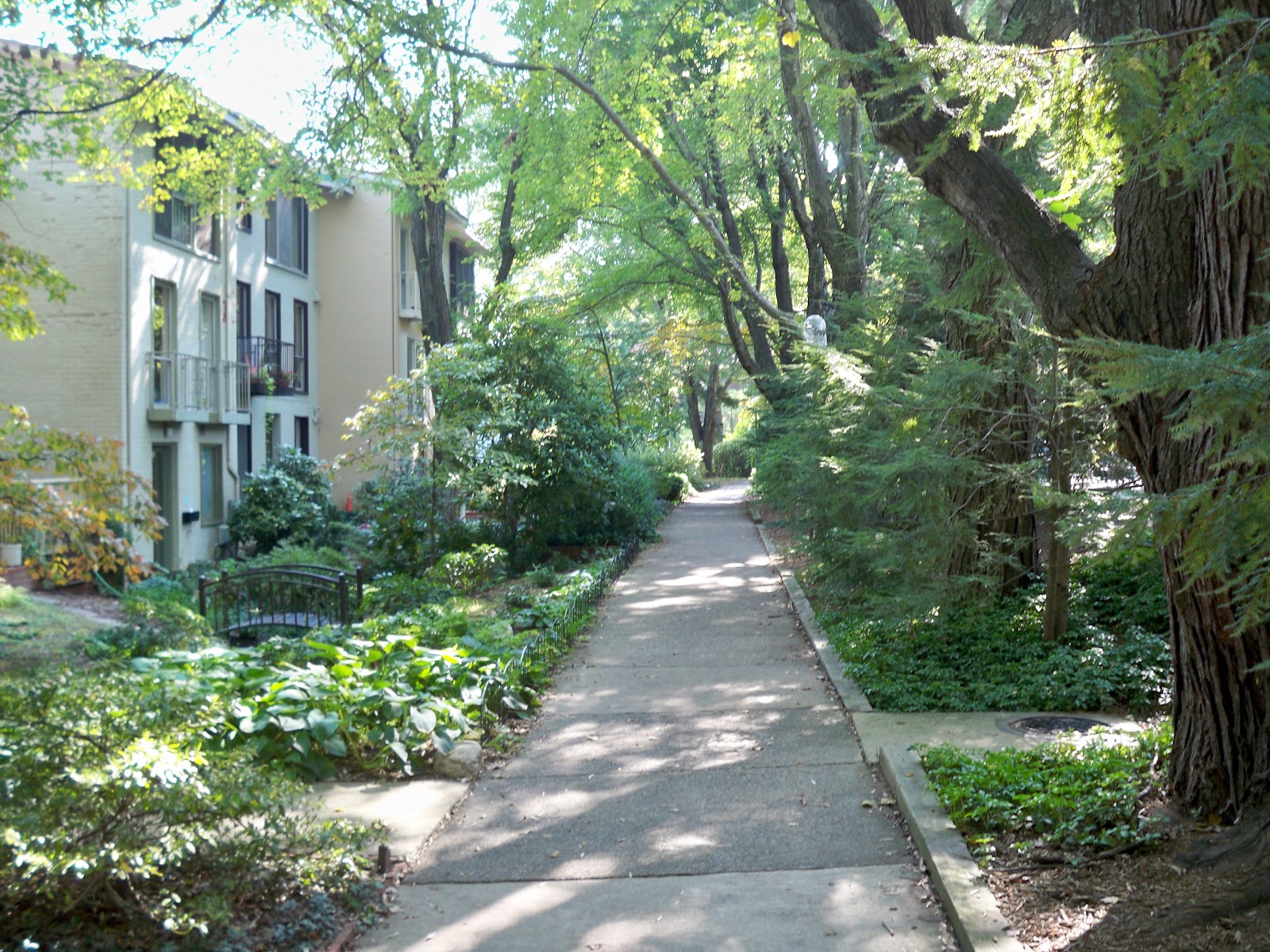
After dinner, almost dark — I work in a quick walk around the neighborhood. The sounds of the day mingle with those of the night. I hear a catbird settling in a maple tree, and, at the same moment, a chorus of crickets from a hedge beside the road.

The peepers are gone now but tree frogs are already serenading us. Wind chimes and soft music waft across the street from our neighbors with a front porch.

In a few weeks the pool will be open and the sun setting even later. Long evenings soothe and invigorate. We can live without them — don’t we prove it every winter? — but it was hard last night to imagine how we do.

Eye Candy

Eye Candy

I chose the walk because of what I would see. Not the usual scenery. So I turned left on Third Street, cut across through the courts complex, past the Canadian Embassy and on to a series of plazas. It was the flip side of the Mall, the downtown side of the National Archives, heading toward the White House but never actually there.

There were fountains and chairs and people. Many had just picked up their lunch. They carried fast food bags or pizza boxes or salad containers. (Is there a hierarchy here, I wondered.)

Rain was in the forecast, and people scurried as if at any moment they would have to run. All around me was bustle and commerce and, most of all, new sights to see. I moved through it all quickly, wanting to look and not to think.

It was eye candy, I told myself.  When the landscape grows predictable, vary the route.

What Passes for Darkness

What Passes for Darkness

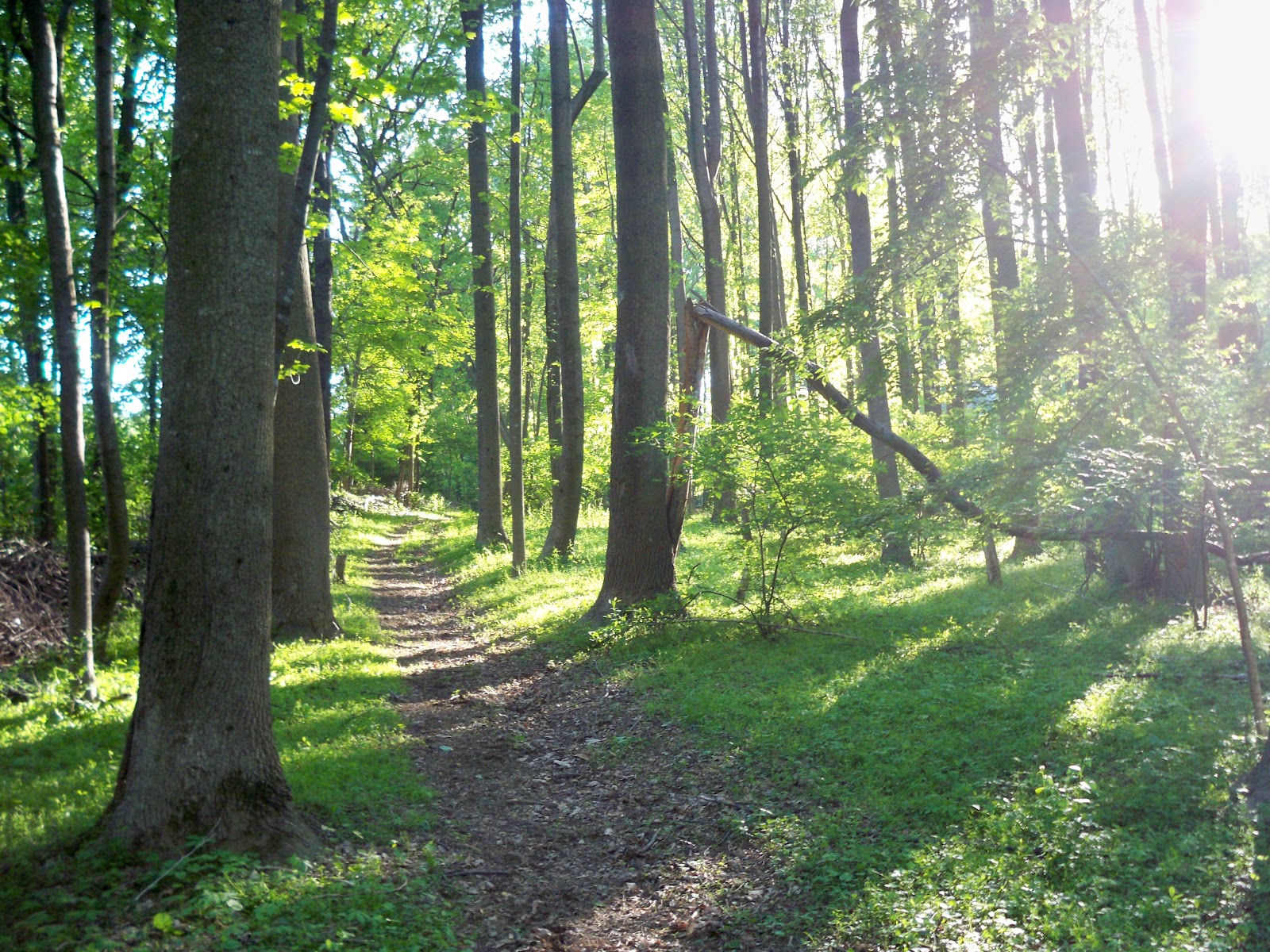
Sometimes a path presents itself, opens as if by magic. It was almost 7:30 when I started walking. A cloudy night, the light fading fast. As I entered the dark passage, my eyes picked up the brighter green of a nearby field. A fox ran toward it, auburn and plump. It posed in a green corner, then skulked into a bordering thicket.

I followed the curved walkway, my feet moving fast on the downward slope. I asked the woods to hold me up, the path to carry me. I asked only movement, and in that movement absorption. If that is all I ask, I reason, the walk will give it to me.

And that is what happened. The path, so close yet unfamiliar, the day almost over, the slight sense of danger as I walk in the woods in what passes for darkness in this well-lit suburban place.

After Dinner

After Dinner

An evening walk. A neighbor and her granddaughter. The girl’s mother was a girl herself when we moved in. We’ve lived here long enough for the child to become the parent. The little girl wore pink, and she whirled herself around in a circle as she swung a stick over her head. The days they are long for her, and the years, they stretch ahead endlessly.

Meanwhile, the grandmother plants annuals around a tree. She talks softly to the little girl. I couldn’t hear what they were saying, only see their heads bowed together in conversation. I inhale a faint whiff of cigar smoke, whether from the girl’s grandfather or from recalling my own, I couldn’t tell you.

It was that kind of evening, a brilliant sunset in the making, a bank of clouds that looked like a wave eddying around a breakwater, the air still and heavy. The past and present packed together in an after-dinner walk, the most portentous kind of stroll, spilling over with the motions of the day and the dying of the light. The fullness that passes for joy, that is deeper than joy.

On Broadway

On Broadway

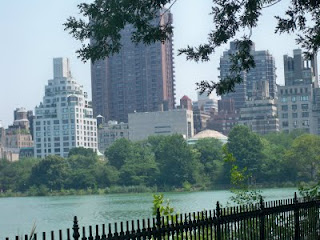
The tune has been in my head the last few days. The tune is there because I was there. On Broadway, that is. Not the part George Benson sings about, not the place where “the neon lights are bright.” Not Times Square Broadway.

I’m talking Upper West Side Broadway. Corner grocers, vacuum cleaner stores, coffee shops. There was a time when I lived there that if I ran out of paper and had to run down to the tiny stationary store to buy some, I hesitated. I would have been on deadline then (I was always on deadline that year) and I knew I would run into at least a couple of people I knew on the way there and back. Could I afford the time to buy the paper and chat with the friends?

The answer, always, was yes.  I had lived there for a few months. And when I walked down Broadway I knew people. I didn’t need neon lights.

Saturday, during my 21-hour visit to Manhattan, I had time to walk from 114th to 77th Street. The sun was bright, the air was warm, the pedestrians were of every size, shape and color.  I didn’t know people to talk to along the way. But I had left one good friend at 113th Street and met another at 77th. My feet flew down the pavement. There was energy and street life. It was good to be back on Broadway.

Cross Walk

Cross Walk


Yesterday I tried something new, something I hadn’t seen in the 23 years we’ve lived in this neighborhood — a crosswalk. It’s our corner’s first. A touch of the city in the suburbs. A time-out for the traffic. A vote of confidence in walkers everywhere.

I pushed the button, and I waited. And waited. And waited.

I started to run across the street against the light. After all, there were no cars coming. It’s what I usually do, wait for a pause in the stream of cars and then thread my way across.

But yesterday, since the cosmos (and the Virginia Department of Transportation) was giving me a break, I gave them one, too. I was a good citizen, a patient pedestrian. I waited my turn. But when the sign said “Walk” — I ran.

Unendangered

Unendangered


Of the three houses I lived in growing up, all had woods and fields nearby where I could ramble. These weren’t parks but undeveloped land, and about them hung an air of impermanence. The neighborhood I left to go to college was once known as Banana Hollow and had been known locally for its fine sledding hill. But the slope had long since fallen to the bulldozer.

I roamed the edges and bottomlands of this territory — just as I had the Ware farm which backed up to our previous house. That land, a plentiful pasture studded with the occasional giant oak, was home to a herd of grazing cattle. Some mornings I woke to the sound of their tramping and munching on the other side of our fence. But the Ware Farm was gone soon after we left that house, when I was a sophomore in high school.

All this is to say that when I hike through Folkstone Forest and the adjacent stream valley park, I am mindful of the gift, the certainty of this semi-natural land. Sure, in winter you might glimpse houses along its periphery, but plunge deep enough and all that’s visible is tree and fern and vine. It is stream valley land, prone to flooding and therefore protected.

I walk in an unendangered suburban wilderness. And I am grateful for that.