The Piedmont

The Piedmont

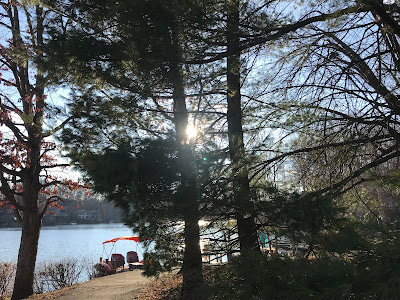
Although you might not think it, there are hills around here, inclines that push walkers and cyclists into overdrive. These are not the hills of Seattle rising like cartoon mountains, making a hazard of rolling suitcases and winding the faint-hearted in just one block. These are more subtle gradients, but gradients just the same.

It dawned on me lately while walking up a steep rise that it’s the piedmont at work. The land we inhabit here on the western edge of Fairfax County is just past the fall line of the Potomac. Virginia hunt country lies nearby. 

We live in the northern Piedmont region, literally at the foot of the mountains, those mountains being the Blue Ridge, which you can see rising like gray ghosts a quarter mile from here if the weather is clear. 

It’s comforting to think, as I chug up a steep grade, that I’m not just out of shape … I’m hiking the Piedmont.

En Peu de Francais

En Peu de Francais

With a new French-speaking grandson, I find myself dredging up phrases from ancient history — a high school class in French I. Today’s is “il fait du vent” … it’s windy.

But how much more trippingly does “Il fait du vent” fall off the tongue? Pretty trippingly, I’d say. 

Apparently, I could also phrase it as “Il y a du vent,” but I’ll stick with what I learned years ago. Which is way too little to converse with a bright 11-year-old.  

Once again, I’m struck by the paucity of foreign language study in the U.S. — or at least my language study!

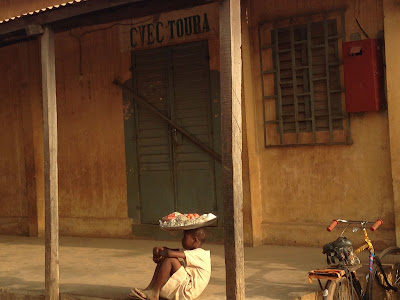
(I met these children on a trip to Benin in 2015.) 

Exorcist Stairs

Exorcist Stairs

Even watching the trailer sends chills down my spine, so I will probably not be watching “The Exorcist” this Halloween. But tonight I will be attending class right next to the “Exorcist Stairs,” the Washington, D.C. landmark where the movie’s final scene was filmed. 

In this scene, Father Miller, who’s attempting to rid the 12-year-old Regan of the demon, falls from Regan’s window down these narrow steps to his death. According to Culture Trip, the stuntman assigned this task had to fall down the stairs twice to perfect the scene. 

I found the stairs a couple weeks ago after walking past them earlier in my rush to get to class. But once a classmate told me where they were, I made a point to walk them the next week. 

I’m happy to say that I did not fall. But I did huff and puff a little. And I definitely felt a sinister vibe. The stairs are steep and creepy, just as billed, and apparently, if you try to count them, you’ll never come up with the same number twice. 

Vienna Walk

Vienna Walk

I found myself in Vienna last Friday. Not Vienna, Austria (though that would have been nice) but Vienna, Virginia, which is 20 minutes from my house, a place I often pass through on my way to somewhere else.

There is a strange disconnect to walk along streets one usually drives, sort of like flipping a video from regular play into slow-mo. 

There is the house on the corner lot with its split-rail fence and funky upstairs addition — but instead of zipping by it I can see the details, the little upstairs deck with its wrought-iron tables and unmatched chairs.

There are streets whose names elude me at 35 miles per hour: Garrett and Malcolm and Holmes. Solid middle-class names, though their neighborhoods are ones made pricey by their (mostly) large lots and desirable location within walking distance of Metro (back when that mattered). 

I ambled along Center and Lawyers, past Salsbury Spring, which was the only source of water for the area during the drought of 1930. I saw the place with new eyes after learning that, felt a little more connected to this place I (almost) call home. 

Beethoven’s Seventh

Beethoven’s Seventh

An open door, a world of light — and a piano. Scarcely a day passes that I don’t play it, or wish I had. To touch the keys and realize, I own this thing, I can walk over here and pound out a Brahms Intermezzo or a Bach Prelude whenever I want — well it’s been months since I bought this piano but it still thrills me. 

Writing about the playing is something else entirely, though. That’s because music is the other, the part that can’t be pinned down by precision. It flows where the words won’t go. 

A few nights ago, I found a book of music I’d forgotten I had, transcriptions of orchestral works, including the second movement of Beethoven’s Seventh Symphony, which I took out and played. 

This was a piece popularized by an impressive scene from “The King’s Speech,” but whenever I hear it I will always remember the University of Kentucky’s Piano Institute the summer before my junior year of high school. There was a young assistant professor there who taught music theory, and for one class he had us sit in a dingy room in basement of the Performing Arts building with big clunky earphones on our ears and our heads down on our arms listening to this music. 

I can’t remember now what lesson we were to take away from that experience. All I know is that in the darkness and with the earphones, the soft dirge of the opening chords built slowly to the crescendo at the piece’s midpoint in a way that made my heart fill near to bursting. And somehow, the other night, I was able to capture a bit of that feeling again … on the new piano. 

Bernadette’s Present

Bernadette’s Present

Yesterday there was another first birthday, this one for our precious granddaughter, Bernadette. There were presents and cake and a special meal, a trip to the park with her mom and a visit with her grandparents and aunts and cousin. 

But the big present was still to come. She was going to meet it (him!) right after she and her mom left us at 8 p.m. That would be her new brother, age 11, arriving with his dad on a plane from Benin, West Africa via Istanbul. 

A year and two days ago, Suzanne and Appolinaire were a family of two. Now … they’re a family of four. We’re all rejoicing for them.

Mirror of the Moment

Mirror of the Moment

So many walks to choose from these days, paths around ponds and through forests. Trails in the morning, chaste of footfall. Paths in the afternoon, littered with leaf bits from all the walking.

On Tuesday I passed two ponds, a bright one with cattails and a shady one rippled as if a fan were blowing on it. 

The water was meditative, brisk, a mirror of the moment. 

From A to Zinnia

From A to Zinnia

The end of a gardening season is a good time to ponder next year’s plan … and next year I’ll plant more zinnias. Next year, I’ll welcome their hues and warmth into my life. Next year I’ll be bolder.

This year, I sowed a few zinnia seeds out front and back. But it was late in the season, a half-hearted attempt. This was the only survivor, a stalk that craned its neck toward the sun and produced one forlorn flower that bloomed a few days ago. 

Next year, I’ll start seeds indoors in egg cartons. I’ll nurture those babies with sprinkles and grow lights. And when the soil is warm I’ll transplant them into sunny spots in the garden I’ll prepare soon. 

It’s October, spring promises are easy to make — and the imaginary garden has no end of delights.

(Zinnia bouquet photo courtesy Drilnoth, Wikimedia Commons)

The People Behind the Pill

The People Behind the Pill

I’ve always been an earnest, note-taking reader, especially now that I’m in class again. But increasingly more I enjoy the sidetracks and detours of reading, the rabbit holes, the inefficient digressions. 

For the next paper, we’re analyzing the public reception of a specific scientific discovery, and I’ve chosen oral contraception. It’s a rich topic, so rich that I’m reading more than necessary. 

For instance, in The Birth of the Pill, author Jonathan Eig tells the stories of the four people who are most responsible for the development of the pill:

There is Gregory Pincus, a brilliant scientist with a flair for publicity searching for compounds in his ramshackle laboratory in Massachusetts; Margaret Sanger, the founder of Planned Parenthood, who coined the term “birth control” and crusaded for women’s freedom all her life; Katharine McCormick, heir to the Cyrus McCormick fortune, who funded the experiments; and Dr. John Rock, a gynecologist and devout Catholic who took on his church to help the women in his care.

Though a drug company was involved — G.D. Searle — the pill would not have been created without the  “courage and conviction of the characters involved,” Eig writes. The book is a vivid reminder of how human personalities forge the technologies we inherit. It’s good to be reminded of that from time to time.

(Photo of Margaret Sanger courtesy Wikipedia) 

Biking the Trail

Biking the Trail

I spent the weekend hearing tales from Tom and his brothers, intrepid cyclists just returned from a 350-mile bike adventure down the Great Allegheny Passage and C&O Canal Towpath trails. 

These rails-to-trails paths allow walkers and bikers to make their way from Pittsburg to Washington, D.C. almost completely off-road. They provide a glimpse of the way life used to be, when people journeyed on foot or not at all. 

Tom and the guys hung panniers stuffed with tents and sleeping bags on their bikes, then cycled through forests, along rivers and across iron truss bridges. They told went swimming in the Potomac and heard train whistles in the night.

They passed through Pennsylvania towns like Boston, Connellsville and Ohiopyle (gateway to Falling Water), and Maryland burgs like Cumberland, Paw Paw and Hancock — meeting the same folks along the way.

It was challenging, exhausting, unforgettable. All I can say is … sign me up!

(Photo: Tom Capehart)