Briefly Lost

Briefly Lost

I started off slowly yesterday, as if I knew the walk would be longer than usual. It was one of those sultry afternoons that envelops you in summer, humid without being oppressive, full-bodied and yet (to me at least) still comfortable. 

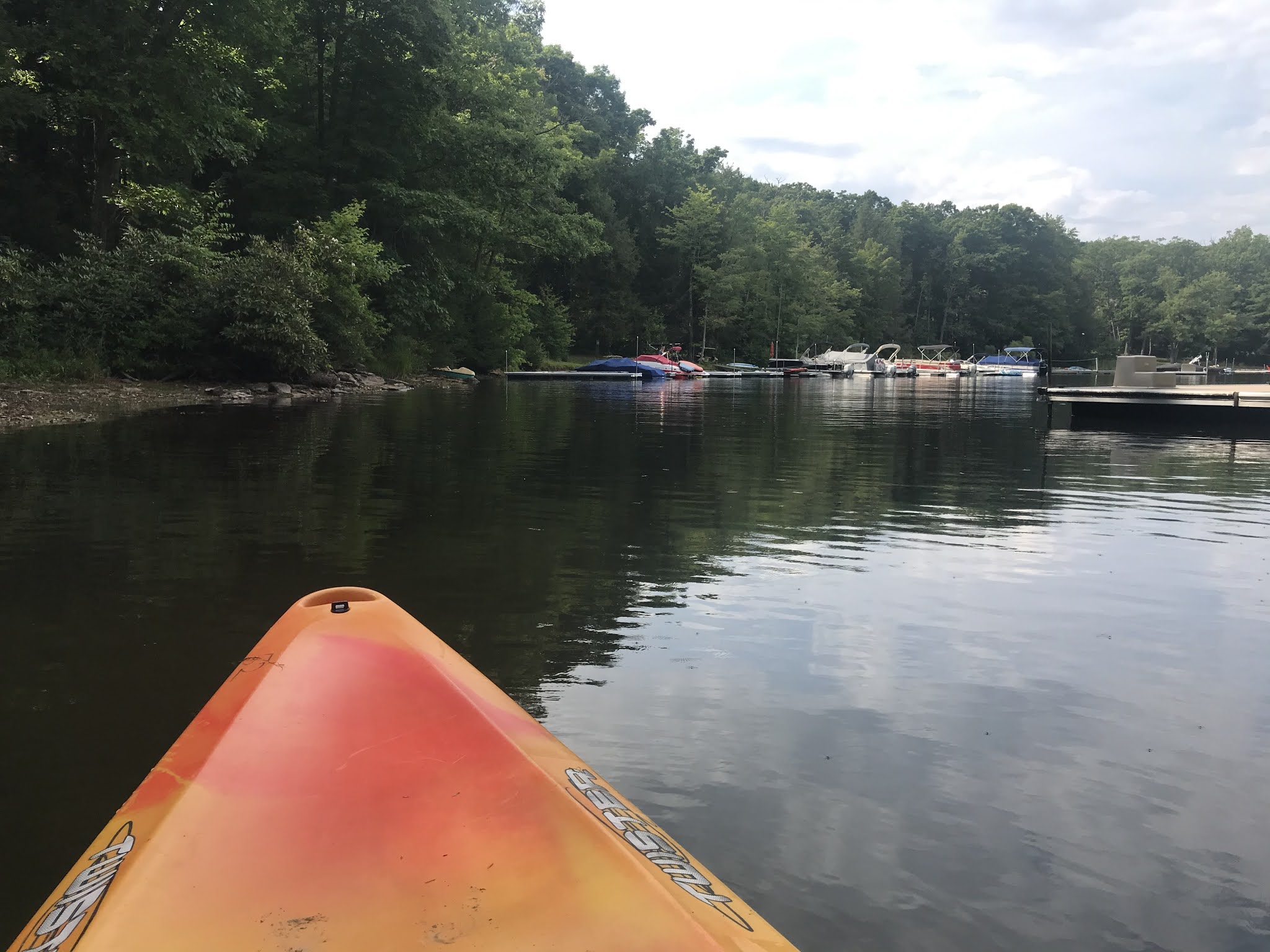
The Glade Trail beckoned, cool and single-minded, one long tunnel of green. I took it to the Cross-County Trail and then to Lake Audubon.

I had strolled around Lake Audubon before and knew you could not circumnavigate it, but I tried again anyway, knowing it would spit me out somewhere. And it did — only at first I had no idea where that somewhere was. Was it a neighborhood near the pool? A development near the shopping center? 

For a moment, I had to get my bearings. For a moment, I was lost. 

But I turned the way I thought I should, and there, on my right, was the Montessori School, a marker. Nowhere near where I thought I would be. But somewhere I knew, just the same. 

Brown-Edged

Brown-Edged

You’d think writing several posts about the Brood X cicadas would have been enough. 

I described how I felt sorry for them and their short lives. Then I wrote about how they inspired me to want to “seize the day.” Finally, I noted their departure..

What I haven’t yet described is what they left behind: the brown branches hanging from cherry, gum and oak. The crinkly brown tips that fall off and litter the yard.

Known as flagging — since the limp branches wave in the wind like so many sad little flags — the condition is not serious, I hear. Trees affected with this look sicker than they are, gardening experts say. 

But for folks in my neighborhood, who are quite used to 100-foot oaks toppling over in a storm or breeze, any sign of sylvan distress is taken seriously. 

Walking the other day, noticing the damage and thinking about a name for it, I came up with “brown-edged,” which reminds me of a cookie, the brown-edged wafer, popular in my youth. 

Though a brown-edged tree looks nothing like a cookie, somehow that makes it easier to take.

Mixing it Up

Mixing it Up

Walking yesterday I found myself going the “wrong” way on familiar routes. I was, without intending to when I began, mixing it up. 

Down West Ox and into Franklin Farm, striding down the shady path into the neighborhood instead of out of it, as I usually do. From there to Dower House Drive, and only picking up the open trail when I got to Flat Meadow.

One of the last times I was in this area the walking paths were being repaved, and I was chased away by a small tar-roller machine. This time it was quiet, a Sunday morning, fresh and cool after days of oppressive humidity. 

The trail was open, the way was clear. I need to mix it up more often. 

All Aboard?

All Aboard?

Boarding the train  back to Washington last Saturday, I found myself in the new Daniel Patrick Moynihan Train Hall. It’s an imposing place, artfully done with glass ceilings that frame original stone walls. 

The space created for this new building was at one point suggested by the former senator from New York, and as a New Yorker article about it points out, the new terminal seeks to atone for the travesty that was the teardown of the original Penn Station in 1963. 

The train hall is glossy and spit-polished and features huge screens with rotating displays, including photographs of 1940s travelers, women in frocks with sleeves down to their elbows, a generous if  not always flattering cut, I thought, as I waited for the train in my cap-sleeved dress. 

That I spent as much time as I did musing on those passengers and those dresses is proof that there was little else to look at. 

So, with apologies for acting the curmudgeon, let me grieve for a moment the loss of the Amtrak boarding area in the previous Penn Station, the one that replaced the”Beaux Arts beauty” of the original, the Penn Station of more recent yore, where the chaos of waiting for a train was the city’s final gift to the departing traveler. A reminder of the chaos you were leaving behind, the chaos that you would miss when you returned home.

For Bart

For Bart

The quick and surprising death of our parakeet Bart on Wednesday brings to mind this quotation from Jeremy Bentham: “The question is not, can they reason? nor, can they talk? but, can they suffer?”

The poor bird never seemed as chipper as his cage mate, Alfie, and back in March, I feared Bart was on his last legs. But he perked up and lived several more months to nibble and climb and spar with Alfie.

There was little clue to what ailed him, but I hope his suffering was brief. It certainly seemed that way. 

Now Alfie is left alone in the cage. He’s outlived two other budgies, and we’ll look soon for a new bird to join him. 

Birds are creatures of air and movement and song. And that’s the way I’d like to remember Bart. 

(Bart in a recent photo shoot.)

Good Fences

Good Fences

“Good fences make good neighbors,” Robert Frost’s neighbor says to him, though the poet believes the opposite is true: “Something there is that doesn’t love a wall/That sends the frozen ground-swell under it/And spills the upper boulders in the sun.” 

But when it comes to deer, good fences do make good neighbors — or at least they have this summer. Some of these day lilies haven’t bloomed in years. They’ve been nibbled off at the stem by a hungry mob of does and fawns.

This year, we put up chicken wire and caution tape (the latter is for Copper, who kept trying to run through the fence without it), and, voila, here are creamy yellow day lilies, lovely rose red ones, too. Here are the cone flowers in pink and white and russet. Here are black-eyed Susans, too. It’s a bounty, a visual feast. 

For years I’ve relied on something called Liquid Fence to protect the flowers. But a heavy rain can wash it off during the night and a marauding herd of deer can eat every bud in sight in one unprotected evening. 

“Before I built a wall I’d ask to know what I was walling in or walling out,” Frost says.

I don’t need to ask. I know. 

Garden Bench

Garden Bench

I’m writing this post from the far reaches of the backyard, a place I seldom sit but am sitting now because of a lovely new garden bench. 

The garden bench is a wondrous invention. Made of wood and surrounded by trees, it invites contemplation, pause, taking stock. It’s a place for reverie. 

From here the house is just part of the equation, silent and still. Its worn flooring and stained carpet are safely out of sight. 

The bench sits where I was thinking of putting my writer’s cabin, back when I was thinking I needed a writer’s cabin. 

Now I think I may have what I need: a series of places — my new upstairs office, this wooden bench, the hammock, the trampoline, the deck under the rose-covered pergola — and, most of all finally, some time. 

Function and Form

Function and Form

Most of the time I float along in my English major bubble, writing posts and essays, paying little to no heed to how things work.  I turn the tap and water flows. I flip a switch and lights come on.

But lately I’ve been forced to take measurements, consider function over form, to — in my own small and limited way — think like an engineer. 

This shouldn’t be difficult; two of my siblings are engineers. However, they ended up with all of the math genes, while I muddle along in a touchy-feely alternative universe. 

Until recently, when I’ve been forced to pay attention. Take the bathroom shower, for instance. I jump in one every day; most of us do. But it took me weeks to realize that a fixed glass panel by the shower controls in the new bathroom would prevent me from setting the water temperature before I get in. 

Turns out, there’s a remedy for this — the shower controls can be moved closer to the entryway and away from the shower head — but had I not thought differently for a moment…  I would never have known about it.

Shank’s Mare

Shank’s Mare

Today, my feet are in the suburbs but my soul is in the city. I’m missing New York City in many ways, especially in this one: walking there is purposeful. It’s about getting where you need to be, not taking 10,000 steps.

You don’t bother with the subway if you’re just hopping 20 blocks. Taxis are harder to come by than they used to be, and on Thursday night, Uber was asking $120 to take you from the Upper West Side to the Lower East Side. Yes, they are on opposite sides of the island, but come on!

Which brings us to shank’s mare, that most dependable mode of transportation. It might be hot and it might take a minute, but walking will get you where you need to be.

Yes, I rhapsodize about the practice of walking. It calms and inspires me on a daily basis. So much so that it’s easy to forget its original purpose, which is to get us from one place to another. In New York City, you don’t forget.

A Symphony

A Symphony

If walking in the suburbs is a sonata, walking in the city is a symphony. It is the cued entrance of  countless well-tuned players, the trilling of a piccolo, the thrum of a timpani. It is pedestrians striding through the square and construction workers in hard hats taking a break. 

It’s a stroll on the High Line and a view of lower Manhattan from Little Island, the city’s newest park. 

It’s meandering through the West Village, down Bedford and Barrow, past the Cherry Lane Theater and on to Bleecker, where I’ll grab a Napoleon and watch ten white-habited monks who’ve come from Our Lady of Pompeii to buy some cannolis. 

It’s the plume of a fountain in Washington Square Park and the chess players and weed hawkers and pickup jazz bands that gather nearby.

It’s a trip to the Strand Bookstore (still there!) on the way uptown, then dinner at a hundred-plus-year-old bar and grill.

Four movements, none of them replicable. A city walk. A symphony.