Impressionistic View

Impressionistic View

Most days I have little choice about which walk I take. I have 30 or so spare minutes, and I sandwich in a stroll between meetings and deadlines, taking the most expedient route — the one out my front door, down the main drag in the neighborhood and back.

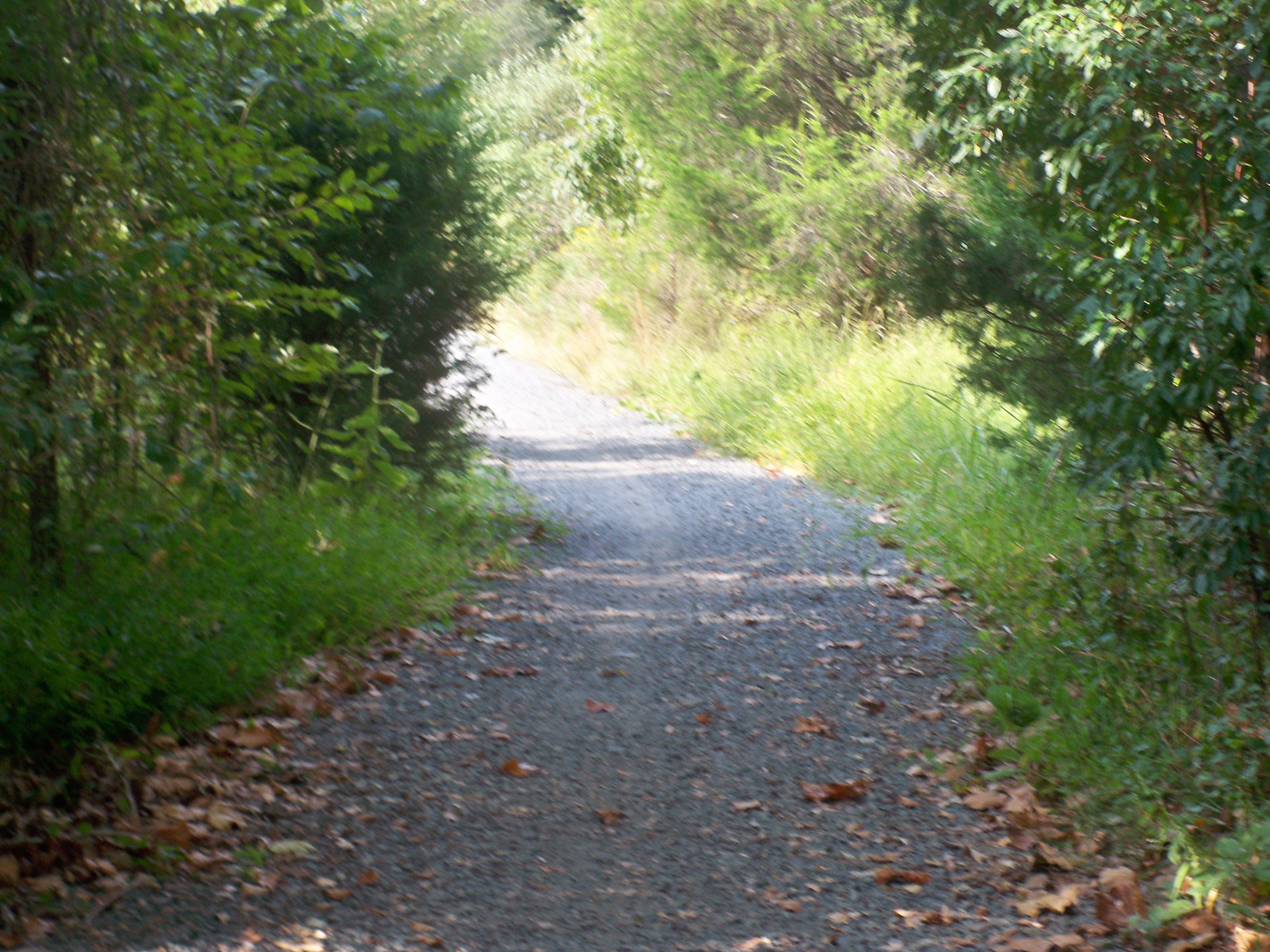
But yesterday, I had a little more time, so I picked a paved path that runs along the Fairfax County Parkway because it afforded the best view of blooming Bradford Pear and Redbud trees. I’d been seeing white petals blowing in the breeze like so many springtime snowflakes, and I figured if I was going to see the pears, I’d better do it soon.

The parkway path provided a broad-stroke, Impressionistic view of spring, the kind seen from a distance. It made me feel as if I had traveled far, when actually I was only a few miles from home.

Blue Sky

Blue Sky

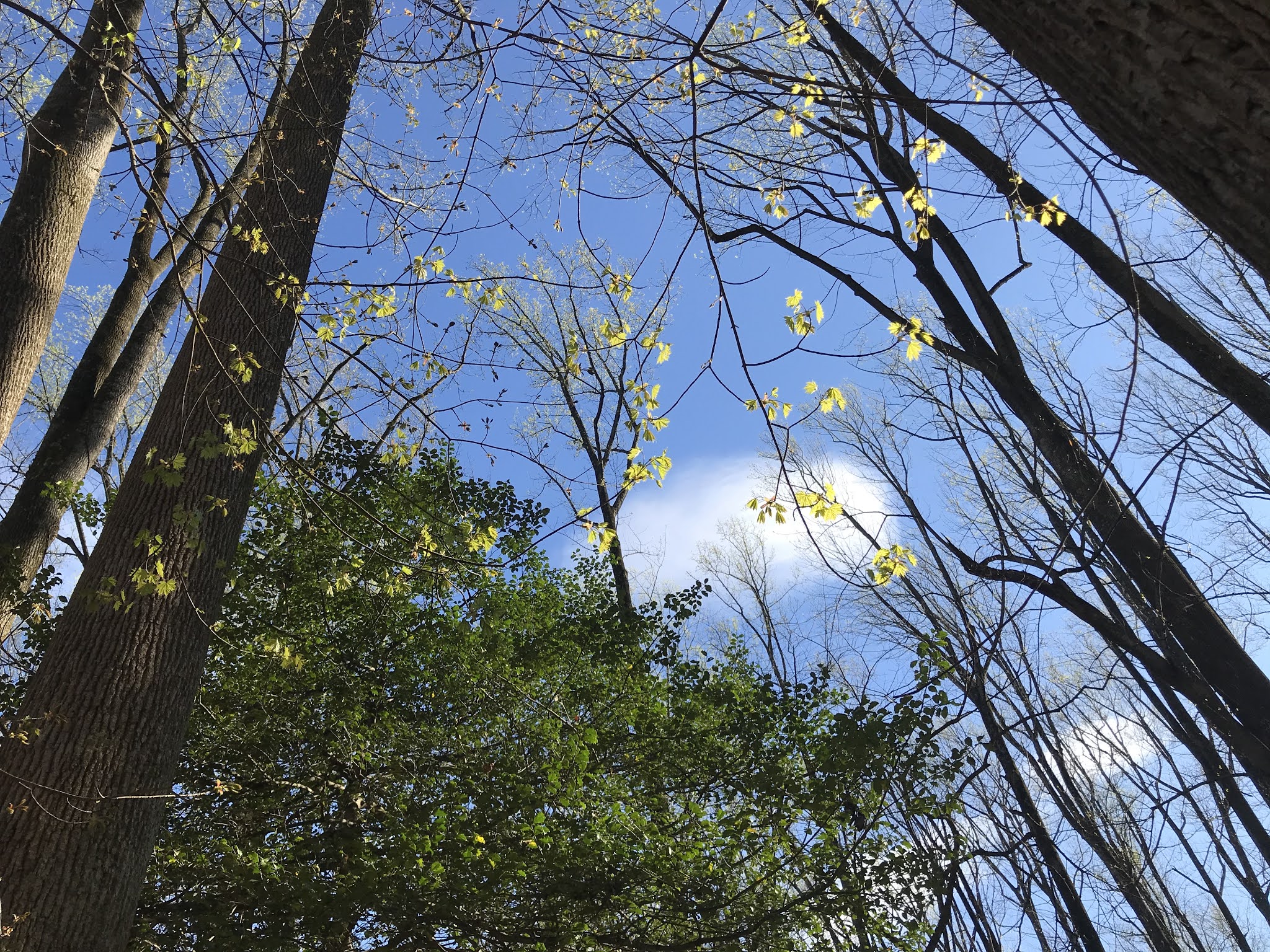
In group meditation, we are visualizing creativity as blue sky and a spark of clear spacious light that expands and grows until it covers the universe. 

This is easier said than done. Into the mind comes the grocery list, the calendar, the need to notify team members that I’m off today. Blue sky vanishes behind clouds of my own silly making, which is what it always does. Because clouds are almost all of my own making. 

But today I’m stepping away from calendar and duties, hoping to spend as much time as possible outside, under the real sky, which is, as it turns out, mostly blue today.

Easter Saturday

Easter Saturday

I write today as the eggs are boiling, before the bulk of the cleaning starts and the cake goes in the oven. There will be 16 people here tomorrow. That’s a big gathering when the number is usually two. 

And it’s a big moment in this slow return to normalcy. It’s not exactly like the opening of the gates in Oran from Camus’ The Plague. Our experience with disease has been longer but less acute than what those poor fictional souls experienced. 

But it’s been enough, thank you very much. And our hope that this might be the beginning of the end will make tomorrow’s alleluias ring out all the louder. 

The Alignment Problem

The Alignment Problem

Maybe it’s because I’m going back to school in September and must get some practice reading books I don’t totally understand, but for some reason I was determined to finish The Alignment Problem: Machine Learning and Human Values, by Brian Christian. I picked it up from the “New Nonfiction” shelf a couple of months ago, and thanks to my library’s liberal renewal policies, I have it still. 

I could tell from the beginning that I was in a bit over my head with this tome, which, though written engagingly, presupposes knowledge of artificial intelligence that I do not have at my fingertips. But it seemed like an important book on an important topic so I plowed through it. 

I finished it last night and, after using the index to flip back and forth to various definitions I spaced out while perusing the first time, was at least able to understand what the alignment problem is and why it’s important to solve it. 

The alignment problem is a term in computer science that refers to the divergence between the models we have created and the intentions we have when creating them, often imprecise or incomplete. It is, Christian assures us, a problem that the AI community is working to understand and rectify, but is by no means solved. 

Instead, he says, “We are in danger of losing control of the world not to AI or to machines as such but to models. To formal, often numerical specifications for what exists and what we want.”

We must be concerned, Christian says, but not grim. “Alignment will be messy. How could it be otherwise? Its story will be our story, for better or worse. How could it not?”

Popped Blossoms

Popped Blossoms

Well, that was interesting. The month of March, I mean. It seemed to last forever.  There was plenty of wind and rain, the University of Kentucky was not in the NCAA Men’s Basketball Championship, and I was under the weather on St. Patty’s Day. 

But it’s a new month, the cherry blossoms have popped (though I can’t think of a way to see them unless I ride downtown on Metro at some way-too-early hour) and with more vaccines being given every day, life seems to hold the promise of normalcy in the months to come. 

Then again, this is April Fool’s Day! 

(Photo of popped corn in honor of popped cherry blossoms.)

The Unvoiced

The Unvoiced

I read an essay over the weekend about the writer Tillie Olsen, whose impact was large though her output was small. It was that last point that comforted and inspired me. And not for the best of reasons. As I contemplate a life soon freed of the day job, I’m already looking for excuses. 

Before, I could always say … gee, I wish I could write more of my own stuff, but I have to work for my living. What will I use for an excuse now? This essay, by A. O. Scott in the New York Times Book Review, provides a blueprint. I’m going to quote liberally from it, because it articulates an exhaustion I’ve long felt but seldom read about. The italics are mine.  

Olsen was a writer her whole life — she died in 2007 — but she didn’t write much. Not because she was blocked or lacked material. The blockage — the obligation of earning a living and tending children, the “immersion” in caring that was a source of fulfillment as well as frustration — was the subject matter. The silence that surrounds those stories is its own kind of statement.

Is there a place in literature — in our canons and course listings, in our criticism and theory — for unwritten work? … Literary ethics prompts us to attend to the unheard and the marginal; curiosity or impatience with the same old stuff sends us in search of the forgotten and the neglected. But what kind of attention do we owe — what kind of attention is it even possible to pay — to the unvoiced?

I’d have to go back to an essay by Ursula Le Guin, “The Hand that Rocks the Cradle Writes the Books,”  to find words that so perfectly describe the unique challenges facing the woman who raises children, makes a home, holds a job and dares call herself a writer. 

It’s a topic I soon hope to explore with renewed relish — or at least, that’s the plan.

Dune Walk

Dune Walk

Two years ago, I visited the Great Sand Dunes in southern Colorado. My brother Drew and I drove until nightfall to reach the place,  but it was so dark that evening that we could only see the snow on the peaks. The dunes were invisible, being dusk-colored. 

But that only made the morning’s vista grander, a landscape that picked me up and put me in my place, that begged to be explored, which is what I did, starting at the lodge …

Passing a small picnic grounds

And a primitive gas station

I walked for more than an hour in the cold mountain air, all the while being pulled toward the dunes as if by a magnet.

Once on the sand, I trudged and marveled, watching the experienced dune-goers, who brought saucers and boards for sliding. But I had what I needed to capture the experience — and that was what I was after.

20,001

20,001

Over the weekend I learned that the daughter of a former neighbor, a man I watched grow up, was gunned down in broad daylight just steps away from her middle school outside Richmond, Virginia. 

This was not one of the mass murders we’ve experienced recently; there was “only” one victim: a young girl who brought happiness and light to all who knew her, who was stepping up to take more responsibility on her family’s farm, who had all of life ahead of her. 

Police have the alleged assailant, also a juvenile, in custody, but have released no further information. We can be sure, though, that his life will also never be the same, nor will his family’s. 

I think of the unimaginable pain this murder has caused, and of all who are grieving for this young girl — hundreds if not thousands of people — and multiply it by 20,000, the number of people who lost their lives to gun violence in 2020. 

I know it’s not only about guns. But it’s a lot about guns. How many random shootings and mass murders will it take? How many more lost lives?

P.S. After posting this early yesterday morning, I read about another young life tragically ended. And the next day, there was this

An Excellent Trade

An Excellent Trade

Every year in early spring I try to organize the two climbing rose bushes that clamber over the pergola on the deck. So yesterday, I ventured forth with clippers and gardening gloves and a ladder to snip off the deadwood and re-attach boughs with twisty green gardening wire.  

A new task this year was freeing the detritus that collects under the tangle of limbs. This meant holding up the thorny wood with one hand while sweeping the gunk out with another, all while balanced on a ladder.

By the time I was done, I had leaf bits in my hair, black smudges on my face and pricked fingers and thumbs (the gardening gloves can only do so much). I was, in short, a mess. But the rose … it was looking pretty good. Maybe it’s just where I am now, but I consider this an excellent trade. 

(The rose at the beginning of its blooming period last year.) 

The Heat

The Heat

For the first time in a long time, I’m warm. The windows are open, the sweater and long-sleeved shirt are peeled off and I’m sitting comfortably in short sleeves. 

The heat has roared in on a wild west wind, sending temperatures into the 70s before 10 a.m. It reminds me of a mythical beast, this heat, like something I’d heard about but wasn’t sure was real. Now that I’ve had a taste of it, I’m remembering how it limbers up the muscles and frees up the mind. How it opens doors, both literally and metaphorically. 

I’d like to think the heat is here to stay, but I know better. It’s a fickle time of year. We could have cold rain tomorrow. But at least the heat is here now. And I’m basking in it.