The Newcomer

The Newcomer

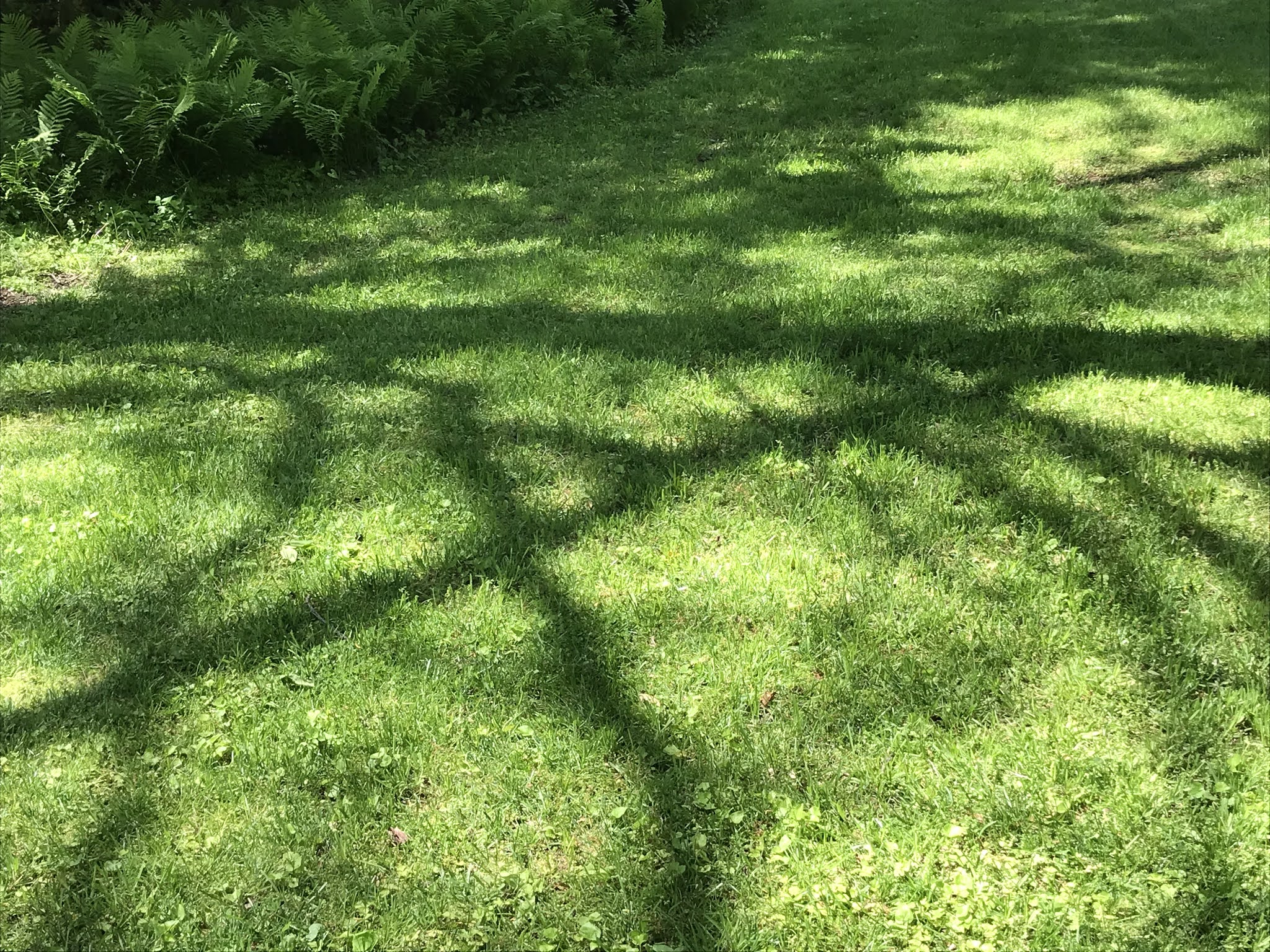
A walk in Reston yesterday, parking in my new spot, taking the trail that starts at the recycling bins (lovely!) but picks up in attractiveness from there. It’s a great find, this trail, because it begins so close to my house and connects with long favored paved paths. 

I’m still learning about this trail in winter, marveling at just how close the houses are, discovering one of those little free libraries along the way and finding a route with a slight rise in the middle (perfect for upping my heart rate).  

There’s a bounty to seasonal openness — to see far ahead, to spot the flash of a robin in the holly, to feel for a moment that expansiveness winter offers. 

It’s plain this will become a favorite, part of the deck I choose from when deciding which strip of asphalt to amble. I’m always glad to welcome another.

Taking Care of Business

Taking Care of Business

Today is a work holiday, which means that it’s a Day to Get Things Done. What kind of things? Applying generous electronic gift cards to electronic accounts, for instance. 

I’m famous (or infamous) for letting gift cards go unspent. I imagine many of us are; retailers count on it. But this way, that will be harder to do (if all these pronouns make sense). 

Of course, electronic to-dos aren’t the only ones I have today. There are other, more tangible tasks: cleaning and cooking and decluttering … the endless list. Guess I’d better get to them!

(Detail of a surface that needs dusting …) 

Two for the Road

Two for the Road

When Mom and I traveled to Europe together many years ago, we bought matching sweaters “just in case” it was chilly. We were immediately glad we did. We donned them the first evening, as we listened to an outdoor concert in a chill June drizzle in London, and wore them often throughout the next six weeks as we toured England, Ireland, France, Germany, Austria and Italy. 

We slipped ponchos over them when it was raining and slept under them on overnight train trips. They also came in handy as robes and cushions. We wore them so much that we never wanted to see them again when we got home. 

They’ve always been sentimental to me, enough that I stuck them in a suitcase and stored them in the attic for years. And that has preserved them, preserved the memories, too. 

20 Years!

20 Years!

I learned early this morning that today is the 20th anniversary of Wikipedia. That I learned so early is noteworthy, I think, a sign of how much I rely on something I once thought was faintly ridiculous. 

A crowd-sourced encyclopedia? What of the scholar laboring in his or her attic (and let’s face it, it was usually a “his” back in the day)? What of the World Books lining the shelf? 

Through the years I’ve learned a little about the standards of Wikipedia, which, though odd, can sometimes be rigorous. Let’s just say that if you submit a PR-like entry, they will come after you. 

Plus, I’ve become lazy. I spent many years doing research in libraries, and I love the older style of knowledge acquisition. But I’ll admit, it’s pretty amazing to have such a compendium at my fingertips. 

So happy anniversary, Wikipedia! And thank you for your service!

(Photo: Wikipedia! And that’s another reason I love them. I can use their photos without fear of copyright infringement.)

Warm and Light

Warm and Light

In my quest to be winter-hardy, I’ve discovered the many virtues of merino wool. I have a couple of merino wool blend “base layers,” which in the old days I would have called undershirts, and I’m wearing them now underneath everything: turtlenecks and cardigans and pullovers and sweatshirts. 

The fact that we keep our house temperature in the mid-60s means that I need at least three layers even when inside. When I go for a walk I throw a jacket over the ensemble, cover my ears and hands, and I’m good to go.

The key, I’ve realized, is warmth without weight. It sounds like an advertisement for pricey athleisure wear — in fact, I’m pretty sure it is — but it actually works. I feel warm with three layers on, providing one of them is my base layer.  And the “weightlessness” means I’m not stuffed like a sausage into my clothes. Warm and still able to bend my arms — what more could I want?

A Dog, a Pig and the Music

A Dog, a Pig and the Music

It’s barely discernible but significant to me that at 5 p.m. there’s now enough light to play with Copper in the backyard. He enjoys it when I bounce on the trampoline, and one of the best ways I can think of to wind down the day is to close the computer, run outside and urge him to come with me so that I can watch him trot down the slight rise in the yard: his sturdy little legs, his mouth open with joy — or perhaps because he wants to bite me. 

Last evening I bounced to the last movement of the Saint-Saëns Organ Symphony, which I came to love after seeing the movie “Babe.” (The final theme of the symphony is the tune that rallies the little pig.) 

How lovely it is to bounce to that grand sound, looking up at the house, the windows dark in the room where I was just writing, so different from moving through the air, the glorious release of it all. And yet knowing that the experience of bouncing will come most alive for me when I try to get it down on the page. And that involves (you guessed it) … heading right back into that dark room.

(Photo: Universal Studios/Photofest and the Hollywood Reporter)


The Walking Listener

The Walking Listener

For the last year I’ve been ambling not always silently and not always with music in my ears but sometimes with words in there too.  Thanks to the gift of Audible, I’ve walked to novels and meditations and nonfiction explications of our current economic woes. 

One day a neighbor stopped me on the street. I took out my ear buds to hear what she was saying. “You must be listening to a book,” she said. 

I wondered how she could tell. Did I have a furrowed brow of concentration? 

She could tell because she does, too. There must be some sort of aura we walking listeners give off that only other walking listeners can see. 

We chatted for a moment before going on our separate ways, at which point I put my ear buds back in and discovered that since I’d forgotten to push pause, the narrator was now several “pages” ahead of where I’d stopped. Just a small problem for the walking listener. 

Free Books: Going Fast

Free Books: Going Fast

Today, our public library returns to virtual and curbside pickup only. Since summer we’ve been able to enter our branch (fully masked and separated, of course), to browse the stacks and check out the new fiction and nonfiction sections. We could find our next great read. And often (at least in my case) serendipity was involved. I didn’t go hunting for The Mirror and the Light by Hilary Mantel. But there it was, languishing in the new fiction section.

So much do I count on these library visits, that when I heard the news of the closure late Friday, I added another to-do for Saturday: get over to the Chantilly branch and get some books. Apparently, many folks had the same idea. By late morning the parking lot was filling up and people were dashing from building to car, bundles of books under their arms. 

A woman with a clicker monitored our arrival, to keep capacity to Covid rules. She reminded me I could only stay for 30 minutes. That was fine; I only had 10. 

But I made a beeline for the new section, and got right to browsing. There was Patti Smith’s Year of the Monkey, a memoir that’s been on my list for months. I grabbed John Bolton’s The Room Where It Happened, too. It  seems a little passé by now, but I’ll give it a try. 

Into my arms went books on artificial intelligence and mindfulness and the works of Walt Whitman. If a topic seemed down my alley at all, it made the cut. 

When I left the library there were five souls waiting to get in. Free books — there’s nothing like ’em.

Tossing the ‘Bible’

Tossing the ‘Bible’

When I think of National Geographic magazine, I think of mountains and mummies and majesty. I think of the Bible, since I’ve always approached the magazine with reverence, thanks to its plethora of fine photographs and its perfect binding. I also think of George Bailey in “It’s a Wonderful Life.” Early in the film, when he’s a kid, he boasts that he’s been selected for membership in the National Geographic Society. 

Well, I was, too. And I can tell you what it’s like decades later, when you don’t throw out any of those precious journals, when you don’t even let your kids cut them up when they begged you to let them. Instead, you held onto the magazines, thinking they were too beautiful to toss, that somebody would want a complete set someday. A library, a nursing home, someplace.

But in a world where you can’t even give away a piano, you certainly can’t interest anyone in boxes of National Geographic magazines. In fact, you can’t even throw them all away at once; they’re too heavy. So we’re getting rid of them box by box. It’s like slowly peeling off a bandage — a painful process. But in the end, we’ll be a little bit freer, a little bit lighter, and these days, that’s what it’s all about.  

Lopez and Place

Lopez and Place

I learned earlier this week that the author Barry Lopez died on Christmas Day. I’ve only read one book by Lopez, but it made quite an an impression. 

Lopez’s masterpiece Arctic Dreams is sometimes called a travel book. But as many critics have noted, it’s much more than that. “Arctic Dreams is a book about the Arctic North in the way that Moby Dick is a novel about whales,” the critic Michiko Kakutani wrote.

For me, Arctic Dreams was one of the first books that awakened an appreciation of writing about place. Since then, I’ve come to love the words of Annie Dillard, Henry Beston, John Graves, Aldo Leopold and many more. I’ve come to realize the power of writing about where we are rooted, of paying attention to the trees and animals and vistas that sanctify a city, a seashore, a ranch, a farm, a home. 

Lopez died of complications from prostate cancer, but according to his wife, his ailments intensified after wildfires destroyed his house in Oregon last September. He lost all his original manuscripts and a lifetime of artifacts. Most of all, I thought as I read his obituary … he lost his place. 

(Photo: Brian Schaller/Wikimedia)