Christ the King

Christ the King

Today is the feast day of Christ the King, the last Sunday of the liturgical year. But for me, Christ the King will always be, first and foremost, a school — “CKS,” my earliest alma mater, the place where I learned to read and write, where I got my first crushes on boys, where I arrived most days with a knot in my stomach. 

It was not a feel-good place; most parochial schools were not in those days. It was a bar of Ivory soap and a rough towel, just the basics. There were no counselors, no social workers. If the nuns were unhappy with you, they weren’t above grabbing you by the arm and giving it a firm squeeze.

I remember the scent of wet rubber boots in the cloak room on a rainy day, the smell of vomit and of the detergent used to clean it (I wasn’t the only one who arrived at school with a knot in my stomach). I remember chalk dust and the way the nuns would tuck their arms up their voluminous sleeves, the clicking of the rosary beads they wore clipped to the side of their habits.

A few years ago, when I was visiting Lexington, I went back to Christ the King, strode through the halls, peeked into the classrooms, wandered through the lunchroom, which was where I tried out for cheerleader in seventh grade. “Two bits, four bits, six bits, a dollar, All for Christ the King, stand up and holler.” 

Eight years is a long time to spend in a place, especially when those years are your sixth through 13th. Those years throw long shadows; I walk in them still. 

Early to Bed…

Early to Bed…

Last night, I was in bed reading before 9 p.m. with lights out before 9:30 — which means that when I woke up at 4:30 a.m., as I often do, I gave myself permission to rise and start the day. 

This led to what felt like a revelation: does this mean I should always retire so early? Am I more of a lark than I think I am? 

One morning does not a lifestyle change make. So for now, I’m enjoying today’s head start and hoping I can keep my eyes open long enough to have dinner!

Aural Warmth

Aural Warmth

It’s our first frost of the season, and though I haven’t ventured outside yet, I can predict how it will feel: crunchy beneath the feet, the white spears of grass tufted and hardened, winter here before we’ve even seen the first days of December.

It was 27 when I woke up this morning — and 62 inside the house, which we are keeping cooler for various reasons, including stuffy sinuses and easing the transition from inside to outside (thus prolonging this infatuation I have with working al fresco). 

I have to say it feels mighty fine now to work inside the house, with hot air pouring from the vents, warming the air to a relatively toasty 67. Even the sound of the furnace makes me feel warm. As does the roar of the electric kettle coming to a boil. 

If warmth were aural we could do away with hats, scarves and mittens, so I know a lot of this is in my head. But they are lovely sounds just the same. 

Two Novembers

Two Novembers

I knew I would catch it after yesterday’s post, waxing rhapsodic about our “two homes,” about the human need for outside time, for the comfort and the balm of nature.

Yesterday, nature was definitely without her diadem. A stiff breeze bore down on us all day, not enough to reroute the Dulles air traffic but powerful enough to “prune” the trees and make walking a trial. Copper and I ventured twice into the tempest: once in the morning and once in the afternoon.

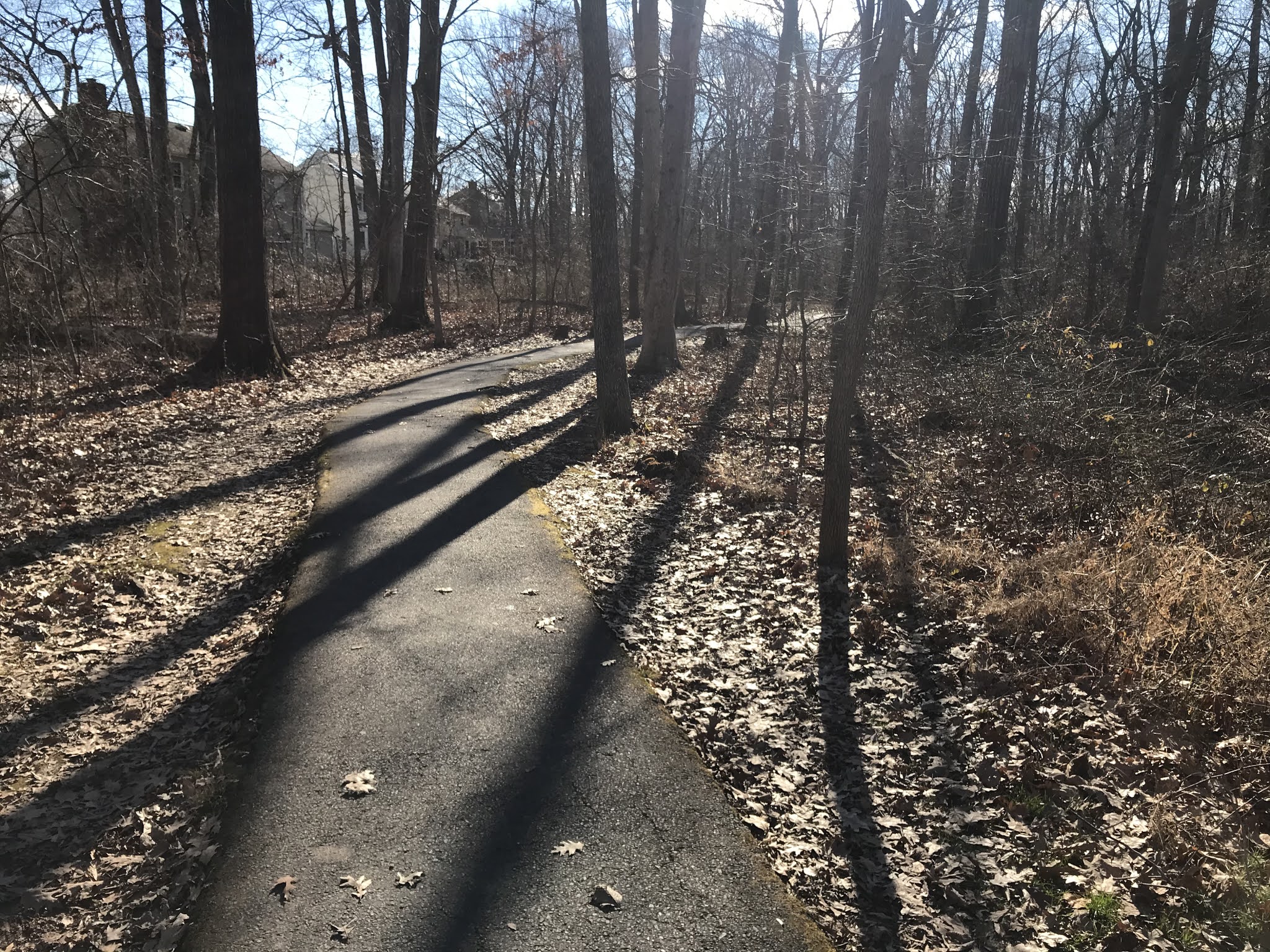
Here’s a shot I snapped during the latter. I’ll use it to remind myself that, just as we have two homes, so also do we have two Novembers. One is warm sun on the face and the scent of dry leaves; it lures us to sit on the deck stairs and take in the scene. 

The other is what we had yesterday: raw skies and an angry wind. That November has one message for us: go inside! 

Two Homes

Two Homes

As the light fades, the sounds change. Instead of birds flitting through azaleas, squirrels scamper through leaves. The sound of autumn is the sound of rustling, of animals circling to find their resting places.

We humans, too, take our clues from the light. First our plants come in, then we do, too, reluctantly in the beginning but eagerly in the end. Back to these houses that are both balm and bait, which cushion our captivity with heat and comfort, with down pillows and warm baths.

Once inside, we will forget the wild world where Blue jays cry and ants crawl slowly up the pergola post. Our spirits will flag without that knowledge.

And then, one warm winter afternoon, we will sit in the sun on the top of the deck steps. We will sniff the earth again and feel stirred by the same breeze that eddies the crushed leaves. We will know then that we have two homes, and we do best when we live in both of them.

Musical Chores

Musical Chores

I’m always listening to music while walking with my iPod, but until recently I’d lost the ability to blare symphonies or musicals or folk tunes at home. But now, a jerry-rigged system is once again filling the house with sound. 

On Saturday morning, while putting away the groceries, it was Simon and Garfunkel’s “Old Friends.” “Bye-bye Love”  is a surprisingly apt tune for wiping down packages of peppers and strawberries and finding a place for them in the fridge. The “bye-bye” part is good for jettisoning leftovers.

Later in the day, I listened to Benny Goodman while chopping vegetables for potato-leek soup. “Sing, sing, sing” mimicked “Chop, chop, chop,” the driving bass beat perfect for making quick work with the potato peeler. Dad must have been behind the scenes for this pick, loving both food and Big Band.

And finally, while making pot roast in the crockpot, I matched the cool, foggy weather outside with the Hernon Brothers’ “Across the Sound,” an album picked up two summers ago on the isle of  Inishmore. 

Chores fly when they have a musical accompaniment. 

Writing Together?

Writing Together?

As a new grandmother I’m certainly not skimping on the photos or the ink — or what passes as digital ink, the keystrokes that allow me to describe in detail all the glories of my new grandchildren.

But a passage in a book I was re-reading last night brought to mind a time when recording one’s life was near to impossible and led to an odd sort of epistolary cohabitation. 

At the end of Hilary Mantel’s Bring Up the Bodies, Cromwell writes at his desk. “Paper is precious. Its offcuts and remnants are not discarded, but turned over, reused.” As a result, he finds the penmanship of Cardinal Wolsey, his departed friend, “a hasty computation, a discarded draft,” Mantel writes. But Cromwell “had to put down his pen till the spasm of grief passed.”

Imagine what our world would be if we had to reuse the scrap paper of our friends and neighbors. Would it help us see the world from another perspective? Would it bring us together?

The answer, I’m afraid, is clear: It certainly didn’t help the 16th century. 

Leaf Meal

Leaf Meal

I borrow this term from the poet Gerard Manley Hopkins, who in “Spring and Fall to a Young Child,” wrote of Goldengrove unleaving and of “worlds of wanwood [that] leafmeal lie.” 

Here is my leaf meal — what is left of the Kwanzan cherry’s foliage, which disappeared in a day. 

I shivered when I saw it, and not just from the chill wind that followed the rain (and which, paired with the rain, brought down the leaves). 

I shivered because looking at that bare trunk I felt winter in my face — and the single-mindedness of seasonal change. 

A Bump in the Night

A Bump in the Night

Halloween is behind us. The skeletons and graveyards that decorate neighbor’s yards have given way to sedate autumn wreaths. But my heart was beating faster yesterday than it did the entire month of October. 

The reason: a bump in the night. The early night, to be sure, but it was dark and it was rainy and the bump sounded like something big had fallen upstairs. 

Was it a cat burglar come to get my jewels (an errand sure to disappoint, I might add)? We crept upstairs to check it out, entered each room carefully, and there was  — nada. No box had fallen from a shelf, not a thing out of place.

There’s a chance this was an outside noise mimicking an inside one. But I doubt that. I’m going to assume it was just a friendly poltergeist messing with us a little, taking advantage of this old house, with its creaks and groans, sending us a message — that we are not alone. 

November Question

November Question

Warm Novembers confront us with a question: Is it the early darkness that makes the month gloomy — or the cold temperatures? Melville would say the latter, I think, at least he would if we take the famous opening lines of Moby Dick with its “damp, drizzly November in my soul” as proof of where the novelist stood on the matter.

For many of us, though, it’s not just the damp drizzle; it’s also the early darkness, the dying of the light. I saw this first hand in the parakeets yesterday. Lulled into autumnal complacency by the mid-70 temps, I brought the birds out onto the deck to share the glass-topped table with me as I worked. 

They were chattering and happy, doing their best to respond to wild bird calls … until the sun began slanting lower and lower in the sky.  Then, as if on cue, they quieted and calmed, began tucking their heads into their wings. 

Even when it’s warm, the early darkness has its way with us.