The late-turning trees are giving us a final burst of color. In the front yard, the Kwanzan cherry has burst into a sunny yellow that matches its spring bloom for brightness and intensity.
In the backyard, the volunteer Japanese maple is outdoing itself: its bright scarlet hue shining in the sun that is just now touching the back fence.
Closer to the house, the black gum’s final leaves flutter like tiny, opalescent flags. Their color is a magnet, drawing the eye. As I look more closely, I see two young upstart black gums right behind the tall one. How is it that I’d never noticed this before, never used the fall color not just as inspiration but as information, another clue to naming names in the natural world?
A hike yesterday on less familiar ground, light slanting low from the late-afternoon sun. Only a short way down the trail came a fast-moving stream and what was billed as a “rock crossing” on the map but which was in fact a few slick stepping stones spread far apart and barely peaking their razor-thin edges above the rushing water.
The first few stones of the crossing looked treacherous but feasible. If they weren’t so moss-slicked I could see getting across them. But then I’d be in the middle of the creek, and, from what I could tell, stranded. I could see only the barest, thinnest edges to the mostly submerged rest of the stone crossing.
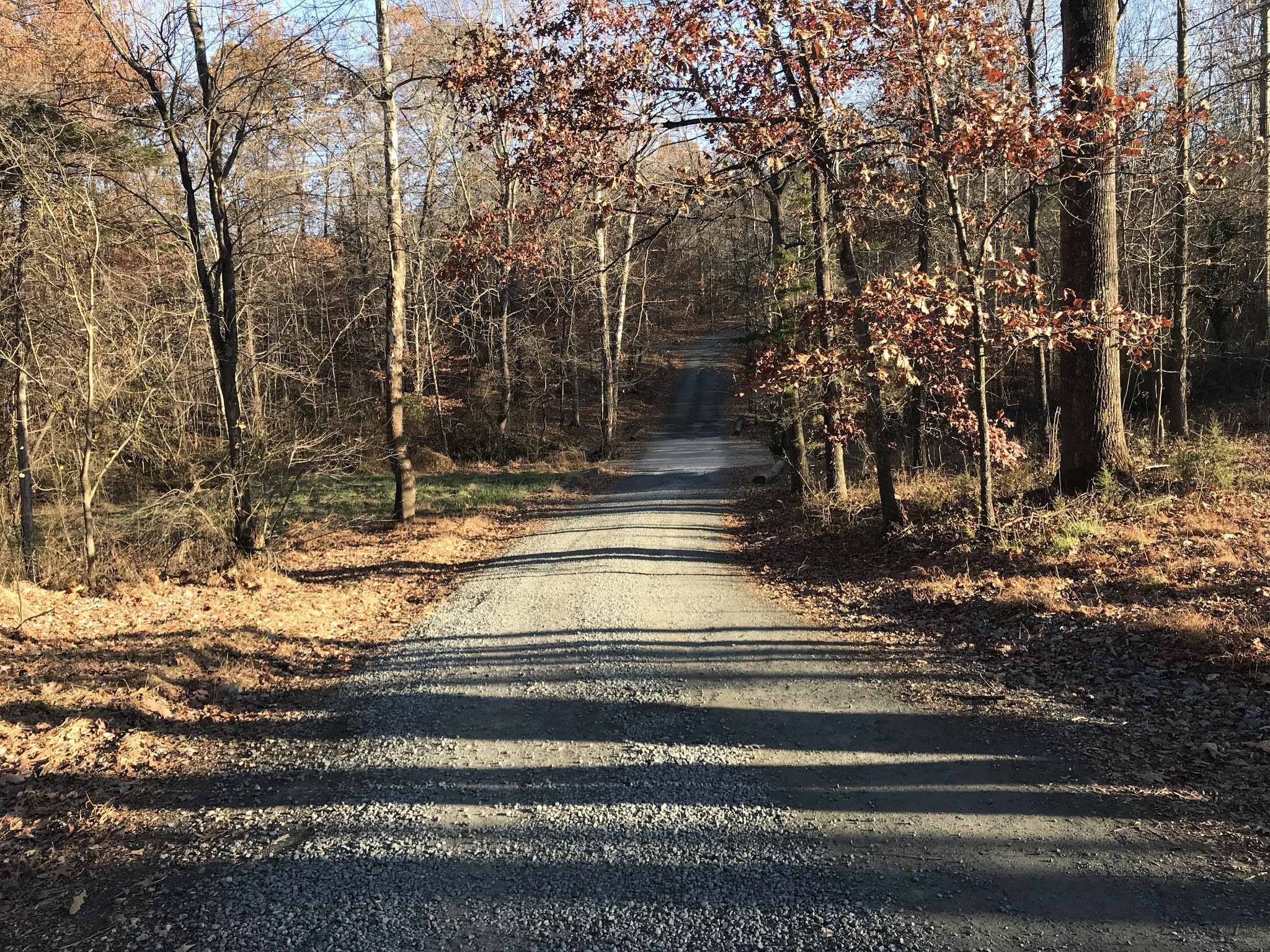
Feeling distinctly wimpy, I turned back. I don’t like turning back; it goes against my nature. So I found a side path to explore. It followed the stream for a few minutes, close enough to glimpse an ancient roadbed (see above), which seemed part of an old watercourse.
I felt better, realizing that waterworks would have remained hidden had we taken the original crossing. And this morning, reading a description of this section of the Cross-County Trail, I felt even better about turning back.
It describes a “stone crossing that is only usable during the low to normal stages of the creek.” The gurgling of the stream, its breadth and raucous rippling, made it clear that the creek was at a high stage creek, not low to normal.
Perhaps I wasn’t as cowardly as I originally thought. Only prudent, even a bit adventurous. Ah, that’s better.
When the word came that Joseph R. Biden had been elected the 46th president of the United States, the country was well along on its Saturday morning. I’d just put the groceries away. Celia in Seattle seemed to have the word even before the news alert on my phone did.
There was no ringing of church bells, no banging of pots and pans or shooting off of firecrackers in my neighborhood, but there was one joyful family and, I assume, many joyful families throughout Folkstone, each celebrating in their own way, glad that a new era is dawning for this country.
I seldom write about politics in this blog — this week has been an exception — but today, especially, is a day worth noting. It’s not that the road won’t be steep and the going tough. But there is now a hope that we may come together as a country. And that is definitely worth celebrating.
I don’t want to write about politics all week, but it’s difficult to think about much else these days. I’m also trying not to read too much into omens and symbols, though I do anyway. Sometimes I think I was born into the wrong time or culture, because I do more than my share of knocking on wood.
Yesterday, hoping that my candidate will prevail, I took comfort in the fact that the climbing rose is still producing lovely, creamy pink flowers — even this first week of November.
And so, although I have already featured the climbing rose in recent posts, I feature it again today. The bloom of a rose, the scent of a rose, speaks of renewal and beauty and augurs many good things. Surely we all need those now.
My self-imposed blackout lasted until about 6 p.m. yesterday. Forgoing media allowed me to be a little more productive and a little less anxious than I would have been otherwise. But then the floodgates were open, and I learned the razor-thin wire on which we walk, each side convinced that “there be dragons” on the other.
In my saner moments, when I can step back from the fray, I continue wondering how we got to this place, this divided place. I’ve been reading and thinking about it for four years. But these musings are in the head, not the heart. And it’s my heart now that is pitter-pattering, as are millions of other hearts across this great land of ours.
On Tuesday I stuck an American flag out by the mailbox, and it has flown there since. It seemed one way to reassert the position I’m trying so hard now to believe — that there is still more that unites us than divides us.
I’ve been awake for hours and have seen only the barest shred of news, an update that appeared unbidden on my phone screen about the vote tally in Arizona. I’m trying to see how long I can hold out without looking at a news or social media site, without turning on the television or picking up the newspaper, which lies forlornly out by the forsythia bush.
It’s not that I don’t want to know the current tallies. I’m as curious as the next person, I imagine. But I also know that once I look, the truth (whatever it is right now, even if inconclusive) will be with me — and I won’t be able to ignore it or wish it away.
So I’ve drifted through the day in my own bubble, writing in my journal and on this screen, exercising on the elliptical and stretching on the floor, making and sipping a cup of tea, tidying up.
I know I can’t keep up this blackout forever. Curiosity will get the better of me and I’ll peak at some sites, learn some totals. But until then, I’m enjoying my own little news-free zone. It’s calm and cozy in here.
I thought I would write about voting on November 3, 2020, an election day long awaited, long feared. But I figure I’ll have plenty to say about the election tomorrow.
What strikes me as words-worthy today is the morning, is finding it again in the wreckage of Eastern Daylight Time, discovering its glimmering, shimmering self among the ruins of the warmth and the tattered leaves of autumn.
Fall-back has given some of us an extra hour to clean the closets and others a welcome roll back to sleep early Sunday morning.
But for me, it’s been a way to reclaim the morning, regaining what I lost in my quest for more sleep, which are these precious golden hours before the day begins. I’ve been missing those — and now, at least for a few days, I have them again.
Ever since becoming a grandmother I’ve meant to find the journals where I described the births of each of my daughters. I was put off by the digging it would take me to find them.
But yesterday I had a few moments, so I looked in the most logical first place — a drawer in a dressing table where I keep some of my old (now well-filled) blank books. And there, right on top, was the journal describing Celia’s arrival — what I’d done that day (Christmas shop) and how it felt (scary!) to look up at the hospital sign from a distance, counting contractions while sitting in a rush-hour traffic jam.
Beneath that journal was the one with the pages for Claire’s arrival. The heat of those summer days came alive again for me, as did the rosebud mouth and cute little nose of my second-born.
And finally, there was the journal that described Suzanne’s birth. I labored longer with my first, of course, and the nurses were marvelous, especially one whose name had escaped me — until yesterday.
It’s not as if I’d forgotten the moments when each of these precious babes was put into my arms, and many of the details were there, too. But to relive the excitement in my own voice brought me back to those days in a way no photograph could — and made me glad that even in that early, new mother exhaustion, I chose writing over napping, that I picked up my pen, grabbed my blank books and wrote the birth stories.
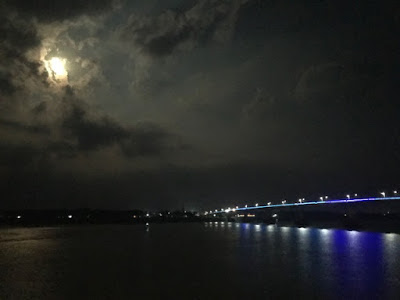
Last evening’s moonlight made striped shadows of newly bare trunks and lit the backyard with its wan glow.
Tonight’s blue moon (the second full moon of the month) will rise on little ghosts and goblins who, instead of ringing doorbells, will grab treat bags from tables placed at the ends of driveways.
If clouds stay away, moonlight will be their companion. But even if they don’t, these kiddos will see houses more decked out for the season than any year in recent memory. Giant spiders climb ropes that span most of a yard. Skeletons dangle from doorways. And webs spread from hedge to hedge.
It’s a creepy, crawly little world folks have created for children this year. A fun, faux-frightening one set amidst the very scary real one we are, at least today, trying to ignore.
Call me strange, but for some reason I’ve gravitated to pandemic fiction these last few months. I re-read The Plague by Camus, tried Jose Saramago’s Blindness but only got a third of the way through it, and just finished the historical novel Year of Wonders by Geraldine Brooks.
Though The Plague was more profound, Year of Wonders was more enjoyable. I was pulling for Anna, the protagonist, who suffers loss upon loss but emerges the stronger for them.
I was whisked away to a 17th-century English village (based on a real place), which decided when faced with the Black Death to keep the disease contained within its boundaries. The citizens voluntarily quarantined themselves, suffering much greater loss of life than if they had run at the first sign of illness.
Knowing that once, long ago, a group of ordinary folk decided to take this step, to give up their own lives to save others, makes this an especially powerful moral message to contemplate.