Lessons from the Pandemic

Lessons from the Pandemic

We received word late yesterday that the earliest the U.S.-based employees in my organization (which is most of us) will return to the office is April 1, 2021. By then, it will have been a full year of remote work. 

As it stands now, we are well into our eighth month. Almost long enough to make a baby. In fact, here’s a thought: infants conceived at the beginning of the pandemic will soon be out in the world. The Quarantine Generation. Gen Q?
What else has been gestating? Fear and confusion, to be sure. Divisiveness, absolutely. But also, as many have noted, a renewed closeness with the natural world. 
What I was trying to get at yesterday, but didn’t quite, is that the outside office, my “deck desk,” is not just a bucolic retreat; it’s at the mercy of the elements. I’ve dashed inside to avoid raindrops, wrapped up in a blanket to withstand the cold. And soon, perhaps even today (I’m writing this an evening ahead), I will be forced inside. 
Being more attuned to the natural world is instructive, though; through it, we can better understand what the pandemic is so rudely teaching us: that we are not in charge. That can be ugly, true. But it can also be beautiful. 
The Deck Desk

The Deck Desk

For the last many months my desk has been a glass-topped table on the deck. It’s where I’ve scattered my notebook and planner, where I’ve carefully placed my laptop and phone after wiping the glass to remove even the tiniest drop of dew. 

It’s a table that gives me a front-row seat on the natural world. Squirrels and chipmunks scamper a few feet away from me, searching for acorns. Cherry tomatoes still cling to the vine. The hanging basket of New Guinea impatiens has thinned and browned, but there are still enough bright flowers to remind me of summer.

Even as the leaves turn from green to yellow — and power tool sounds from lawnmowers to leaf blowers — I sit here still. This is my workplace, my deck desk.

Mind and Body

Mind and Body

Over the weekend I read an essay about the power of literary analysis in the college classroom — and, because of the unique times in which we live — also not in the college classroom.  Apart from the many excellent points made about education in the humanities — the lessons of the great books have never mattered more, the ability to think and analyze is prized in the workplace — the author, Carlo Rotella, made one that brought a crucial point to mind. 

While teaching via Zoom, Rotella said, he realized how much he uses visual cues in his class, figuring out who he should call on, who’s getting a concept and who is not. I ran this through my own, English-major memory, and sure enough, the same seems true from the student’s point of view. 

What I remember most about college literature classes is not just the ideas that seemed to be exploding in my brain as we discussed The Magic Mountain or The Brothers Karamazov, but the visual impressions my teachers left as well. 

I recall in particular my favorite college professor, Dr. Ferguson, who would curl himself around the podium when he lectured, one knee on the desk, one foot on the floor, while stork-like, he led us through the great books. It’s not that I don’t recall the ideas themselves — I think about them all the time — but until I read this essay I wasn’t aware of how closely they are linked to the physical peculiarities of the professors who introduced them to me. 

This essay triggered a dialogue in my brain, a conversation between the author and me, and the part that I supplied surprised me — as it should, when the “conversations” are deep and good. 

Cousin Meeting

Cousin Meeting

Over the weekend, there was a gathering of the clan. And the cousins — who had attended showers and weddings and family dinners together (though with one or both in utero) — finally met in person.  I wouldn’t exactly say that they interacted, but they were held up close to each other, and it felt momentous to me and to their parents.

There’s something about taking on the grandparent role. It’s a stepping into the wings and off the main stage, a move made with gratitude for the most part but not without a backward glance. 

Not that I won’t be a big part of these little people’s lives. But I won’t be raising them, and up till recently, the parenting role is the one I’ve had. 

As we left the house there was one baby fussing and the other being strapped in his car seat for the ride home. Our car felt empty and quiet — but peaceful, too. 

(Photo from another gathering of cousins, this one long ago.)

Gathering Rosebuds

Gathering Rosebuds

The weather gods have given us one more warm day, one more day to walk and bounce and write outside before the cold moves in. It could be 30 degrees cooler tomorrow than it is today.

I can hear the lawnmower outside. Does it only seem more fast and frantic because I’m feeling that way about making the most of this day?

The second bloom roses I’ve been enjoying brought this verse to mind:

Gather ye rosebuds while ye may,
   Old Time is still a-flying;
And this same flower that smiles today
   Tomorrow will be dying.

Autumn Bond

Autumn Bond

Autumn is rolling out quite the red (and gold) carpet for our fall “babies” (our new granddaughter’s mother’s birthday is today). 

Decades ago, when I was expecting Suzanne, I hoped she would be born in time enough to enjoy the glories of autumn. We lived in northern Massachusetts then, though, and the trees were almost bare when she arrived. 

As it turns out, though, Suzanne’s birthday is perfectly aligned for autumn color in the mid-Atlantic — and so is her baby’s. 

Now when I marvel at the bright colors, inhale the scent of crushed leaves, I think about how she and her baby will always have this bond. This time of simultaneous change and equilibrium will always be theirs to share. 

The Wake-Up Walk

The Wake-Up Walk

I woke earlier than usual this morning, woke to a cotton-wool world all blurry around the edges. Perfect for a wake-up walk, one where you start off half asleep and the walk itself is what brings you fully to consciousness. I took sunglasses because there’s a brightness beyond the fog and I wanted to be ready for it.

I began with Dan Fogelberg’s “To the Morning” in my ears, because its quiet start and slow crescendo mimics a day opening its eyes and stretching its arms. At the halfway mark I switched to chants from Anonymous Four.

As it turns out, I didn’t need the sunglasses. The day has yet to brighten as I think it will. All the better for a wake-up walk, one where footfall is stilled and thoughts along with it, where the hours begin their slow unfurling with dignity and grace.

Baby Girl!

Baby Girl!

Our second grandchild arrived in the wee hours of the morning: a little girl this time! Like her cousin, she was born slightly before the due date, an awesome accomplishment that has me wondering … will both these children be punctual beings, or more than punctual, will they always arrive early? An amazing thought!

Childbirth in the age of Covid means we are scattered about the region and the country, sharing the news with middle-of-the-night texts, sending hearts and flowers and congratulations notes, waking and cheering and giving thanks and falling back to sleep (or trying to) with images of infants in our heads. 

Suzanne was a sweet big sister right from the start, as she demonstrates here, in one of the first photos I have of her holding Claire. 

Now she’s holding a baby of her own, long awaited, cherished and treasured by many. I hope mom, dad and baby feel the love we’re sending their way. I bet they do!

Going in Circles

Going in Circles

Happy is the house that allows circumnavigation — by which I mean, happy is the house that allows you to walk in circles through the rooms, 

Our house has an open living room, a center hall that leads into an office (dining room in a former life), which opens onto the kitchen, which flows into the living room. Put these features together and you have a perfect venue for … going in circles. 

This might seem unimportant, and I didn’t think about it when we were buying, but once the girls were toddlers, they loved running loop-the-loops, chasing the cat or evading a parent. Copper uses this configuration for his victory laps. It also comes in handy when you need to pace.

In short, circumnavigation is a nice feature to have in a house. It provides an openness and flexibility that is sorely lacking in many aspects of life. And though I have only anecdotal research to back me up, it may even keep one limber. It’s not a feature I would have put at the top of my list when choosing a house, but now that I have it, I can’t imagine one without it. 

The Pipeline Path

The Pipeline Path

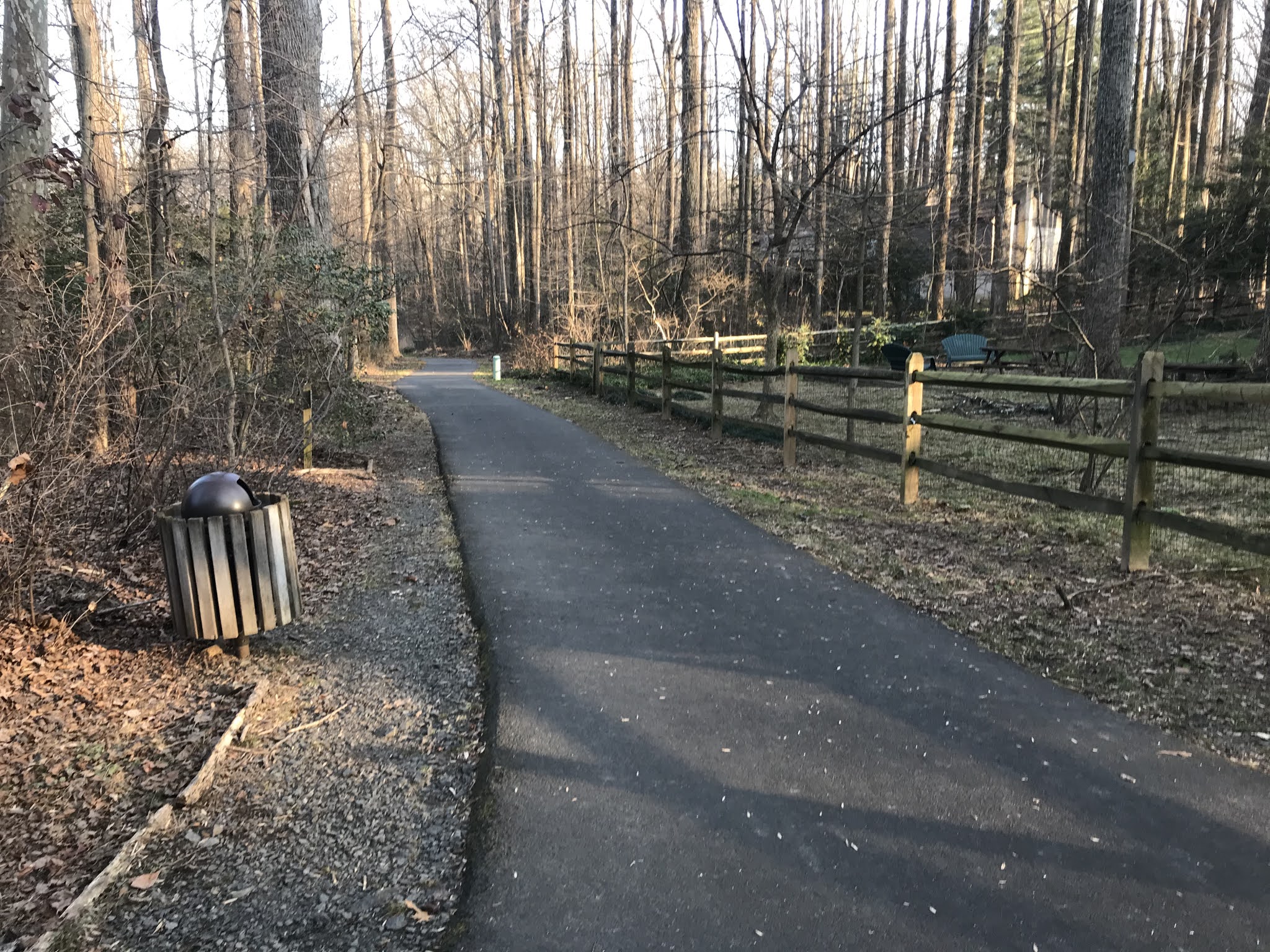
I wouldn’t want to live next to it, but the oil pipeline a couple miles from here has at least one thing to recommend it, and that is its paved path. I walked it on Saturday, right after mailing my letters.  Starting on McLearen, sun-warmed in the brisk air, I dipped off onto a trail I’d tramped long ago, turning left instead of right, navigating a fair-weather crossing right after a dog and his owner had just decided not to attempt it (the man was game but the dog was having none of it). 

From there it was just a bend and a hill-trudge from a buckled, fir-shaded, needle-strewn path along the greensward. Though I enjoy the meditative woods walk, there is much to be said for a stroll that skims the backs of houses. There’s an intimacy there you don’t find otherwise. 

I had a front-row seat on screened-in porches, knock-out roses and garden gates. There were trampolines, bird baths, even campaign signs. And on the path, a complement of fellow walkers who seemed as happy as I was to be alive and walking on such a fine fall morning.