Frozen Sea

Frozen Sea

“A book must be the axe for the frozen sea inside us.” — Franz Kafka

I came across this quotation a week ago while reading The Second Mountain by David Brooks — and it took my breath away.  In that way that books can seem to be speaking directly to you, I first read these words as a writer, as in, writing a book will free up, if not a frozen sea, then at least a creative block I’ve felt off and on for many years.

I was pretty sure that was not the way Kafka intended his words to be construed, though. Today, I’ve had time to find the larger work of which this is a part. And yes, it is most definitely about the books we read, not the books we write. But it is still powerful, especially when you know it was written by a 20-year-old (!) Kafka, in a letter to a friend. Here it is in context:

I think we ought to read only the kind of books that wound and stab us. If the book we’re reading doesn’t wake us up with a blow on the head, what are we reading it for? … We need the books that affect us like a disaster, that grieve us deeply, like the death of someone we loved more than ourselves, like being banished into forests far from everyone, like a suicide. A book must be the axe for the frozen sea inside us. That is my belief.

Civility

Civility

Maybe it’s something you learn as an editor, that if you’re going to take the thoughts and feelings of someone who took the time to write them down on a page, and cover these words with red ink, you’d better do it politely. But I think it’s more fundamental, a lesson we learn as children, to treat others kindly and with compassion, as we would like to be treated. You can argue diametrically opposed opinions, but if you do it with kindness and tact, you’ll get much further.

I’m hardly the first person to note that civility has disappeared from public discourse. But let me add my voice to the chorus of those bemoaning its absence. Yes, we may hail from different sides of the political aisle, may not see eye-to-eye on much of anything. But can we at least address each other respectfully?

“Courtesies of a small and trivial character are the ones which strike deepest in the grateful and appreciating heart,” said Kentucky statesman Henry Clay in another century. I’m hoping we make civility a 21st-century value, too.

(Speaking of Henry Clay, this is the old Henry Clay High School in Lexington, Kentucky, my alma mater.) 

Fading Ferns

Fading Ferns

The ferns are fading. They’ve turned crusty and brown. In some light, perhaps, they appear golden. But that’s a stretch.

I know it’s only seasonal change, but there’s something about ferns that speak more than most plants of youth and vigor. And I feel bad for them in this sorry state.

I think back to April and the earliest tendrils, how exciting it is to see these strange things emerge from the cool and leaf-strewn soil.

I think of how well they have served us through the summer, how faithfully they have waved in the breeze, how cannily they have outwitted the hungry deer that stalk these parts.

Yes, they will be back next year, I know. And I’ll watch them unfurl and come into their own once again, perhaps even spread, as they are wont to do. But it won’t be these ferns. These ferns … are fading.

Morning After

Morning After

On the morning after Congress announced the beginning of impeachment proceedings against the 45th president of the United States, I picked the newspaper up off the driveway as I usually do, knowing, before I opened it, how much there would be inside to read.

I had been glued to the television the night before, uncharacteristically watching news instead of a British soap opera, and yet I had to have more of it this morning. This is the way things are now — that after two and a half years of craziness, there will be even more.

Sometimes I think that we’ve all become addicted to craziness, that we won’t know what to do if we ever again have a bland status quo.

But then again, I don’t think we’ll have to worry about that for a while.

(A blurry Washington, D.C., seen from above and afar. Looks a little like an Impressionist painting, doesn’t it?)

Summer and Fall

Summer and Fall

On the first day of autumn, I walked outside after dark to get something from the car. I was wearing a white nightgown, not the lightest one I have because after a sweltering 90-plus-degree day, the air conditioning was back on.

My purpose was purely practical, but the night was alive with balmy air and the sound of crickets and katydids. I was suddenly aware that despite the seeming permanence of these summer sounds, they are extremely time-limited. The bugs chirp as if they have months to live when it’s probably more like weeks.

I was sorry to walk back into the quiet of a darkened house, windows closed against the heat and humidity. It’s been a warm summer, and many are longing for a spate of coolness. But I’m not. Say what you will about crisp autumn air, warm wool sweaters and chili simmering on the stove… I wouldn’t mind if we had another month of summer swelter.

Stinkbug Season

Stinkbug Season

They fly in from who-knows-where, these funny armored bugs — in from fields where they’ve been gorging themselves all summer, I guess. And predictably, on warm days late in the season, they congregate on our windows and doors and, if possible, inside the house, too.

A stinkbug announces itself with a whirring sound and, when disturbed, will emit a cloying aroma that smells a little like cilantro.

But in the old days, I knew they were around when I heard a certain kind of shriek, as this house full of girls reacted, I’m afraid to say, in a most gender-stereotyped way. One especially notable occasion happened late one night when a daughter pulled down her window shades only to find that a bunch of stinkbugs had nested there during the day.

Now the bugs are calmly scooped up and cast out when they’re found. Not without a shiver, though.

(Luckily, these critters are on the outside of the screen.)

Letting Go

Letting Go

A number of suitcases have been piling up in the basement, suitcases lacking the kind of easy-rolling wheels or with other defects that leave them out of the take-along sweepstakes.

Two of these bags belonged to Mom and Dad. They’re older models, of course. And no one else wanted them when we were going through things a couple years ago. So I used them to pack up books and memorabilia that I was bringing back from Lexington — then, after emptying them, tucked them under the basement stairs, where they stayed for at least two years.

But the bags have recently been unearthed and deemed extraneous, so I just moved them up from the basement to the garage. Next step: the Purple Heart pickup.

They’re in good shape and will come in handy for someone else, I hope. But it’s hard to see them go. I tell myself that things don’t matter, that it’s the intangibles that count. But each time I get rid of something that was Mom and Dad’s, a little bit of them goes, too.

Glory in the Morning

Glory in the Morning

Behold the morning glory volunteers, their seeds slipped into the soil last year, gifts from the past. Back in June they decided to sprout, and now they’ve grown, twined and, finally, bloomed. I seem to recall their relatives were blue, but no matter, maybe the soil acidity has changed or there’s been a mutation. I like these better anyway.

Morning glories make clear the photosensitivity that all plants share. Sunrise and sunset prompt their openings and closings, which is just the obvious part, because it tempers their leaf color and stem strength, too.  
I feel a kinship with morning glories. Like them I bloom in the early hours; it’s when I get my best brain work done. By afternoon I often feel as closed up as they look.
The Golden Hour

The Golden Hour

I almost bailed at the last minute. Standing on the platform in Crystal City, worn out from the usual, I almost jumped on the Blue Line train, which would have connected me to the Orange Line and home.

But I stuck to the plan I’d come up with earlier, which was to drain the last drop from the day, to walk around D.C. in the “golden hour,” the one favored by photographers, when light slants low and fetchingly across the landscape.

So I hopped on a Yellow Line train, rode a few stops north into the District, and exited at L’Enfant Plaza. I strolled east down the Mall toward the Capitol, then pivoted and walked west, directly into the setting sun. I missed the bustle of the lunchtime crowd, but the light made up for it.

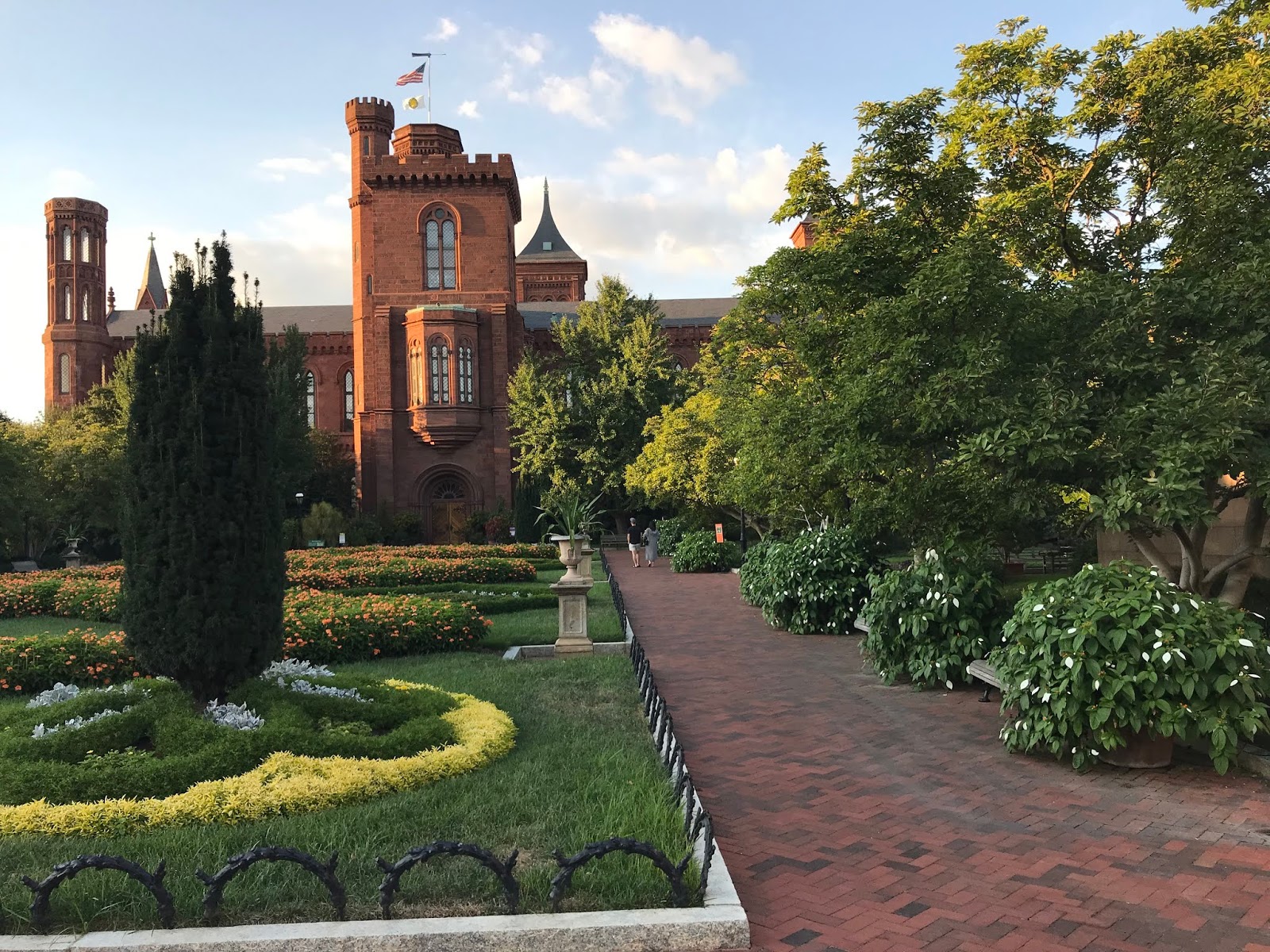
It created an aurora behind the Monument, dramatic and striking. But I preferred what it did to the red sandstone of the Smithsonian castle, how it warmed and illuminated it, changing it from dour to delightful.

Ambling through the Enid Haupt Garden with its orchids, magnolias and dhobi trees, I felt like I was in some Mediterranean palace. The red stone was terra-cotta and the splash of the fountain was the distant sigh of the sea.

Back in Business

Back in Business

The Washington Monument took a beating in the 2011 earthquake. Visitors inside the observation deck at the time were jostled and struck by falling mortar, and the temblor cracked the obelisk, displacing old stones. 

The monument was closed, then opened, then closed again.  It’s been three years since anyone was allowed up in it, but it’s back in business today. Coincidentally, I happened by the monument last evening, just in time to snap some shots of our spiffed-up national icon.

Here’s what Robert Winthrop said at dedication of the Washington Monument in 1885:

“The storms of winter must blow and beat upon it … the lightnings of Heaven may scar and blacken it. An earthquake may shake its foundations … but the character which it commemorates and illustrates is secure.”