A Thicket

A Thicket

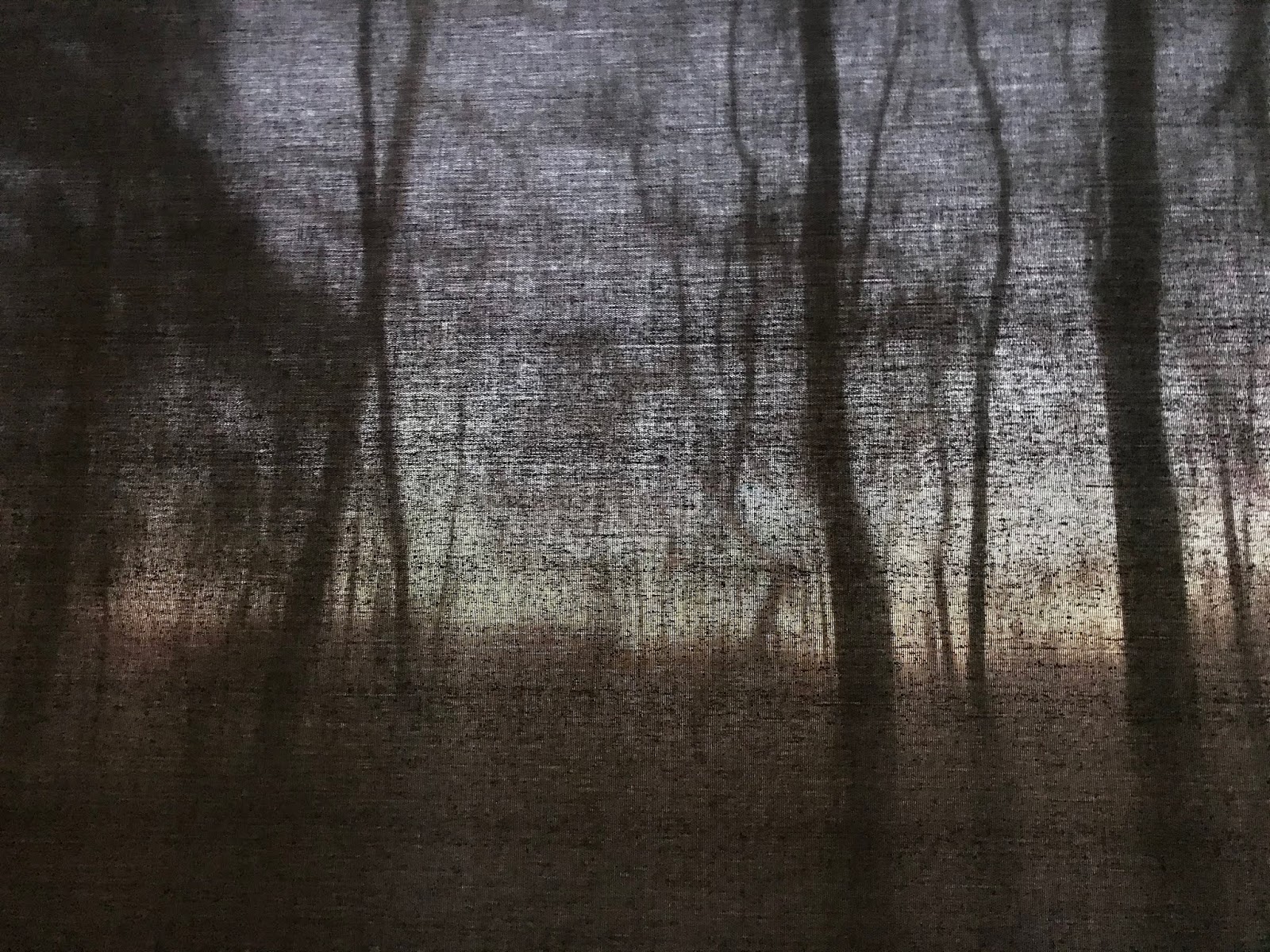
Yesterday I heard a peep, bright and insistent. It was a sparrow roosting in the bamboo that flanks the west side of the house. The little bird found a good place to shelter.

Our bamboo grove is a mass of leaves and stems, lush and green, some bending, many still upright. I look into the tight center of it all and remember the joy of hidden places, of climbing under the forsythia when I was young, of entering the cinder trail (below) as recently as last Saturday.
It is the human need for enclosure, for a safe spot from which to peer out at the rest of the world. It’s Robinson Crusoe and his protective hedge, or our Neanderthal ancestors in their secluded cave. We don’t always need it, or always seek it out. But it’s good to know that it’s there. 
Battling Ants

Battling Ants

For several months, we’ve been engaged in a valiant fight against tiny ants that have taken up residence in the kitchen. Several times they seem to have been vanquished — only to return a few days later with reinforcements.

I have no problem with ants as long as they stay outside. Let them have their ant hills, their cooperative societies, let them lug crumbs around on their little backs. But once they invade my house, I’m going after them.

The problem is, nothing seems to help — no vinegar, diatomaceous earth, no home remedy. Various over-the-counter poisons sideline the critters for a few days … then they come marching back — not two by two, as the song says, but just as resolutely.

I’m always a little loathe to call in the professionals, whose remedies, I fear, may be worse than the problem itself. But on Friday, I’m officially giving in.  This has evolved from a skirmish to a battle. By the end of the week, it will be a war.

(Hoping there’s not something like this under my house.)

September Song

September Song

Here’s what our recent weather makes me think, and it’s something I think often this time of year in the Mid-Atlantic: that if you’ve been very good and borne up well under summer heat and humidity, September gives you days like these: languid and bright with pleasantly warm noons and lovely cool evenings.

I savor each brief hike, each long, languorous stroll with Copper. I wake to air cooled not by a machine but by night itself, as window fans pull in the loamy coolness and send it swirling around the house.

I know the rains will come, the leaves will tire, turn and fall. But not yet. These golden days are like a love duet between two seasons. They’re a September song.

Writing Outside

Writing Outside

The far end of the new lounge chair was already exposed, so I whipped away the rest of the waterproof green covering, brushed off the acorns that landed overnight and raised the recliner to the proper angle for writing.

The air is moist with the fullness of summer. Also summer-like is the background music. Crickets sing the sostenuto line, and wrens and sparrows chirp a tremolo. Bluejays screech, and in the distance a crow caws. 
Now the wind has picked up and leaves are stirring. A distant lawn mower whirrs, and a low plane thrums. It strikes me that today’s white noise is not unlike yesterday’s artless arrangement of fall flora: beautiful in its randomness. 
Shaggy Beauty

Shaggy Beauty

A cloudy walk on the Washington and Old Dominion Trail bridle path. Or at least I call it the bridle path. It’s the cinder trail that runs alongside the main paved road.

Taking it meant I could avoid the “On your left’s” that would surely have been the soundtrack of my walk had I jockeyed for position with the speeding cyclists who cruise up and down the 26-mile ribbon of asphalt on weekend mornings.

The road not taken was just right for the day. I had a close-up view of the autumn foliage, the goldenrod and chicory and wild clematis cascading over greenery. It was a shaggy beauty —profuse, casual, easy on the eye.

Farewell, Express

Farewell, Express

Yesterday I picked up the Express newspaper offered to me by our Vienna hawker Bobbie. I don’t always get this abbreviated, tabloid giveaway version of the Washington Post. But when I don’t have the parent paper or something else to read, I pick it up. And I always take it if Bobbie offers it to me. He’s a kind soul whose feelings might be hurt if I did not.

But sometimes when I do have the parent paper and Bobbie holds out the Express, I pick it up … then gently place it on top of the trash can at the entrance to Metro. I don’t throw it away — no one has read it yet! — but I do put it up for adoption.

That’s what I did yesterday, not even glancing at the headline. Then, on the way home, I saw a copy of Express someone had left behind on the bus. “Hope you enjoy your stinking’ phones” said the headline, which caught my eye, then below, the small print: “Add Express to the list of print publications done in by mobile technology. Sadly, this is our final edition.”

As you can tell, I’m not an everyday Express reader, but I’m a common-enough one to mourn its passing. There was an irreverence about it, and it was informative, too. Now, another print publication bites the dust, 20 journalists lose their jobs, and a community culture goes away (because Express hawkers drew commuters together).

I’ll let Express have the last word here. This is from a small item on its inside front cover:

Nation Shocked! Shocked!
Traditional print news product abruptly goes out of business
In news that scandalized a nation, The Washington Post Express abruptly shut down Thursday, citing falling readership and insufficient revenue. Apparently, everyone riding the D.C. Metro now looks at their phones instead of reading print newspapers. Express editors will miss the newspaper and its readers very much. It has been a pleasure and an honor to provide commuters with this daily dose of this odd news.

Foot Traffic

Foot Traffic

We are mothers and fathers, sisters and brothers, daughters and sons. We are accountants and writers, baristas and producers. But mostly … we are two legs at the bottom of which are two feet.

That’s what matters in the morning. That our feet propel us up the escalator and into the street, where we stride and sidestep, move from conveyance to office. 
Every morning there are slight deviations:  the blaring of a siren as a fire engine rushes past us on 18th Street, the sound of jackhammers as a building is demolished on Crystal Drive. We must wait at the corner, skirt around the window-washers. 
Some days we move quickly, there is a spring in our step. Other days we find ourselves dragging. But the movement is ineluctable. The current moves us ever onward, forward to our days. 
Contemplative Tasks

Contemplative Tasks

A walker in the suburbs spends a lot of time thinking. So does a writer in the suburbs (or the city, depending upon whether I’m working at home or at the office).

I think best, though, when I’m doing something else. And I was thinking the other day (see?!) about how certain tasks are perfect for contemplation.

This will come as no surprise to monks and nuns who pray ceaselessly whether they’re hoeing a field or baking a fruitcake. They’ve long since realized how much physical labor lends itself to thought and prayer.

Walking, of course, is one of the most contemplative occupations, which is a large part of why I do it. Others include weeding, mowing, sweeping and ironing.

Each of these deserves its own post (and some have them), but I’m focusing today on what they have in common, on the pulling and the stretching, the pounding and the smoothing — on all the repetitive motions that exercise the muscles so the mind can roam free.

(Once freed, a mind can go anywhere.) 

Waiting Time

Waiting Time

A return to the hospital. It doesn’t matter which one. Inside, they are all the same: a world of their own, bright of light and cool of air. If you’re lucky, you find a quiet corner to wait. It will be near an electrical outlet and away from a vent, because when air is 63 degrees, it’s better if it’s not blowing in your face.

You will get busy with the work you brought, not only because it must be done but also because it tethers you to the outside world, a world that vanishes the minute you enter the lobby with its quiet hush. 
There will be no clocks on display in the waiting room. At the nurse’s station, however, a large round analog version with numbers written in a clear black font looms serenely over the scene. 
You realize then that clocks are signs of power. Those who have them are those who are responsible to them, those who have something to do. You, on the other hand, are only waiting. 
Planking Alone

Planking Alone

A crowd of people in my office have begun a 30-day planking program — holding ourselves up in a “plank” position, either on elbows or hands. We began at 30 seconds and are working our way up to three minutes.

At 11 a.m. every day we gather in the hallway near the elevators to chat and hold. Thirty seconds of planking isn’t much. Three minutes is quite a lot. Adding seconds in small increments attempts to blunt the difference between these two.

This works best when done in company. Someone plays music on their phone, or we share recent celebrity sightings. Someone saw Justice Ruth Bader Ginsburg in the Philadelphia train station. Someone else bumped into the heir to the British throne — that is, literally bumped into Prince William. Twice!

When I’m not in the office, I plank on my own.  I set my phone to two minutes 10 seconds or whatever the time might be, get down on the floor, suck in my gut and hold … and hold …. and hold.

I try not to watch the seconds tick down on my phone timer, but I can’t help myself. Alone in my living room, I’m ready to collapse, to pause briefly, anything to end the pain. As I watch, the seconds seem to move in slow motion, a painfully stilted procession that will never, ever finish.

Want to make time pass more slowly? Just plank alone.