A Windfall

A Windfall

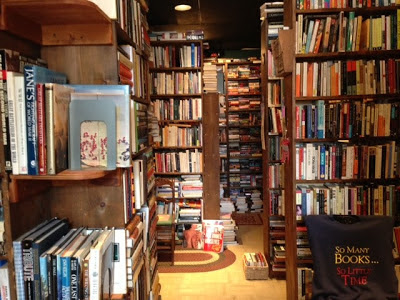
The Fairfax County Library system has many benefits, chief among them the fact that I can order books online and pick them up at my branch — not a high-tech offering, I’ll admit, but a generous and handy one.

Of course, this means I usually have more books on my nightstand than I can possibly read and must stay on top of a wide array of due dates. It’s a task I’m more than happy to undertake given the pleasures it provides.

Usually I have a little slip plus an email reminder that tells me when the books are due. But this time the email failed to arrive, so I went online to check the due dates. And lo and behold, I found a brand-new catalog and extended deadlines — two weeks longer! — for the three volumes I have.

Though I know the extension is due to the new catalog, it feels more like an early holiday gift for those of us whose reading eyes are bigger than our stomachs. It’s positively a windfall — and I’ll enjoy every (extra) minute of it!

Foggy Memories

Foggy Memories

A foggy dawn has given way to a partly cloudy — wait a minute, make that sunny — morning.  But my head is still in the clouds as I remember great fogs I have known.

There was a stretch of misty weather in Chicago long ago, unseasonable November warmth that steamed up the city’s windows for days. I walked from my house to the corner where I met my ride as if in a dream, passing stately homes and the distinctive domed church on Deming, pretending I was in Europe instead of the Midwest.

And then there were the pea soup fogs in Arkansas, so thick they made it impossible to drive the 25 minutes from Petit Jean Mountain to Morrilton. Since there were very few services on the mountain, a few days of fog created a desert-island feeling.

Finally, there were the fogs of my youth, which swirled around the big oaks in the Ware Farm behind our house, making those open fields look haunted and lonesome. The farm is filled with houses now, of course. But through the miracle of memory, the fogs and the fields are there for me whenever I want to see them.

Train Spotting

Train Spotting

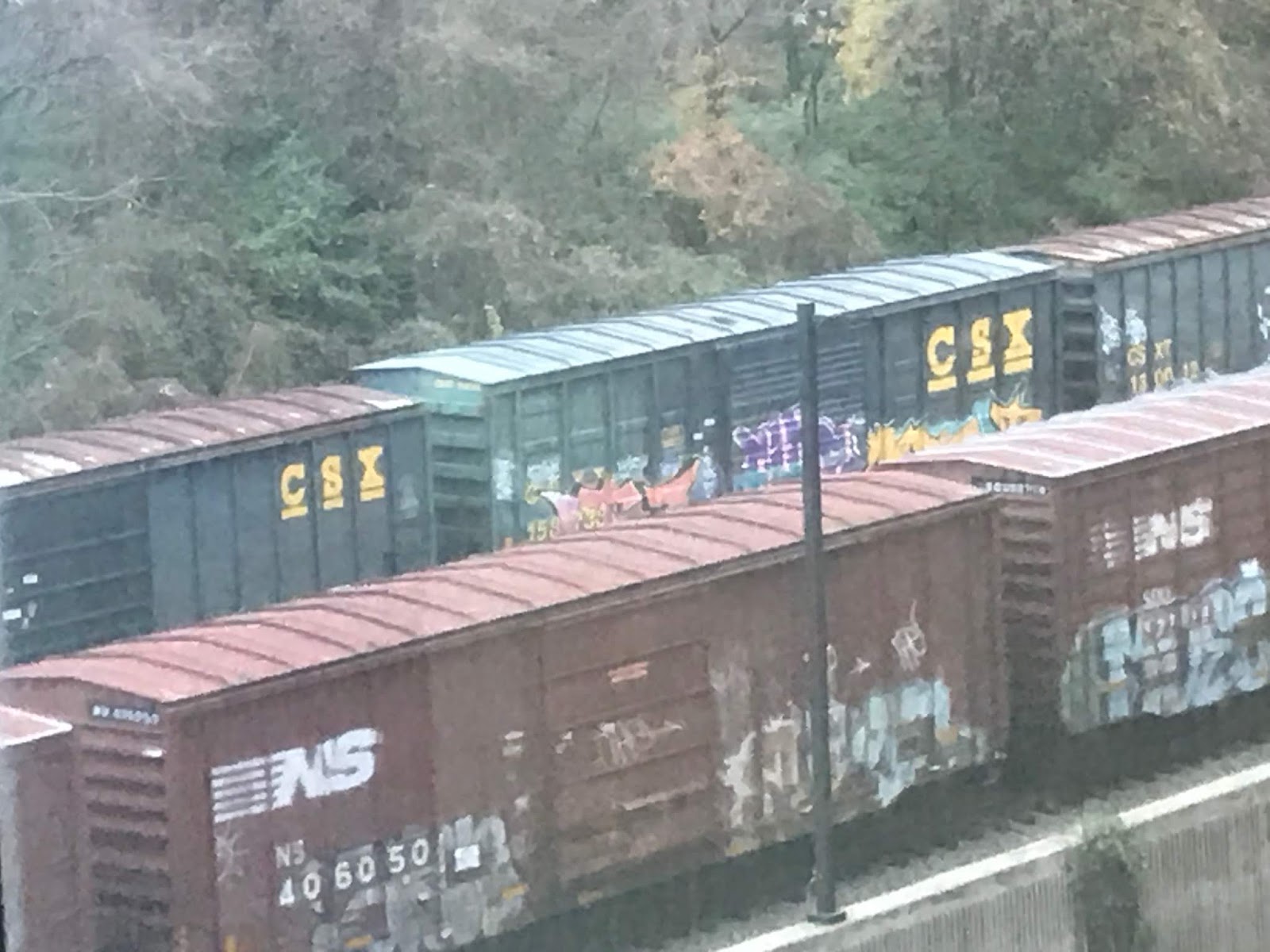
The windows of my new office overlook the main north-south railroad line in the eastern United States. So as I conduct interviews and write articles, I keep one eye peeled for the sights and sounds of a passing freight or passenger train.

Whether it’s the Virginia Railway Express commuter line (one just zoomed by!), the quicksilver flash of an Amtrak engine heading up the Northeast Corridor, or one of the lumbering freights that seem to go on forever, I find this new pastime more than a little distracting.

Usually, the work of the day creates a vortex on the other side of the glass, and there could be a circus train chugging by and I wouldn’t have time to ogle it. But early or late, when my eyes are prone to wander … do I ever have a lot to see!

On Looking

On Looking

In her book On Looking: Eleven Walks with Expert Eyes, Alexandra Horowitz asks us to look at the world with the wonder of a child and the expertise of geologist, entomologist, illustrator or other professional observer.

Horowitz’s simple and elegant argument: that we cease to really see the world we inhabit because we become so accustomed to it. Through a series of strolls with those trained to see what we do not, Horowitz urges us to “look, look!”

In one of my favorites so far, she ambles with the typographer Paul Shaw. He points out the text on a manhole cover, ghost writing on the sides of buildings, and always and everywhere, the type itself: the thickness of a serif, the placement of a crossbar, and the humanistic qualities of the letters, a “long-legged” R and a”high-waisted” S. After a few hours of this, Horowitz realizes she “had been blithely walking by undiagnosed lettering disasters my whole life.”

But after her stroll with Shaw, she sees not just the words but the letters that compose them. “Walking back to the subway, I glanced down at my feet as I crossed the street. Look was painted on the sidewalk where I stood. I will — but I feel sure that now, my vision changed, the letters will find me.”

Standing their Ground

Standing their Ground

At first I worried that something was wrong with the crepe myrtle trees. Their leaves shriveled quickly, as if caught so suddenly by the cold that they didn’t have time to turn, loosen and gently fall to earth.

Then I noticed other trees, other species, with the same condition. This isn’t a disease. This is the crazy Arctic air that’s come south to taunt us.

These trees were minding their own business, heading gently through the season. They were captured still green and growing, led into winter with handcuffs on. At least they put up a fight.

Because yes, it’s reasonable to accept the seasons in one’s climate, place and lifetime. But sometimes it’s necessary to say no, this won’t stand. To cling to what is ours.

Salvation in Place

Salvation in Place

In his essay “Seven Days in a Sea Creature Town” in the November issue of The Sun, Poe Ballantine names periods of his writing life. There was the Diligent Typing Period, the Terrible Imitation of Southern Gothic Period and the Drunken Daydreaming Period.

By the time he was writing this essay, he was in his Geographical Salvation Period, which he defines as a belief, common among Americans, that “finding the right place to live  — someplace with a beautiful view, or nearby beaches, or casinos, or wonderful weather, or, in my case, an idyll straight out of a Normal Rockwell painting or pastoral boyhood story by Mark Twain — will solve the majority of your problems.”

Ah, I can relate. I had a “place thing” for a long time, probably still do, if you want to know the truth. One of the reasons I started this blog was to explore the concept of place in the suburbs, which can be covered fairly quickly if you listen to some folks.

One of the lessons I’ve learned here is that place is as place does. In walking we belong. And in belonging … we have place.

A Night at the Office

A Night at the Office

It was a late day at the office. Which didn’t mean I was there until the wee hours, only an hour and a half later than usual, just long enough to label, transfer and prune some MP3 files that had been filling up my voice recorder.

My attention had been riveted by the screen for a couple hours, that and my inner ear, where voices from interviews I conducted months ago replayed through an earphone. It’s a strange thing, listening to voices heard only once and trying to figure out who they are. It was an interior exercise, a journey into memory, aided by last year’s day planner and typed notes.

But back to the matter at hand, which was the long day, the tedious task, and then, finally, completion. I clicked off my computer, packed up my things — and only when I stood up to grab my coat did I look out the window.

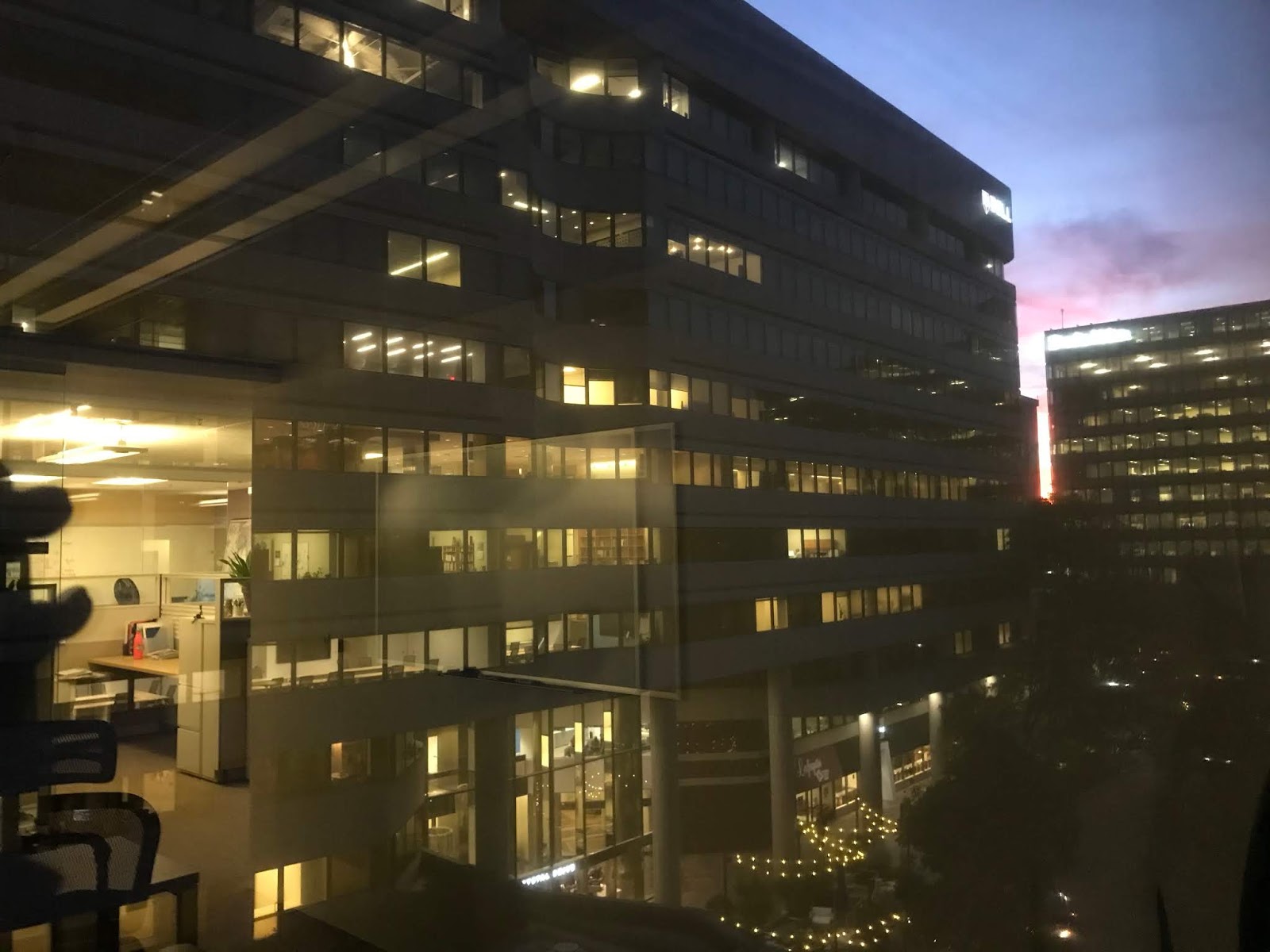
And there, spread out before me, was a magical sight. Offices that are drab brown and inscrutable in daylight were all lit up at night. What was normally invisible was suddenly seen. I marveled at the lights and the reflections. I marveled also at the comfort they brought. And that’s when it occurred to me, something I know but too often forget — that we’re never alone in our toil. Even when we think we are, there are countless others who are close by, working along beside us.

Snowflake Spotting

Snowflake Spotting

Snowflakes were spotted yesterday, and the temperature never rose about the “high” of 37 that greeted me when I woke up. It’s Arctic air, the weather people said, and I wonder: Does Arctic air feel colder than plain old winter air?

Today I’d have to say yes. That may be because it was 15 degrees when I woke up and there’s a stiff breeze out there, too. Emerging from the Crystal City Underground felt like a slap in the face. Even just a few hundred feet of exposure was enough to send me shivering inside.

But the sun is bright and a big old moon was still up this morning when I walked Copper across the frost-stiffened grass. We’re moving closer to solstice, so ’tis the season for shivering. Which is just what I’m doing now.

(Caution: Snowflakes in the window may be smaller — and less real — than they appear.)

Smell of Burning Leaves

Smell of Burning Leaves

Yesterday’s walk through the fading light of a late fall afternoon reminded me of what has been missing from the season. I caught a whiff of it when I rounded the corner. It was that autumn elixir — the smell of burning leaves.

Its source was unknown — and even if it wasn’t, I would protect its identity, since the practice must surely be illegal. In fact, I hesitate to mention it at all with California burning.

But neither illegality nor political incorrectness can erase the fact that I love this scent, that it fills me with both poignance and peace, an unlikely pairing that takes me right back to childhood.

I would have been playing all day in that scent, would have been jumping in those leaves, in big crisp piles of them before they were set to smolder. And soon I would be walking back into my mother’s kitchen, not my own. And it was the promise of that warmth and closeness that contrasted so perfectly with the lonely fragrance of ash and oak.

This, along with the scent of tobacco wafting from the big auction houses on the west end of town,  were the “smell-scapes” of my Kentucky childhood.  I don’t smell either of them anymore.  But they’re there. All it takes is the whiff of burning leaves to bring them back.

On Veteran’s Day

On Veteran’s Day

It’s impossible not to think of my favorite veteran on Veteran’s Day, so Dad will be much on my mind today. And, because it is a federal holiday, I’ll be able to drive into the office and back, creating a more “flow” commute than usual. Beyond these realities, what’s on my mind this Veteran’s Day is that this dear country, which so many have fought and died for, needs us in ways it never has before.

When my son-in-law took the oath of citizenship last August, he pledged to support and defend the Constitution against all enemies, foreign and domestic. Those of us lucky enough to be born here never take such an oath, unless we serve in the military or other public service. But I think many of us would go to great lengths to make this nation a less divisive place.

So what can we do? Maybe something that’s not very complicated. Something that doesn’t require signing up or shipping out. Something like this: that we try every day to understand those on the other side of the political divide.