Forest Bathing

Forest Bathing

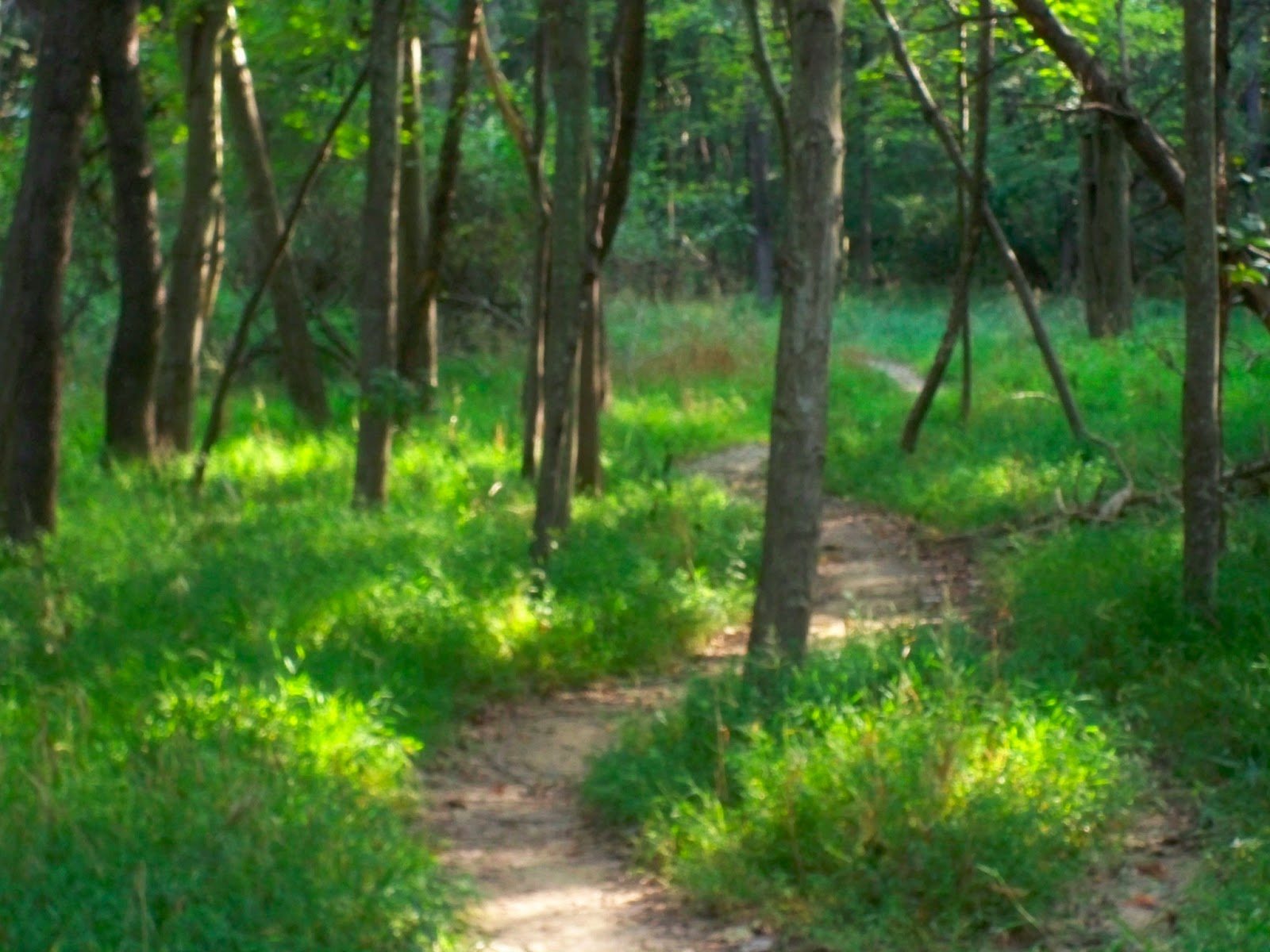
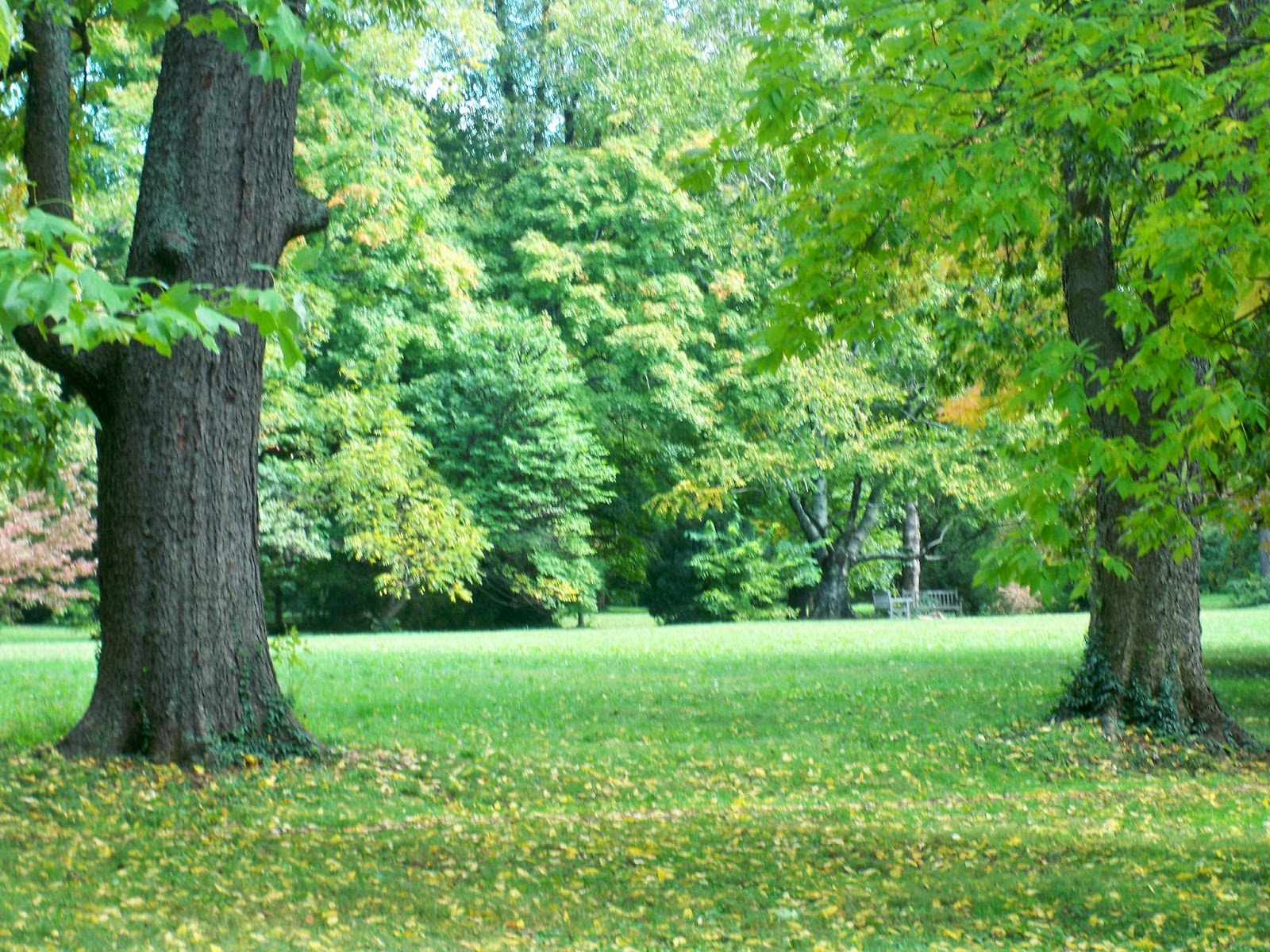
Shinrin yoku — Japanese for forest bathing — is the practice of immersing one’s self in a forest or other natural environment to relieve stress. Practitioners walk slowly through the woods, marveling at the shades of green.They aren’t there to bike down a hill or hike up a mountain. The journey is their destination. It is enough simply to be outside, to inhale the scent of pine.

I like the imagery involved, the idea that one can slide into a forest as if into a tub of warm water.  That its beauty will surround and calm and lift up.

A walk in the suburbs is not always a bath in the forest. It’s too fast, too purposeful. Often, there are no forests involved.

But even the briefest and most cursory stroll works its magic. I leave the house with fists clenched, brow furrowed. I return renewed and refreshed, reminded that we are not just creatures of rooms and screens. That after all, we are born of earth and will return to it, that every visit there is going home.

Science and Miracles

Science and Miracles

“We are not sure if this was a miracle, a science or what,” wrote the Thai Navy seals of the rescue they had just brought about. I would say the recovery of the 12 boys and their coach from a Thai cave  was all of the above, first the miracle, then the science, then a mishmash of both.

That the world’s attention could be riveted on those 13 unfortunate people, that help could flow in from all corners of the globe, is in itself miraculous. We’ve gotten used to these stories, a little girl falls down a well and we will move heaven and earth to retrieve her, that the wonder of it all, that one story so captures our imaginations that it leaps out from every other shred of news, can be overlooked. But it is a wonder.

And then there was the technical cooperation required to mount the rescue, the assembling of people and equipment, the science part, the daring escape. I think about my own limited caving experiences — crawling between two large slabs of rock in the dark, the beam of my headlamp on pocked stone, thinking all the while what it would be like to be pinned between them. No wonder we marshaled every bit of expertise we could to help the youngsters.

And finally, there is the communal joy that is bigger than politics, bigger than soccer, bigger than national pride. That’s miraculous too.

(Photo: Wikipedia) 

On the Way Home

On the Way Home

We file out in khaki and denim, in summer cottons and linens. Battalions of commuters on the march, back from our first day after long weekends and festive 4ths. Back to the artificial chill of the D.C. cubicle. Back to the train and the bus, to waiting in the swelter.

Leaving Vienna yesterday, I spot a happy Metro employee. He’s wearing short sleeves, bounces when he walks. The trashcan he pushes has wheels and makes a sound on the tile floor not unlike a train clacking on its rails. He walks against a sea of commuters.

We are the tired ones, worn out from our office jobs, from moving the mouse, from having the meeting. He looks fit and happy and ready to go.

I hear his clickety-clack as I move out of the station, into the early evening, and my car. I want to compare our lives but I have no way to do so. He is moving one way, we are moving the other. That’s the story.

Long Drive

Long Drive

The long drive begins like any other: settling into the seat, snapping on the belt, adjusting the mirror. And for the first few hours, it feels like any other, too: staring at the road, flipping through a newspaper (only if you’re not driving!), munching on cereal or pretzels.

But the long drive quickly asserts itself in the mind and body. An exit that would normally herald a resting place is just a milepost, barely a quarter of the way into the trip. The hopeful slant of morning sun quickly fades into the desolate phantom-puddled pavement of mid-afternoon. And as darkness falls you are still far from home.

The long drive is made bearable by good company, by podcasts — and, of course, by snacks. Cereal in the morning, pretzels in the afternoon, an apple, a Snapple and Fresh Mint Tic Tacs, which prop open even the heaviest of eyelids.

The best part of the long drive is the final few feet, pulling into the driveway, hearing Copper bark, knowing a bed — a familiar bed — is waiting upstairs.

Far-Flung

Far-Flung

In St. Louis for a family wedding, I find myself thinking about place, about generations placed and unplaced, about the difference it makes.

Families that began in Indiana and Kentucky spread to Arizona, California, Colorado, Florida, Idaho, Illinois, Maryland, Missouri, Montana, New York, Oregon, Texas, Virginia, Washington, Wisconsin — and I’m probably forgetting a few.

It was bound to happen when transportation became supersonic and communication became instantaneous, but do texts, calls and jet planes fill in for the shout down the street, for Sunday visits?

People leave for college, for jobs, for opportunities, for fresh starts. It’s how we’ve live now.

It’s just changed us, that’s all.

Grading Copper

Grading Copper

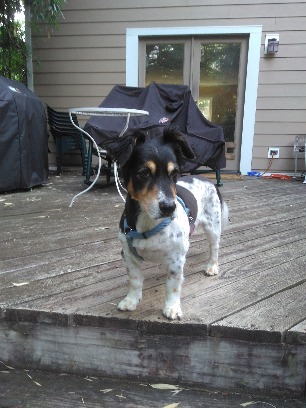
Such is the nature of our times that not only do we receive “Service Feedback” emails from the dog sitting outfit caring for Copper and the parakeets, but the emails also contain photos.

These give me a taste of the current childcare scene, of nanny cams and hidden cameras. The general atmosphere of surveillance that overlays this line of work. It’s a little bit about checking up on and a lot about missing.

Yesterday’s email was a surprise, as was Copper’s “grade” of “B,” which though “Very Good” was not, obviously, good enough. I’m assuming he missed an “A” because he was “a bit testy” during breakfast.

Did the sitter hover too close to his food bowl? Was blood drawn?

I’m hoping the answers to these questions are “no” and “no.” And I was relived that this morning’s email contained an “A+” rating. Copper “was more interested in snuggles than food.” He’s lonely, poor guy. But at least he’s behaving himself.

(Photo: Becky’s Pet Care)

A Day, a Diary

A Day, a Diary

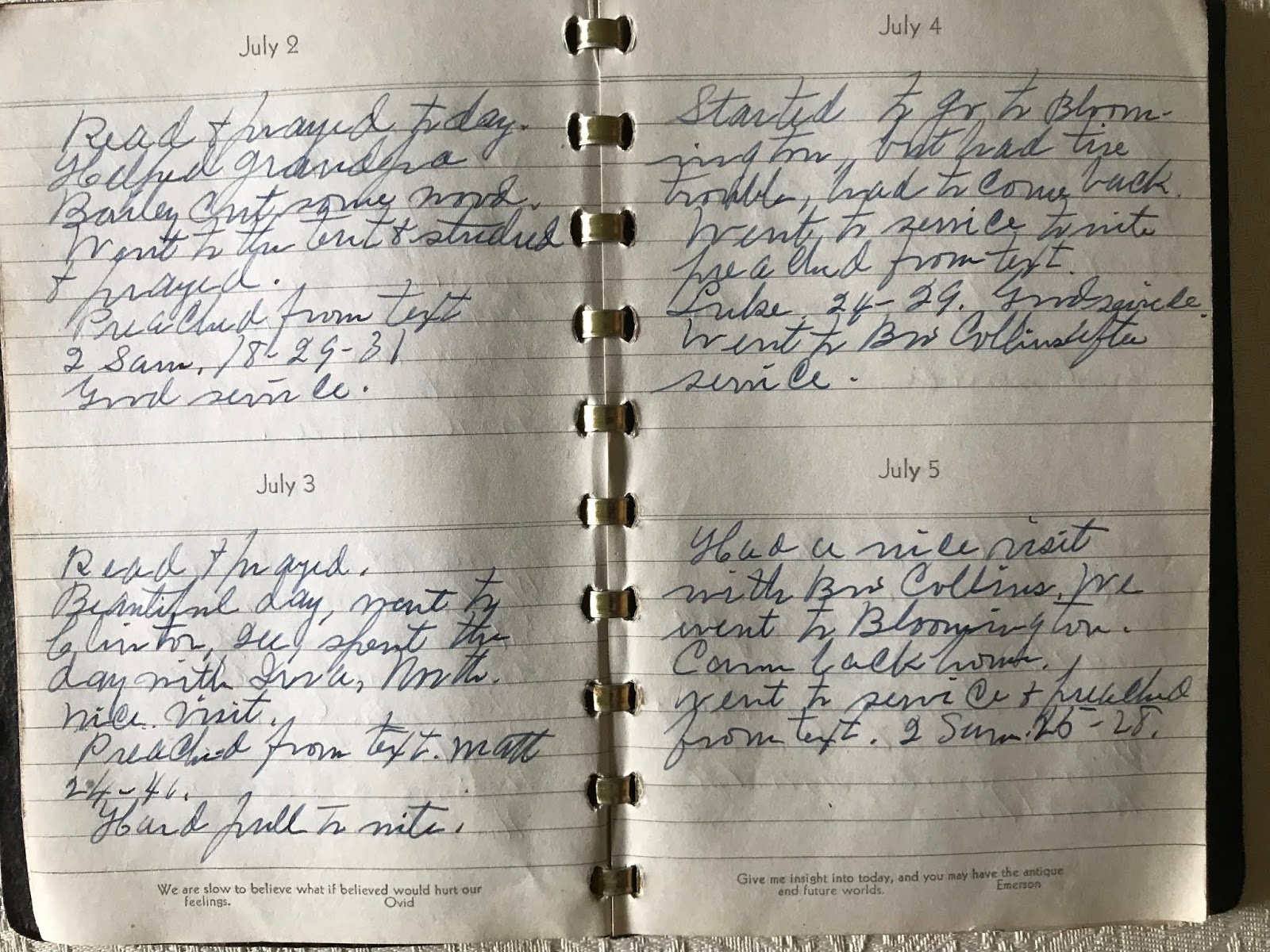
I found an old journal in the back room of my parents’ old house, my grandfather Cassidy’s diary from 1940. This is my father’s father, who I never knew; he died before I was born. He was a Nazarene preacher, and much of this diary records his prayer habits and the texts he preached from.

On this day, 78 years ago, the tent was in or near Clinton, Illinois, and his sermon came from 2 Samuel 25-28:

“I pray you, forgive the trespass of your handmaid: for the Lord will certainly make my lord an enduring house; because my lord fights the battles of the Lord, and evil has not been found in you all your days.”

Many days began with reading and praying. There were walks, helping friends cut wood, marveling at the beauty of the day.

My grandfather followed his calling even though his family, my father then a young man, were far away. I’m not sure what they lived on, how they made it. But somehow, they did.

The world is a different place now, but the pages in this diary are as crisp and clear as the day he wrote them. At the bottom of each page, a quotation. This one is from Emerson: “Give me insight into today, and you may have the antique and future worlds.”

Yankee Doodle Dandy Day

Yankee Doodle Dandy Day

In honor of Independence Day,  I’m running a post from July 7, 2010. I wrote it shortly after Mom and I watched the movie “Yankee Doodle Dandy.” That was Mom’s way to celebrate the 4th. And today I’m thinking about her … and even further back, to the time of George M. Cohan, a time of innocence and optimism.

A return to innocence may be a stretch … but on this July 4, 2018, I’m pulling for a return to optimism:

Here’s the post, slightly edited:

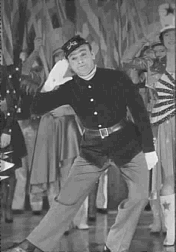
The firecrackers aren’t yet snapping and the flags aren’t yet flapping. What I’m thinking of is James Cagney as George M. Cohan in “Yankee Doodle Dandy.” I can’t stop humming “It’s a Grand Old Flag,” “Over There” or “I’m a Yankee Doodle Dandy.” And I can’t forget the sight of that powerful little man going into one of his tap-dancing riffs. He is the essence of jaunty, of sticking out one’s chin and plunging into life. Was our country ever that innocent and optimistic? I replay the final scene of that movie, Cagney dancing down the steps of the White House after telling his life story to President Roosevelt, and I think yes, maybe it was.

Traffic Calming

Traffic Calming

At first I didn’t know what was happening to one of my main commuting routes to Metro. There were big trucks and construction crews and the beeping and honking and disruption that comes with them.

There were detours, too, new ones each week, it seemed like. One day we would all be driving on the left side of the road; the next week we’d all be driving on the right.

At some point, though, the point of this became clear. There was no repaving in the works, no new road or ramp. Instead, there was a traffic calming island — a roundabout to nowhere — being installed. This was all about slowing us down, “calming” us.

I noticed today that the little roundabout is even being landscaped. There’s a baby tree and some plantings to make us even calmer as we add a few more minutes to our lengthy commutes, as we slow down enough to navigate the thing, then immediately speed up as we pass it.

The traffic may be calmer (though I doubt it), but the drivers (at least this one) are not!

Natural Cool

Natural Cool

We leapt from a rainy June to a sizzling July, and are now measuring the heat index instead of the precipitation.  On my slow walks this weekend I sought the relative cool of the shady stretches that line Folkstone Drive.

Is there any cool better than natural cool? I know what the air conditioning devotees will say. Of course there is. It’s the cranked-down chill of a 72-degree office or living room. And don’t get me wrong. On days when the mercury climbs toward 100, it’s mighty nice to step inside a well-chilled house.

But there is also something to be said for the deep woods, for ferns waving in a slight breeze, for soil that is still a bit moist from last month’s downpours, for a creek gurgling in the distance.

For sections of road where tree branches lace overhead and spread their shade to the pavement below. For old houses with thick walls flanked by tall oaks.

There is something to be said for natural cool.