Refuge

Refuge

It was not an auspicious way to leave for a beach vacation, pelted by rain, a tornado watch blaring from the radio, wind buffeting the car — but it was what I could salvage of summer when my work was finally done, a few days at the rag-tag end of August.

But ah! It brought me here to the Refuge. Just me and a bag of books, a bike, a bathing suit and towels.

Refuge: a place of safety, a protected place, a sanctuary.

It is what we hope to find at the end of a weary year. Insects humming, surf pounding, gulls crying. But all of these sounds mingling somehow to a dull, peaceful background roar. A place of rest. Active rest, but rest just the same.

Dry Season

Dry Season

We live in a part of Fairfax County laced with runs and rills. Last fall, torrential rains swelled these small streams into wide rivers that spilled across our narrow lanes, taking tree limbs and other debris with them.

You wouldn’t know that now. Most creek beds are bone dry; the deepest are only a trickle of their former selves. This is not good news for the water table, but it is a boon for the walker.

Routes without bridges, paths that lead to narrow log crossings (or none at all) are now open for business. For the last two weeks I’ve been walking trails I hadn’t walked since 2007, when, in an attempt to ford a stream, I pulled myself up with what turned out to be poison ivy vines. (I somehow grew up without knowing that the second half of the rhyme “leaves of three, let them be” is “only a dope would touch a hairy rope.”)

But this summer I can easily cross that stream on a concrete spillway that is usually under several feet of water. And this opens up an entire network of trails through woods and along country lanes. 

 The dry season reveals worlds that are invisible under high water.

Capitol Hill Walk

Capitol Hill Walk

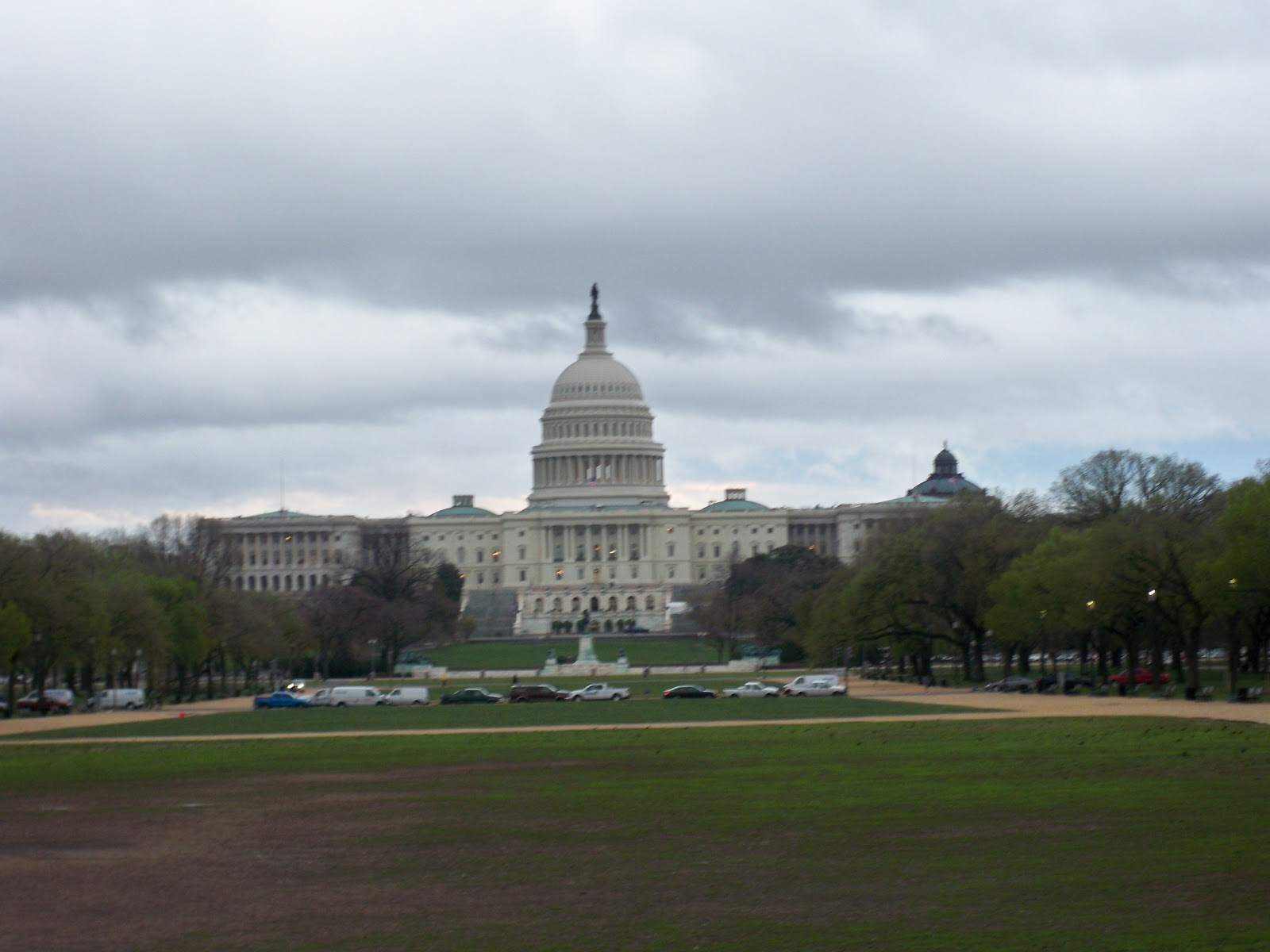
A lunchtime stroll up New Jersey Avenue to the Capitol, the grounds and plantings and pleasant vistas of which (I now realize) are thanks to Frederick Law Olmsted. Now that I’ve read his biography and learned this fact, I think of him often when I walk by. No wonder my eyes rest so easily on the west front, are led so capably to the dome. He planned it that way.

But the Capitol was not my destination. I walked around it to East Capitol Street, past the Folger and down the shady brick sidewalk to Lincoln Park.

If Mall walks are about the grandiose and the touristic (the grand edifices of the National Gallery, Natural History and American History Museums), Capitol Hill walks are about the domestic and the personal. Artful arrangements of zinnias and marigolds; the fluttering miracle of an overgrown butterfly bush; a fountain accessorized with a kitschy artificial deer (out here in the suburbs we have enough of the real thing, thank  you very much); and dry cleaners, markets and drug stores tucked away on inconspicuous corners (no tacky neon signs here).

My mind wanders: If we lived here, I could walk to work. We would mow our grass with a push mower, grow roses and herbs in large clay pots. And that balconied turret, that’s where I’d write.

The Capitol Hill walk is also about fantasy.

A photo of the Capitol that is old and out of season and that convinces me to bring my camera along the next time I take a lunchtime stroll in the city.

A Year Ago Today

A Year Ago Today

It was an ordinary late summer afternoon, silky air, the sort of day you wished you didn’t have to spend inside. And, as it turned out, many of us didn’t have to.  Because at 1:50 p.m. we were turned from our homes and offices onto the street by a 5.8 magnitude earthquake.

Though we later learned we should have sheltered in place under our desks (ignoring every protective instinct we had), we headed outside.  And for the next few hours the streets of D.C. were filled with panicked and then (once we got used to the idea) bemused office dwellers.

I had leapt from my chair without purse or cell phone but (strangely) with the Diet Coke I was holding when the building began to shake. For the next hour I frantically tried to reach family members on borrowed phones. At home I found broken china and a closet ankle deep in photos, papers and clothes that had been shaken off their shelves.

The earthquake happened a year ago today. A year of record heat and drought — with the occasional hurricane and derecho thrown in.

The tremblor seemed strange at the time. But strange is becoming commonplace.


The “D.C. Earthquake Devastation” photo that made the rounds on the Internet last year.

Picture Postcard

Picture Postcard

I am a sucker for the post card shot. The off-center, the too-close, the out-of-kilter — these do nothing for me.

When it comes to landscapes, I have a middle-brow sense of composition. Give me blue skies, puffy clouds (see yesterday’s post), a road winding in the distance, fir trees in the foreground, and I’m happy. Even if there’s a bit of blurring (because, say, the picture was taken out of a car window at 50 miles an hour).

This is a photograph of Glacier National Park, snapped on a vacation there  a few years ago. It made me catch my breath then. It still does.

Cloud Post

Cloud Post

Though I’m sitting at a desk staring at a screen, in my mind’s eye I’m surveying clouds. I’m lying on a deck chair, as I did on Saturday. My hands are laced behind my head, and I’m marveling at the puffy cumulus clouds that float across an impossibly blue sky.

Maybe I was just short on imagination that day, but I spied no particular shapes. No castles, dogs or sinister faces. I saw just the clouds themselves, and that was enough. I looked at them for what felt like hours but was only minutes. Still, it was long enough to get lost in their alabaster swirls, their tufted promises; to swim recklessly from one to the other across the fathomless blue.

The clouds were both companionable and regal. Looking at them long enough I wondered what it would be like to be a part of them. It would mean I’d be drenched, of course, but if by some miracle I could remain dry, and I could fly without fear to the outermost thin trails of cirrus, what would the green world look like underneath? How verdant? How insignificant? How much like home?

Photo: Weather report.com

Caught in the Web

Caught in the Web

The woods are full of webs these days, spun silk across the path, invisible until breached (which of course is the point) and therefore impossible to avoid. Built by aerialists for aerialists, they don’t bother our fern-high hound.

But for me, the biped, they are an annoyance, tangling themselves in my hair and sticking to my arms, legs and face. I tried swinging a stick in front of me as I walked, but felt ridiculous.

So I decided (without formally deciding) to accept the webs, to brush them off as I stroll, to apologize silently to the forest as I unravel its delicate stitchery, knowing this is just one way among many that I alter — just by moving through it — the woods I love.

Among webs’ many annoyances is the difficulty of photographing them. At least I snapped the perpetrator in this shot.

Timber!

Timber!

Once you look for them, they’re everywhere. The giant oaks that give our neighborhood much of its character, that shade us in the summer and through whose branches the winter wind blusters and moans — these trees are dying.

We have two dead trees in our yard now; we’re waiting for the winter discount rates to take them down. But we’re not alone. On my walks through the neighborhood I spot more dead or dying trees than I can count. It’s the drought, arborists say. Or it’s simply their time.

Dead trees have been in the local news recently, too, since a 140-year-old oak with root rot blew down in a storm, crushed a car and killed its driver. This sparked a search for other ailing trees on state rights-of-way. And now chain saws are buzzing all over Fairfax County.

I drove past a work crew yesterday at an intersection where I often stop. What used to be closed and private is now open and exposed. It’s safer now, that’s true. But it has lost its character.

What We Did on Our Summer Vacations

What We Did on Our Summer Vacations

As one’s children grow up and out, as friends and boyfriends become a center of gravity, as one’s own career demands make travel difficult, there comes a point — often unknown till it’s past — when the family vacation is over.

This does not mean it will never come again (she tells herself optimistically). But if it comes again it will be in a different form, often atomized (two of us visiting a third) and not all of us together again until people are older and more settled.

So for now, for us, the family vacation season is over and the just-for-two vacation season hasn’t yet begun. It makes me sad to admit this, but I can’t complain. We’ve had a good run. Together we’ve seen much of this country, have sampled Canada and even once ventured across the Atlantic. The glories of the Grand Canyon, Big Sur, Yosemite (where Claire turned 16) and the Maine Coast (where Claire turned 17 — ah, the inconvenience and the privilege of the summer birthday) were all ours to share.

This summer two of us went to Montana, another went to Africa and one is leaving today for the beach. We’ve made quick trips to Kentucky and Indiana. But all together, well, the last trip we all made together was going out to dinner at Reston Town Center. We sat on little chairs and ate our food off short tables. We laughed and talked about the “cougar bar” across the street. It was a good vacation.

Leaf, Blossom, Bole

Leaf, Blossom, Bole

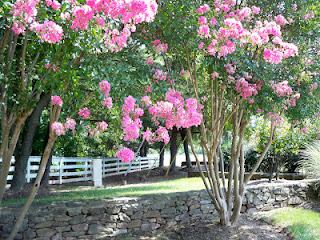
The crepe myrtle blooms when other foliage withers. It adds springtime hues to a late-summer palate. It does all of this and more.

But only if you have sunlight to sustain it.

Our two crepe myrtles have decided this is not the case. So we have the leaves and in one case even the buds, but not the flowers.

But what is the essence of the plant?

For some reason I think of Yeats, who speaks of that and so much more:

O chestnut-tree, great-rooted blossomer,
Are you the leaf, the blossom or the bole?
O body swayed to music, O brightening glance,
How can we know the dancer from the dance?