Browsed by
Author: Anne Cassidy

Color, Still

Color, Still

Most of the time, nature is kind. It gives us something to hang onto. In this case, fall color. Not all of it goes at once. Even yesterday’s wind gusts left a few tenacious leaves on the trees.

This gives the eye something horizontal on which to gaze, a relief from the unremitting verticality of winter’s bare trunks.

Is it just my imagination, or are the final colors more vivid, more alive?

Bouncing with Britten

Bouncing with Britten

Almost lost among the Kennedy anniversary hoopla was that yesterday was also the 100th anniversary of the birth of Benjamin Britten.

For some reason I’ve been on a “Britten kick” lately anyway, having taken one of the British composer’s CDs along with me (totally randomly) on my most recent drive to Kentucky. I’m no Britten aficionado — no “Peter Grimes” for me, thank you very much. But the more accessible stuff, like the “Simple Symphony” or “The Young Person’s Guide to the Orchestra” are highly hummable and provide hours of listening pleasure.

Last night, long after dark, I went outside and jumped up and down on the trampoline with Benjamin Britten’s music in my ears. I do some variation of this all the time — bounce while listening to the music of dead white guys. But for some reason last night the miraculousness of it all hit me with extra force.

Benjamin Britten was born 100 years ago. He wrote this piece in 1946. And here I am, 67 years later, his music piped into my ears with a device he could not have imagined, bouncing on a trampoline to its rhythms. Bouncing with goosebumps, I might add.

(Last night’s Benjamin Britten portal.)

What Died with Him

What Died with Him

It’s hard to say anything about President John F. Kennedy that hasn’t already been said. There was even a newspaper article about the pink suit and pill box hat Jacqueline Kennedy wore in Dallas that day. (They have been preserved, complete with blood stains, not to be displayed for another 50 years.)

What struck me last week, when I watched the two-part PBS special about JFK, is how young he was, how young we were.

Young and innocent.

This was before Watergate, Columbine, 9/11, Newtown. This is before we lost face, lost hope.

It’s as if he embodied all the promise of a younger nation — and all that died with him on November 22, 1963.


(Tourists visit Kennedy’s grave in Arlington Cemetery.)

November in the City

November in the City

Walking up the Metro escalator into the gray light of a D.C. morning, I see a woman with a turban, perched regally atop a folded box. Another woman, less regal, warms herself on a grate, hood over her head and, on her feet, impossibly high platform shoes.

I see the gray felt blankets from the homeless shelter abandoned on street corners. Chicken bones and cigarette butts blown up against the walls.

Around the trees are pansies the color of dark blood. In the distance, a car alarm sounds. And closer by, an ambulance.

Commuters walk quickly. Their shoes click briskly on the pavement. They don’t want to linger here. 

“It’s so much better than it used to be,” say old-timers of the neighborhood.  And I believe them; really, I do.

150 Years and One Day Ago Today…

150 Years and One Day Ago Today…

… President Lincoln delivered the Gettysburg Address. Yesterday’s coverage of the event noted that the speech was 272 words and it took Lincoln only two minutes to deliver it. It was preceded by Edward Everett’s two-hour oration, which is remembered now only because of what followed it: 10 perfectly crafted sentences that conveyed a nation’s aspirations and ideals.

One score and three years ago, I wrote about the Gettysburg Address. About how I memorized it in school, promptly forgot it and wished I had remembered it (among many other things).

Memorization seems even quainter now than it did in 1990. Why remember words when you can look them up on your smart phone? 

Perhaps the reason I gave so long ago is still true today. Learning a passage or a poem “by heart” liberates us, I said. “Once we know the words we carry their wisdom around with us; we are freed from the printed page.”

Lincoln’s words liberated us — in more ways than one. 

Talk About Thanksgiving

Talk About Thanksgiving

Thanksgiving’s late date has merchants worried. There is almost a full week less to shop this year than there was last!

But for those who aren’t eager for the Buying Season to begin, we have a welcome pause.

Time to catch the breath between one season and another. Time to work and write. Time to savor what we have before plunging into what we don’t. Talk about Thanksgiving!

All Lit Up

All Lit Up

Days grow short. Light grows scarce. It’s as good a time as any to add a lamp to a once-dark corner.

This arrangement won’t work when the kitchen table is fully occupied. But of course, it seldom is anymore.

With the lamp the table seems inhabited again. Warm, calm, illuminated and fully present. I’ve stopped being surprised by what light can do.

Morning Fog

Morning Fog

After several days that started as cold and hard as a stone, brittle light at morning, we begin today with soft fog and crow-call.

It reminds me of a Thomas Hardy poem:

This is the weather the cuckoo likes,
And so do I;

Although reading the poem more closely, I realize that today’s weather is what Hardy doesn’t like, as  he says in his second stanza:

This is the weather the shepherd shuns,
And so do I;
When beeches drip in browns and duns,
And thresh and ply;

I’ve not been out in this weather yet, but for for atmospheric backdrop while sitting inside with a cup of tea, it can’t be beat.

Old Dogs, New Tricks

Old Dogs, New Tricks

A genetic study of ancient canine bones shows that dogs became domesticated in Europe anywhere from 18,800 to 32,100 years ago. Most likely this transition happened when wolves started hanging around humans in hopes of scoring leftovers from a mammoth (in both senses of the word) kill.

Why does this not surprise me? 

Listening to a radio report of this study  — and then reading about it in the morning newspaper — I’m struck once again by this point: that dogs are still the only large carnivore to be domesticated.

I think about Copper, so loving, so cute. Able to sit on his haunches and beg for food. Clever enough to know that if he sits there long enough he may get a treat.

The human-canine bond is a profound and mysterious one, but at times it is a fragile one. I’ve seen Copper snap when he feels cornered, challenged. I’ve seen the wolf inside him. But still I hug him, pet him, treat him increasingly more like a child.

It’s comforting to know that this has been going on for tens of thousands of years.


(Photo: Claire Cassidy Capehart)

The Other Side of the Moon

The Other Side of the Moon

The first cold of the season blew in yesterday. I’m not talking about frost on the pumpkin or a nip in the air. This cold meant business. Low 20s with the meteorologists already mentioning wind chill. There was even snow in the forecast for Tuesday.

I’m never ready for this, always find it an affront. What happened to balmy nights, crickets chirping, bats flitting high up, above the tree line? What happened to heat?

Truth be told, it may be with us again by next week! That’s the way our weather goes these days. But even if it warms up tomorrow, it’s too late now. The cold has happened. The gloves are on.

Cold weather is the other side of the moon. Every year a mystery; every year a drag.

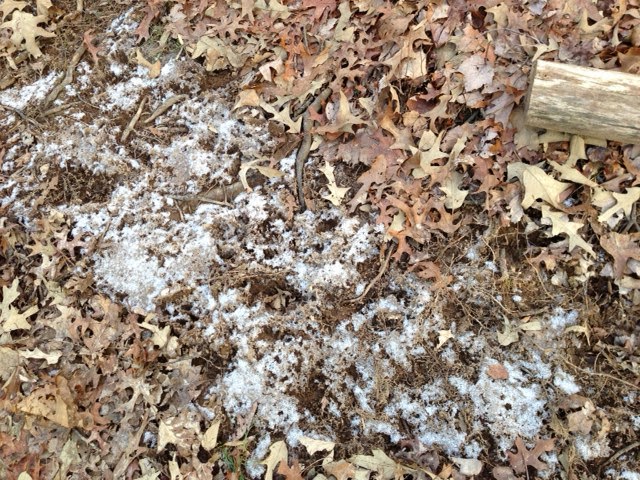
(No snow yet, but it’s only a matter of time!)