The Sixth Extinction
Speaking of warmth without shade, I just finished reading Elizabeth Kolbert’s The Sixth Extinction: An Unnatural History, which explains that we are living through an “extinction event” caused not by an asteroid or volcanic eruption but by homo sapiens. Consider these facts Kolbert presents:
“Human activity has transformed between a third and a half of the land surface of the planet. • Most of the world’s major rivers have been dammed or diverted. • Fertilizer plants produce more nitrogen than is fixed naturally by all terrestrial ecosystems. • Fisheries remove more than a third of the primary production of the oceans’ coastal waters. • Humans use more than half of the world’s readily accessible fresh water runoff.”
Most of all, Kolbert writes, citing Dutch scientist Paul Crutzen, who named this era “Anthropocene” to indicate that it is shaped by humans, we have changed the composition of the atmosphere. The concentration of carbon dioxide in the air has increased by 40 percent in the last 200 years.
All of these changes are happening faster than our world can adapt to them. So, despite the noble efforts we’ve taken to save individual species or to rid our forests of knotweed or other invasive plants, the fact is that the world we’ve created is changing the planet on which we live. Here’s Kolbert again:
“When the world changes faster than species can adapt, many fall out. This is the case whether the agent drops from the sky in a fiery streak or drives to work in a Honda. To argue that the current extinction event could be averted if people just cared more and were willing to make more sacrifices is not wrong, exactly; still, it misses the point. It doesn’t much matter whether people care or don’t care. What matters is that people change the world. This capacity predates modernity, though, of course, modernity is its fullest expression. Indeed, this capacity is probably indistinguishable from the qualities that made us human to begin with: our restlessness, our creativity, our ability to cooperate to solve problems and complete complicated tasks. As soon as humans started using signs and symbols to represent the natural world, they pushed beyond the limits of that world.”
The Sixth Extinction was published in 2015. The situation has only become more dire since then.
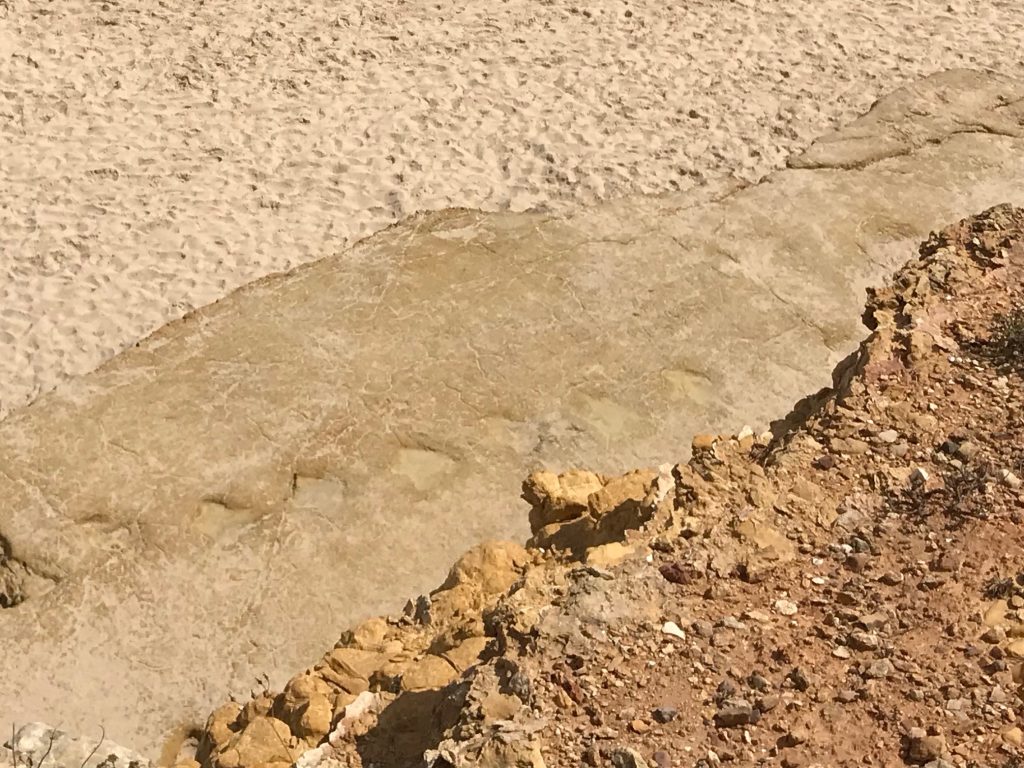
(Dinosaur footprints from the coast of Portugal.)