Browsed by
Author: Anne Cassidy

Meadow Music

Meadow Music

A walk through the meadow. I pull out my earphones to hear the rustle of grasses in the wind, the sound of children playing, a ball bouncing. Past the pond, where a family fishes. The mother is veiled, the little boy intent upon his lure.

Along the ribbon of pavement that bisects a field, I breathe in the scent of pine and cut grass. The Queen Anne’s lace is nodding, the tall weeds waving. Insects buzz, the backdrop noise of summer.

But soon enough, I dart into the woods. There was a place there where I had to duck under a tree that had collapsed upon itself in the storm. But only a bare patch remains. Already I smell autumn in the air, the acrid aroma of dry leaves. I shiver as I stride.

Night Swim, Again

Night Swim, Again

It was almost nightfall. The air was balmy, and a crescent moon grew brighter with every stroke.  I’ve been swimming a lot this summer but never this late. Our dinners have been long, our evenings full. Last night was the first chance to paddle through the mysterious waters of the suburban pool after dark.

There was the same dignified man I remember from last year, doing his quiet breast stroke. He hasn’t changed, though the guards have grown younger. There too was the windmill slowly spinning and the faintest breeze ruffling the leaves in the high branches of the oaks. The thwunk-thwunk of the tennis balls in the adjacent court was the only sound I heard, other than an occasional splash.

I end the day tired and calm. An advantageous combination.

Belonging Matters

Belonging Matters

We will never understand evil and yet, since last Friday’s horrific event in a movie theater in Aurora, Colorado, we have been trying. Alleged mass murderer James Holmes amassed a large cache of weapons and ammunition, all of which he acquired legally. How can we use existing laws and safeguards to stop such madness? Should we reinstate the ban on assault weapons that expired eight years ago? Is there a way to catch incipient insanity through a more rigorous and well funded mental health network? And what about the culture of violence; to what extent did that lead to Columbine, Virginia Tech and now Aurora?

There is one potential cause I’ve heard little about, though, one that might be considered with the others. Holmes was a native of California living in Colorado. Like many of us (and in some places most of us) he wasn’t living in a place he knew well or that knew him.

“The news reports you hear about him, it’s as if people are talking
about one person in San Diego and one in Colorado. Who he is now is not
who he was in San Diego,” said William Parkman, 19, who went to school with Holmes’ younger sister, in USA Today

This, of course, doesn’t provide an immediate explanation for Holmes’ actions, but it does provide an underlying one.  The “lone wolf” exists on the fringes of society; he is not part of a community. The people he kills aren’t known to him; they are characters in a movie, props in his own demented play.

Holmes sought notoriety. He wanted to be known, to set himself apart in a society of malls and mega-theaters and anonymous, empty suburban bustle. He wanted to set himself apart as a scientist, too, but that accomplishment was apparently eluding him.

We have only begun to plumb the mysteries of his psyche, of the mental illness that may have driven him to such unspeakable acts. But even patients with schizophrenia seem to do better when they are part of a family and a community. The World Health Organization’s International Pilot Study on Schizophrenia tracked 3,300 patients in a dozen countries and found that patients in poorer countries did better than those in more well-off ones. Families and communities in countries like India and Nigeria are more likely to care for patients, to give them jobs, to include them in day-to-day life. The human touch, it appears, is more important than we think. And it seems to be more readily available elsewhere than in the U.S., where individual autonomy and accomplishment trump social and family connections.

But what happens when we fail? When accomplishment isn’t enough? When autonomy forces us deeper and deeper into our own misguided thoughts?

Tragedies force us to take stock of ourselves and the world we have created. The random violence abroad in this land (and which, unfortunately, we seem to have exported) makes me think there is more to place than how we feel about where we live.  For the more than the last half century, moving up has often meant moving out.  We’re beginning to see what a culture of anonymity looks like. Yes, we are free. No one knows our business. But what have we become?

Belonging matters.

Rainscape

Rainscape

The summer stroller finds much to appreciate in an occasional rainy day. Along moisture-blackened creek bridges and past the errant sprig of sagging bamboo, today’s amble left me with wet hair and soggy shoes but other than that none the worse for the wear.

Today’s rain is slight, slender, sparse enough to walk through. When the
trail is canopied, as mine was, you can slip through the drips and
drops as if sidestepping them.

I passed people weeding, walking and running in the rain. The wet day didn’t bother them either.

Meet Sid

Meet Sid

His name is Sid and he has a noble profile. When I saw a picture of him in yesterday’s paper I knew I had to meet him. Luckily, Tom agreed.  We briefly considered and then dismissed memories of the last time we’d done something like this.

It hasn’t really been so bad, I said.

What do you mean? Copper is a jerk.

This is just talk, of course. Tom loves Copper, rambunctious and ill-behaved though he is (Copper that is, not Tom).

So we jumped in the car and drove to the animal shelter, and there was Sid, noble profile and all. We knew right away he would be our little birdie.

What we didn’t know for a few minutes was that two cages away was another parakeet, a canary yellow bird with banded leg and of unknown gender (under “sex” the word “unknown” was crossed out and “male” scrawled above it, though the final paperwork said “female”), and that she would be coming home with us too. Her given name was “Taylor,” but we are trying “Dominique” on for size.

Both budgies were strays, so we figured they are scrappy and familiar with the world. And they (in the two cages they came in) are now perched on our kitchen counter, listening to Saint-Saëns’ Organ Symphony. They are still shy and quiet and getting to know each other through the bars of their  cages. We don’t expect them to be anything like our beloved Hermes, who’s been gone more than a year and a half now, and we don’t pretend to be their all or nothing (hence the pair). But they have already begun to fill our house with twitters and chirps. It’s good to have birds again.

This (obviously low-res!) shot of Sid is what got my attention. Look at that noble chin!

“Look on my Works”

“Look on my Works”

Gray clouds part as I drive across the river, which is smooth and still. The familiar monuments rise in the foreground. It’s early morning and already cars are jockeying for the center lane on Constitution, the only lane I trust to take me where I want to go.

Entering the city above ground I’m suddenly aware of its heft, its stone edifices, the Corinthian columns of the National Archives Building. The trees that grow beside it, the rich old magnolias and oaks — they seem a construct too. And the words carved on its pediment, Archives of the United States of America, look ancient and proud.

For some reason (the hour? the light? the mood?), these words of Shelley’s “Ozymandias” come to mind:

And on the pedestal, these words appear:
My name is Ozymandias, King of Kings;
Look on my Works, ye Mighty, and despair!
Nothing beside remains. Round the decay
Of that colossal Wreck, boundless and bare

The lone and level sands stretch far away.

Photo: Wikipedia

Pssst … Want to Hear Some Gossip?

Pssst … Want to Hear Some Gossip?

“Candor has been greatly, perhaps too greatly, heightened in our day. With the stakes of candor everywhere raised, the premium is on the new and edgy. People who write autobiographies or memoirs must have something at least slightly shocking — better of course if it is powerfully shocking — to convey.”

In his newish book Gossip, essayist Joseph Epstein brings his elegant prose style, his wit and his erudition to bear on a subject with which many of us are all too familiar.

A couple of years ago, I tried to give up gossiping for Lent. It was even more difficult than forgoing chocolate, no easy feat itself. Reading Epstein’s book I realize why I had trouble. Gossip has been with us from the beginning. It is part of the human condition. At times it even serves a moral purpose.

But in “these times” (oh, how my children hate to hear me talk like this!) — that is, in a celebrity culture where rumors travel at the speed of, well, whatever speed the Internet operates, which is pretty fast — gossip has morphed into something much more insidious and tricky.

Epstein tells some juicy tales in this book, but he also analyzes how society has become more gossip-riven and gossip-tolerant. How it has created a “change of social tone, an accumulation of many bridges being lowered … [ which has ] helped to bring down the decorum that was a strong feature of — let us call it — square society. Not too many people around today to defend square society, with all its rules and inhibitions.”

Thank God there are a few, Joseph Epstein, of course, being among them.

Full disclosure: I took a class from Epstein in college. It was under his tutelage that I wrote my first real essay.

Red and Blue

Red and Blue

It’s the middle of the summer, with mountains of work to do and no relief from the heat. My Metro car was offloaded before 7 a.m. to fill the platform at Ballston with even more perspiring bodies clinging valiantly to some semblance of morning cool.

It’s time for . . . a virtual vacation.  What will be, I imagine, the first in a series.

My brother- and sister-in-law are visiting Tom’s cousin Dan and his wife, Ann-Katrin, in Sweden now. So I’m taking myself there today, to their lakeside bungalow with the terraced yard and the charming little guest house in blue and red. To the back porch with the deck chairs and lake view, to the pansies and the pumpkin plants, and, in the distance, the cuckoo bird — the real thing, not our loud clock replica — sounding faintly, faithfully, through the woods.

On a walk from their house the first day there we came across these two boats moored companionably next to each other. I snapped a shot. It’s still one of my favorite pictures.

Dogs and Cats

Dogs and Cats

Over a fun dinner out last night, a conversation about cats and dogs. Celia, who adores our canine Copper, still prefers cats because she’s never met two that are alike, she says. Dogs, on the other hand, are always the same. Panting, licking, looking for love.

I can’t say that she isn’t on to something, but given how much attitude I have to accept in people,  I’m looking for something a little less complicated in pets. Loyalty. Obedience. Unconditional love. Or at least two of the three.

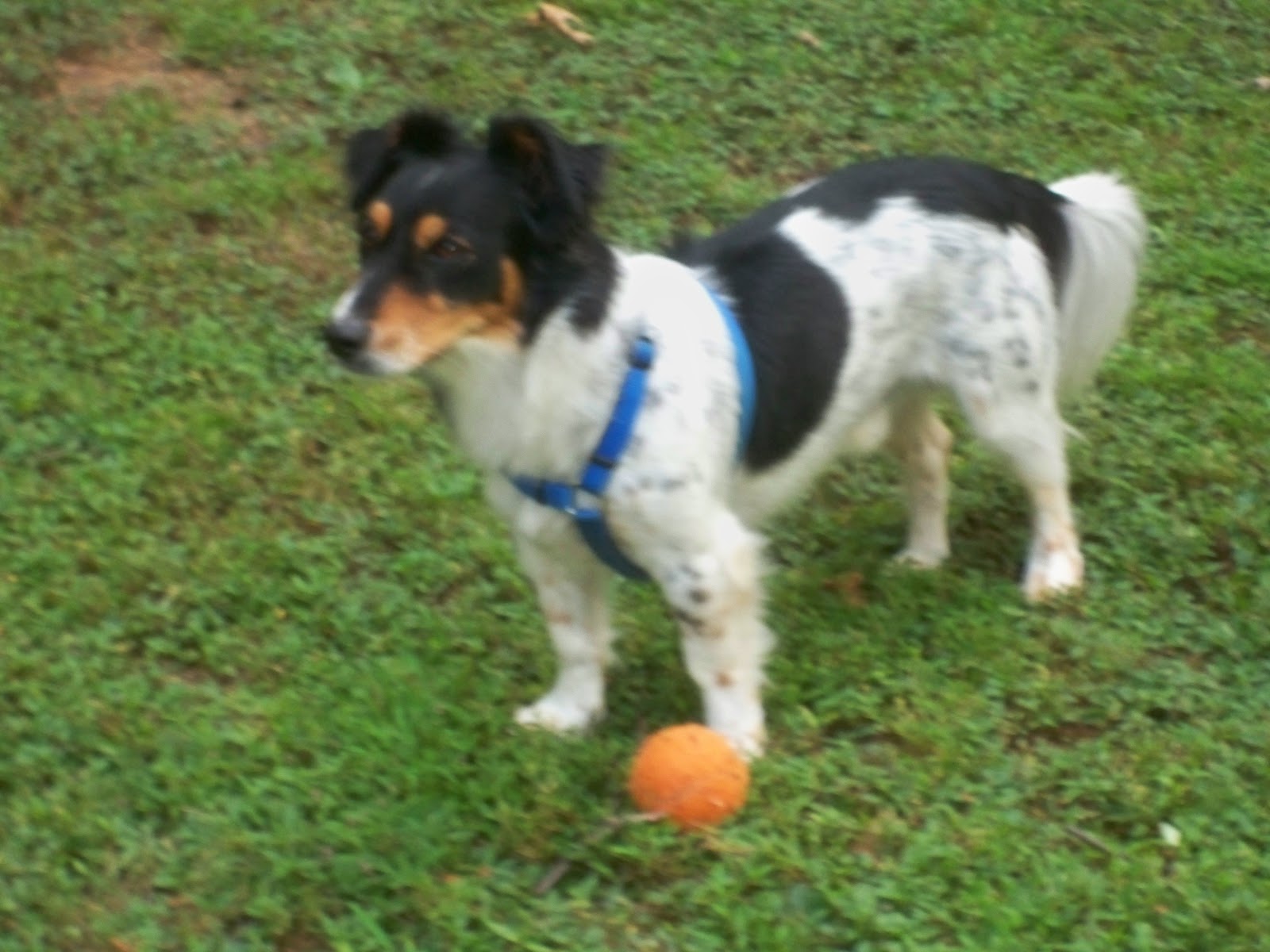
Above, a cat with attitude and a loyal, loving (but disobedient) dog.

Downed Trees

Downed Trees

As I walk on familiar trails once again the extent of last month’s storm is evermore clear. Limbs down in almost every yard, the sound of chain saws and chippers and, what I noticed especially today, the tall trees in the forest that have been completely uprooted, whose roots lie exposed and bare.

With what deep tentacles do these oaks cling to their soil. Ferocious dedication to their plot of land. They didn’t give up without a fight, but 80 mile-an-hour winds make it difficult for even the hardiest to hang on.

In the long run, it was largely a matter of angle and placement. The downed trees are laid out in one direction. The wind came sweeping in from the west and the trees most directly in its path toppled down to the ground. But they still cling to the earth, even with their roots exposed and their trunks strewn across the forest floor.