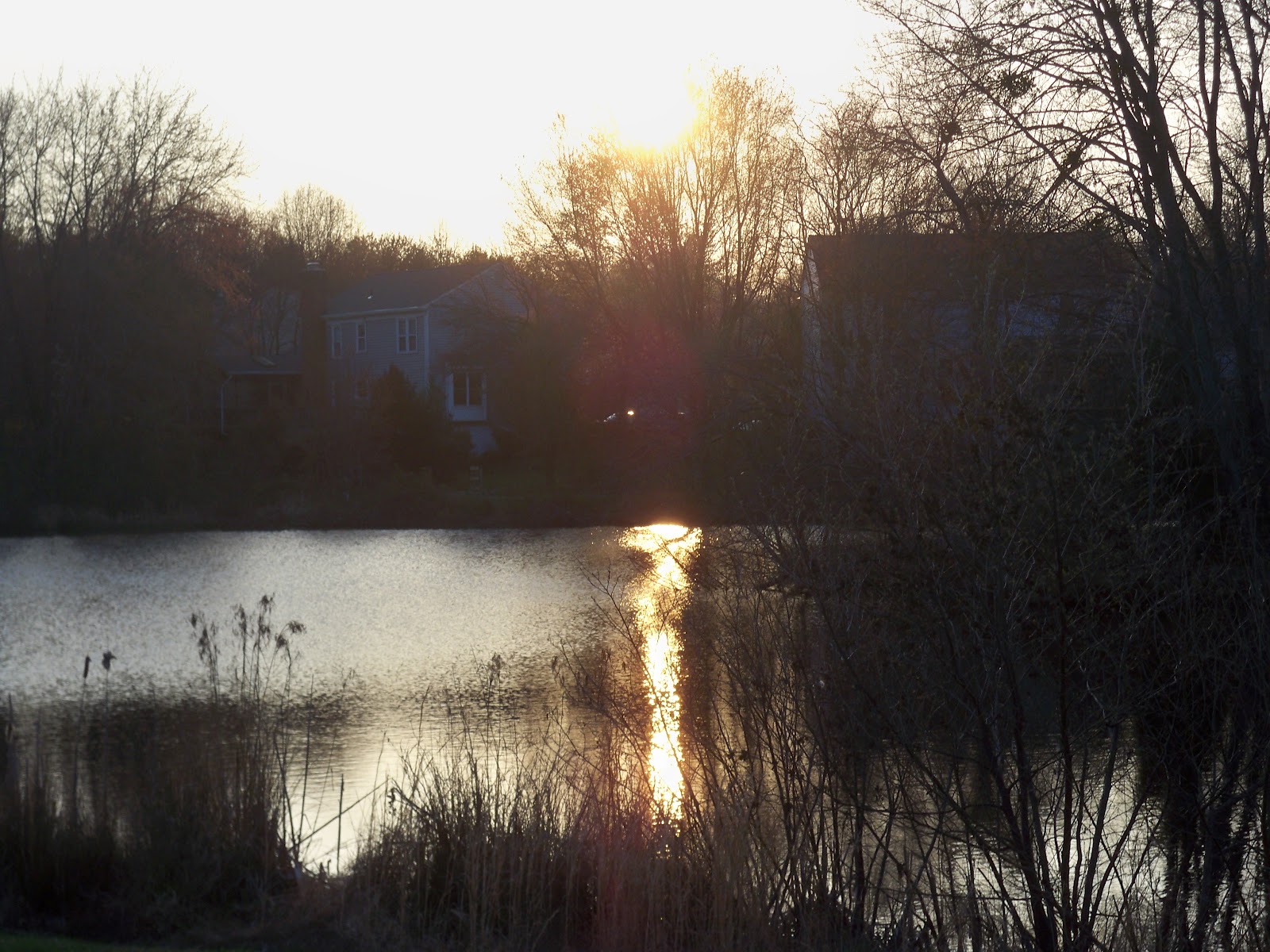
The rain had stopped, but the wind had not yet come up when Copper and I left for a walk. He was restless, pulling on his leash. I was content to trot along behind him. The sky was gray, but I wore sunglasses.
Water was pooled in low places, and the trees were darkly drenched. The air was warmer than it ought to be. No longer a false spring; now it is the real thing.
I thought about how good it is to step out of the house, how the air can coddle us, can wipe our minds clean.
By the end of our walk, the sun had broken through the clouds.
“Landscapes are, in general, one of the few predictables we have.” Deborah Tall, From Where We Stand
As I walk and write and think about the place we live, about its texture and topography and my ability to bond with it, I enjoy collecting the thoughts and experiences of others who have made similar journeys.
Deborah Tall moved to Geneva, New York, to teach, and From Where We Stand is the story of her becoming connected to that place. She does it through coming to know and love the landscape, particularly the lake, and she does it through learning the history of its people.
The Finger Lakes Region has made her its citizen by throwing her back on the land, she says, “instead of distracting me with urban amenities.”
In the suburbs it is easy to be distracted with urban amenities. Here we are only 10 minutes drive from one mall and 15 minutes from another. Our landscape is mostly hidden from view by large houses and strip malls.
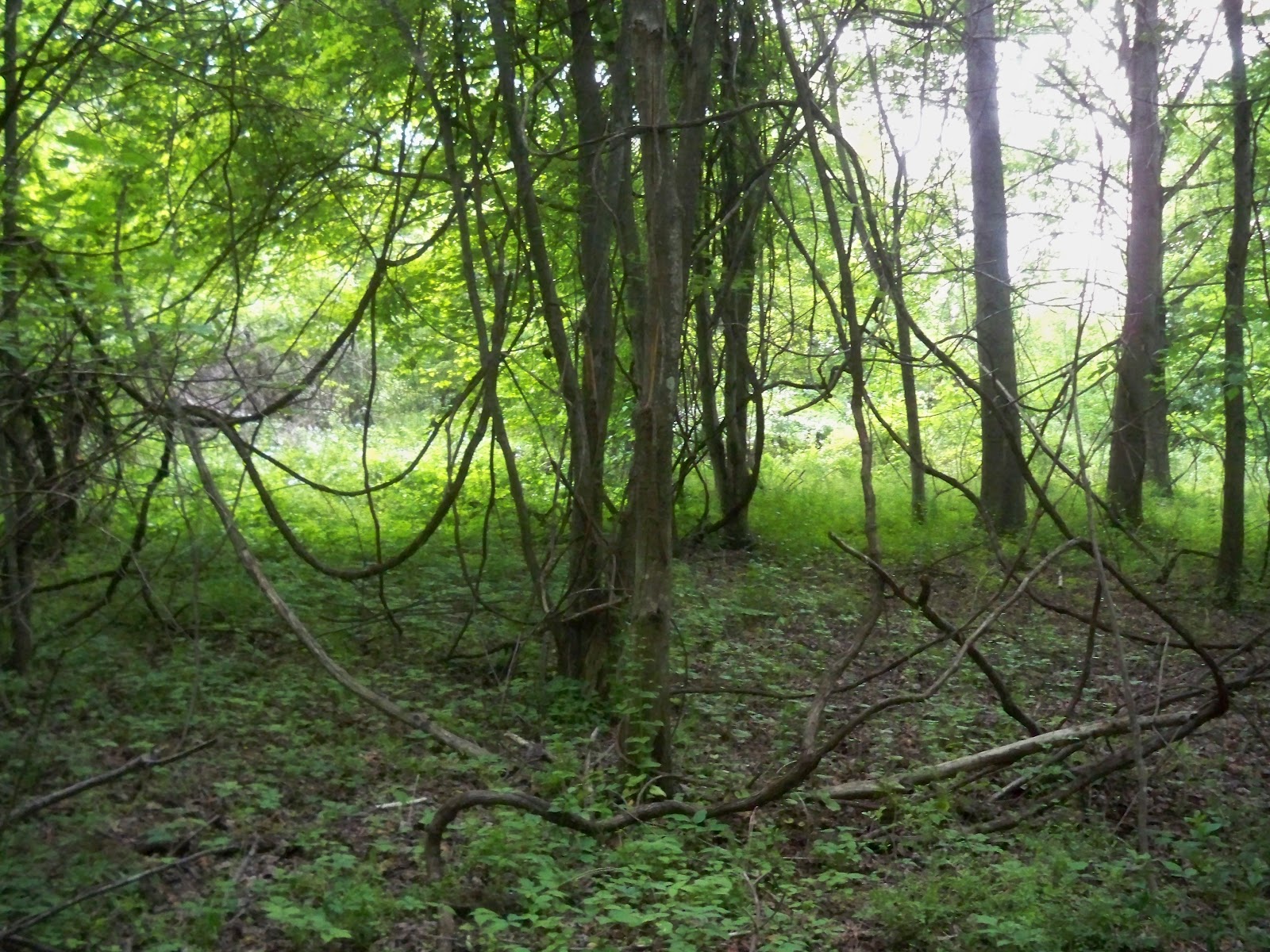
But get out of the car, cut through back yards, find the hidden trails, and you will find landscape. It is still here.
We live in a tame world that is full of wild things. Deer run and play and graze in herds of a dozen or more. They scamper away when they sense us nearby — but not before they have taken all the blooms off our lilies or hostas. Bears have been spotted as close in as Falls Church and as close by as Loudoun County, a few miles west.
Sometimes at night we hear a fox. The sound is piercing, unnerving, otherworldly. Easily mistaken for a riled up cat or any animal on its deathbed.
We heard it a few nights ago, a keening cry that made Copper bark and me leap out of bed. It took a few minutes of waking up and orienting myself before I realized what had caused the ruckus.
Ah, it’s a fox, I said to myself. That which was once alien and unknowable is now familiar — in a wild sort of way.
It comes only once every four years, this bonus day, this leap day, this tag-along. What can I do with its extra minutes and hours?
I don’t need to ask myself this question. I know what I’ll do. The same thing I do with all the others. Work, family, reading through the long commute, a walk if I can work one in.
The key is not to make this day special. It’s to make this day make all the others so.
Someone I know is about to travel to a faraway country. It will be cold there, she said, so she’s taking lots of warm clothes.
For a minute this confused me. Warm clothes? Winter? I had almost forgotten them.
Yesterday our daffodils finally bloomed. Finally is a funny word to use about spring at the end of February. But the buds have been full to bursting for a couple of weeks now. So “finally” is what it feels like.
I want to protect these early flowers, the frost-nipped tulip tree, the shy, early-blooming cherry. But all I can do is watch and hope. The daffodils are sturdy, though, so I have more confidence in them. Which also means more joy.
Less than 36 hours before it won “Best picture” I caught “The Artist” at a local cinema. It was, as promised, a paen to old Hollywood and the golden age of film. But more than that it was a testament to the power of the human face.
That I could sit for two hours and hear only two spoken words — yet still be caught up in the drama and pathos of the characters’ lives — speaks to the enormity of emotions that can be conveyed by two eyes, a nose, mouth and a whole lot of facial muscles.
So here’s to twinkles, frowns, smiles and arched eyebrows. No matter how sensitive our instruments and how sophisticated our technology, their power is never lost.
Yesterday’s presentation was for wordsmiths, so the organizer tailored it to her audience. “Think of it as editing your stuff,” she said. You’re creating white space. Less is more. She didn’t actually say “kill your darlings,” but that’s what she meant. “You want white space,” she said. “You don’t want to walk into a study that’s like a bad article.”
Clearing clutter is a mental game, of course, so what I appreciated most were the pep talks, the encouraging language, the mantras. “Think of it as breaking up with your stuff,” she said. Sort your materials into past, present and future. “If 99 percent of it is from the past then you are keeping the future out. You don’t want to turn your home office into a museum.”
Or this decluttering mantra: “You are not your stuff.” You’re not your books or your file folders or your hard-won interview notes. “Learn to detach.”
For longtime pack rats like me, these are hard words to assimilate. But the organizer also had this practical, benign tactic. Cull your files. Put the refuse in a bin and move it from the office to the hall, from the hall to the garage. If you can live without those papers for a few weeks, then out they go.
Deep breaths. I’m going in …
Photo of a cluttered garage will have to do. I have no photos of a cluttered file cabinet.
On a walk to my car from Metro the other day I noticed how I was no longer noticing the early spring. As if it were normal to see buttercups and dandelions in February. As if the balmy air was to be expected.
Winter has no time for us this year, and I’m glad of it. We’re not emerging from a dark tunnel of cold and snow.
In the past, a mild winter has felt like cheating. Not this year. I’m glad of the warmth and greenery — even though I know we will pay for it with a hot summer.
But for now the year is a circle, not a spiral. We are walking the high road.
Until a few days ago, I hadn’t seen a movie in a theater for months, but it’s time now for my yearly binge. Monday was “Descendants” and last night “War Horse.” If I’m lucky I’ll work “The Artist” and “Hugo” into the next few days.
Thanks to Netflix, I watched “Midnight in Paris” and “Moneyball” at home. I caught “The Help” when it was out earlier this year. And the rest of the nominated films (I’ll never get used to having more than five in the top category) I can live without seeing. Unlike last year with “The King’s Speech,” this year I have no clear favorite. Which makes it more fun.
A film binge is a nice way to see out what is usually (though not this year) the winter doldrums: sitting in a darkened theater, losing myself in the sounds and lights. It’s too early for March Madness. I’ll call it February Madness instead.
Because today is Ash Wednesday I’m thinking about sacred walking, the pilgrimage. Walking with purpose to a shrine or holy place.
Here the walk is for both the journey and the destination: the destination because it holds spiritual riches; the journey because it holds hardship and the opportunity for enlightenment.
To think of daily life as a pilgrimage, that is the challenge. To infuse the ordinary strolls with meaning.