Here on the outer edge of Eastern Standard Time the sun is late to rise. But when it does, it floods the backroom with morning light. That’s what it’s doing right now.
A riot of rays spills in from the east, silhouetting the lamp and globe, which turn into out-size back-lit shadows.
It dawns on me that I can make hand puppets in this light, and I do, a long gangly goose that laughs and quacks his way into the morning.
The light promises a good day, a freshening season. No Black Friday for us. We are after sunshine and ice-skating, the three-mile trip downtown (yes, we can handle that, we suburbanites), and a little more family time.
An e-mail arrives, an e-mail about gratitude. So does inspiration travel in these wireless days. It reminds me of specifics: not just the feast but the pumpkin praline pie at the end of it.
And it reminds me to take inventory. To look up, pay attention, notice the trees outlined against a blue sky, the mountains that rise behind them.
Sometimes gratitude wells up unbidden. A glance, an aroma, and it floods the being. Other times it must be coaxed as a flame is coaxed, first the spark, then the kindling, finally the log and the blaze. It will roar again, this fire. All it needs is time and fuel.
Today is the birthday of the British writer George Eliot, author of Middlemarch and The Mill on the Floss, who was sent away to boarding school at age 5 but who was still able to write these words: “We could never have loved the earth so well if we had had no childhood in it.”
It’s an observation no one else I’ve read has made in quite the same poetic and pithy way, that the sights and sounds of growing up become the template and the canvas upon which our love of the natural world is painted.
I think of it often, remembering the awe of my early years in the world, the way an empty lot could become a fairy meadow, or a scraggly woods the forest primeval. It’s an awe that lives in me still and surprises me from time to time, the rallying cry of beauty.
Here’s Eliot again. I’ll end with her because she says it best: “Our delight in the sunshine on the deep bladed grass today might be no more than the faint perception of wearied souls, if it were not for the sunshine and the grass in the far-off years, which still live in us and transform our perception into love.”
In the library this weekend I picked up a book called Listening Below the Noise by Anne LeClaire. I’ve almost finished it, would have already had I not decided to savor the final chapter. The book grew from the author’s decision some years ago to spend a day in silence. The day brought her such peace and creative energy that she decided to spend every other Monday without speaking.
LeClaire has since become a prophet of silence, giving workshops, writing the book. The compromises she proposes — making time for a quiet morning, shutting off e-mail, slowly eating a juicy apple — graft a monastic habit onto a hectic modern life. They seem realistic enough that most any of us could finagle them.
For me they reaffirm the connection between silence and creativity, the need to withdraw in order to produce, to quiet one’s self in order to speak.
I had another blog post simmering in my mind when I read on this morning’s Writer’s Almanac that on today’s date in 1863 Abraham Lincoln delivered the Gettysburg Address.
Since my visit to the Lincoln Cottage a few weeks ago I’ve had a deepening appreciation of our 16th president, of his greatness and humility. The cottage on the ground of the Old Soldier’s Home in northwest D.C. is where Lincoln wrote much of the Emancipation Proclamation. I don’t have time this morning to research his writing of the address. Though reports of his dashing it off on the back of an envelope on the way to Gettysburg have, I believe, been discredited, he didn’t have much time to write the speech.
The verifiable information I did learn today was that Lincoln’s two-minute speech followed a two-hour oration by Edward Everett, that many in the audience were not aware that the president had spoken because it happened so quickly, and that afterward Everett said to Lincoln: “I wish that I could flatter myself that I had come as near to the central idea of the occasion in two hours as you did in two minutes.”
Brevity is always the harder path to take. I’d like to imagine that Lincoln got to the heart of the matter because he was living with the war, living with it at the White House and living with it at his summer retreat at the Soldier’s Home, where as many as 30 fresh graves a day appeared in the president’s back yard.
Twenty years ago we visited Gettysburg and I lamented that I had forgotten the words of the address I had to memorize when I was a kid. I could probably recite less of the speech these days than I could even then. But I appreciate it more now.
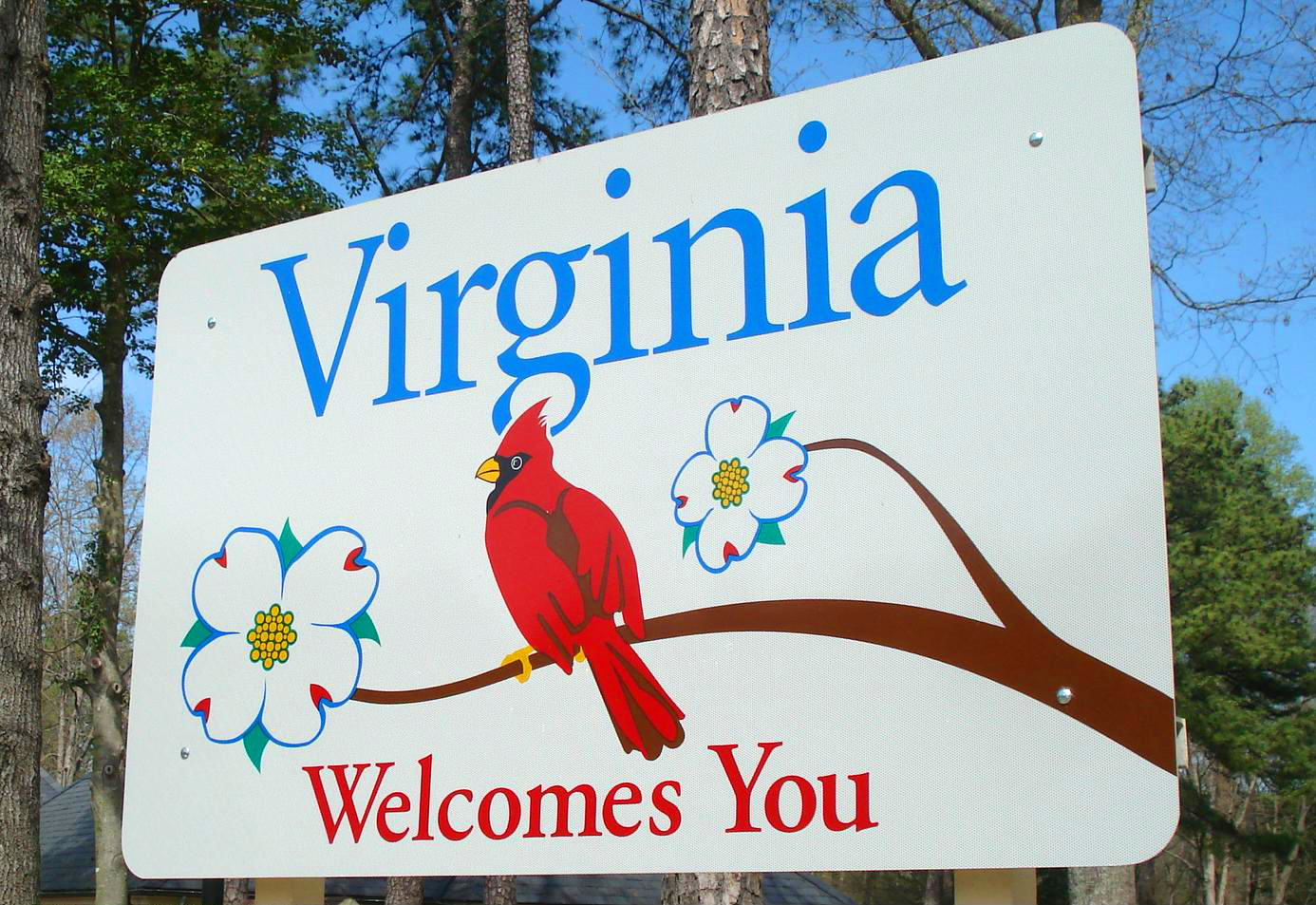
Driving home from Kentucky last Sunday I was touched, as I always am, to see the “Virginia Welcomes You” sign. There was the cardinal, the dogwood, the almost childish renditions of our state bird and state flower. It’s almost as if — dare I say it, might it be? — that I feel like I belong whenever I see it?
A few months ago, in a subway-induced fog, I noticed a “Virginia Welcomes You” sign on the dark subterranean wall at the Rosslyn Metro stop, the first in the commonwealth when traveling west on Metro’s Orange Line. Was I imagining this? I checked the next day. It was definitely there. Now I look for it often on my way home from work. It’s proof of belonging, a whimsical touch.
This morning I ponder these two signs of welcome, these two welcome signs.
Today I almost missed my Metro stop because I was engrossed in a newspaper article about a young man chronicling endangered post offices. Evan Kalish has visited 2,745 post offices in 43 states since 2008. Yesterday he wrote about the closure of a post office in St. James, Maryland. It was tucked away in a general store and featured an imported (from Pennsylvania!) postal facade that looks like something out of a movie set.
When we lived in Groton, Massachusetts, we mailed our letters and packages from a dignified old brick post office with friendly New England clerks. It was the sort of place where people lingered, chatting about when the first snowflakes might fall. It was part of the magic of that village, a component of its character.
When we first moved to Virginia, our post office was a corner of the local hardware store. I’d wait in line there, one baby or the other on my hip, to mail an article to one of my editors in New York. Though far less picturesque than Groton, it had its own madcap charm.
Years passed, the Internet arrived, and I sent my articles by email, my letters too. And that, multiplied and magnified hundreds of thousands of times over, is why post offices are closing.
But understanding the reason isn’t the same as agreeing with it. As the post offices shut down, the small towns and hamlets lose their postmark, their centerpiece, their community center. And the world becomes a little more homogenized, a little more boring, a lot less placed.
On days when there’s no time to walk, only time to drive, the radio sustains me. The last 24 hours have been like that.
Yesterday I heard an interview with filmmaker Shekhar Kapur, who explained why, after stints in Britain and the United States, he is once again living in his native India:
“You can stand in one place and look to your right, and you see a funeral. Look to your left, and you see a marriage. Look in front of you, and you see little children that are born and are starving in the streets. And look behind you, and somebody’s driving a Bentley,” he says. “You’re suddenly faced with the contradictions of just living, and you realize just how mortal you are. And in that mortality, you’re pushed into the idea that life is not under your control — it’s completely chaotic.” This chaos keeps him on edge, Kapur says, keeps “more creatively alive.”
And then, on this morning’s “Writer’s Almanac,” these words from the novelist Andrea Barrett: “I’ve never known a writer who didn’t feel ill at ease in the world. … We all feel unhoused in some sense. That’s part of why we write. We feel we don’t fit in, that this world is not our world, that though we may move in it, we’re not of it. … You don’t need to write a novel if you feel at home in the world.”
The radio provides aural sustenance; this photo of Hallstatt, Austria provides visual sustenance.
“Here before me now is my picture, my map, of a place and therefore of myself, and much that can never be said adds to its reality for me, just as much of its reality is based on my own shadows, my inventions.”
from Map of Another Town: A Memoir of Provence by M.F.K. Fisher.
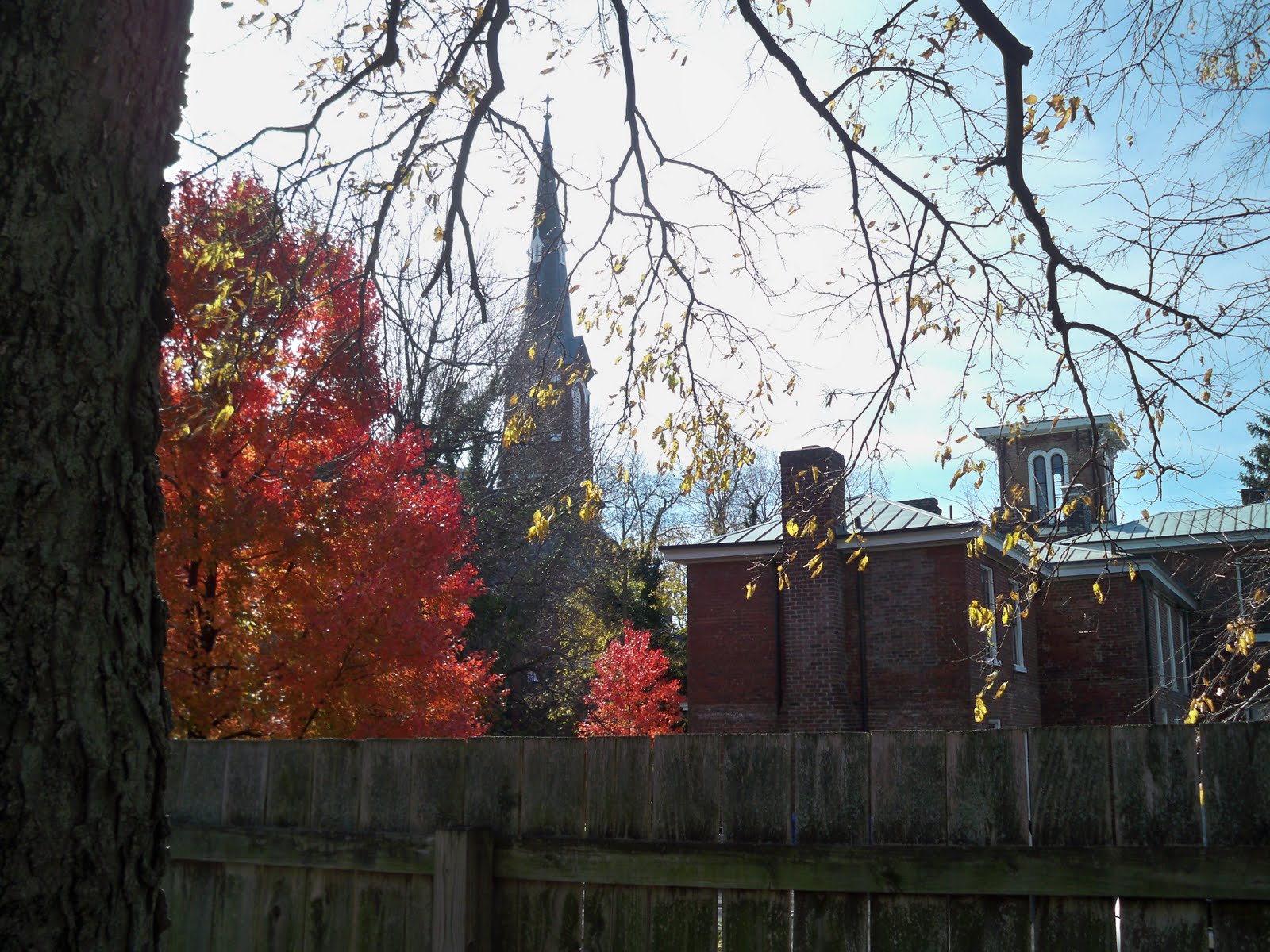
On my way home from the funeral Saturday, I stopped for a moment to snap this shot. It is a view of downtown Lexington from the parking lot of St. Paul’s Church, where Tom and I were married. I turned my head and there it was, this vision of old Lexington with the bright sun overexposing the steeple and the red brick rectory shining by its side and the late autumn foliage adding a spot of color on the left.
Seeing my town from this unconventional angle I see also the old towns of Europe, their cobbled streets and ancient airs, all the living that went on within their walls, the stones somehow absorbing this life and reflecting it back to us centuries later.
Surely when we talk about place we talk about all the living that goes on within the cities and the towns and buildings, and our noble — and ultimately futile — struggle to hold onto what passes too quickly through our hands.
A death in my extended family has me thinking about final resting places, their importance and value. On Saturday, my aunt was laid to rest next to her husband in Kentucky. She was born in the state, but lived much of her life in Ohio and Michigan. My cousins are scattered from Saginaw to Katonah to Cleveland to Washington, D.C. But now they are doubly bound to this plot of soil on the west side of Lexington.
What helps us decide where to end up? It is a complicated and intensely personal decision, of course, and it brings into high relief questions of place and belonging. Because even if we’re scattered to the four winds or kept in a vase on the mantel, we still have to end up somewhere. It is our final decision, where we stop when we can roam no more.
This is Mozart’s grave in Vienna, though there’s a good chance the composer was interred elsewhere in this cemetery.