Since we hoard books in our house, it is often likely that when a particular classic is called for in a high school English class, we already have it. Of course it is not a pristine copy; it is usually adorned with such “English majorisms” as “illustrates dichotomy between life in city and life in country” or “example of bildungsroman.” While our children initially balked at taking such tomes to school, they began to see their advantage. There were answers in those margins!
Turns out that other people appreciate marginalia, too. I learned this several years ago when I wrote an article about the rare old books in the Georgetown Law library. And a new exhibit at Chicago’s Newberry Library celebrates “Other People’s Books” with marginal notes by the likes of Mark Twain and Thomas Jefferson.
A recent article about the exhibit in the New York Times points out that while it’s possible to annotate electronically, it is not so easy to preserve those digital annotations. So add marginalia to the list of What We Have Lost with E-Books (along with, perhaps, paper cuts and Borders?).
Life on the margins: It may be better than we think.
Before there was President’s Day there was Washington’s birthday, and it was today. It was my grandmother’s birthday, too, and when we were young and still had cousins, we gathered at the house on North Hanover to celebrate. The cake was the kind of densely, heavily iced ones you don’t see anymore — maybe the ingredients have been outlawed — and my stomach would ache after eating a slice.
It’s funny how you can remember some details from childhood, and I can remember those cakes. Because of the day, they were adorned with a cherry tree and a little axe made of mounded, brightly colored icing.
To a child the idea of a Washington’s birthday cake seemed perfectly natural, but now I think about the confection and the story (which many now consider a fabrication) of our first president chopping down a cherry tree with his little hatchet and then admitting he did so to his angry father. It was a mild transgression, as presidential transgressions go; it was innocent and old-fashioned and as sugary sweet as the icing on those cakes. It was the sort of thing we believed in long ago.
I’ve been meaning for several weeks to write about a book called Hard Scrabble. It’s by John Graves, a Texas man — and (I was almost afraid to look because he was born in 1920) still a living one, a fact which buoys me, to know that someone like him (he calls himself an “Old Fart,” “OF” or “Head Varmint”) is still with us.
I’d had this book on my “to read” list for months and had hunted for it without success in the several libraries I haunt. Finding no free copies anywhere I was actually driven to purchase it. I’m happy to report that the book was worth every penny I paid for it — and then some.
Hard Scrabble is the name of Graves’ farm, a place that he owns not because he holds the title to it but because he “owns it in his head” — meaning that he’s lived on and worked it for many decades. His writing style is what I would call crunchy — not in the hippie granola sense of that word but meaning that it is full of texture. His surprising word choices and unusual rhythms and phrasing come not from sitting at a desk and looking out a window but from tending bees and building stone houses and finding lost goats. His writing is specific, as all good writing is, but his details are not just observed, they are lived.
And so, when you’re reading Hard Scrabble and you’re clinging to each phrase because there are only a few pages left and you don’t want the book to end, you come across words like these:
” [W]hen past forty — in a period when by rights a man ought to be using what knowledge he has already acquired… did I start consolidating a store of rare knowledge with making a show in carpentry, with fences and humus and stumps and bugs, with the smell of rain on dung and drouthy soil, with how goats bleat when frightened … with fields that are green and why and what flowers the bees work in August in the third smallest county in Texas.”
And then a couple pages later, this:
“It strikes me as more than a possibility that archaism, in times one disagrees with, may touch closer to lasting truth than do the times themselves — that, for instance, the timbre and meaning of various goat-bleats may be at least as much worth learning as the music and mores of the newest wave of youths to arrive at awareness of the eternal steaming turmoil of the human crotch. Therefore, having at least the illusion of choice, one chooses for the moment at any rate isolation and an older way of life.”
It is difficult in the suburbs to choose “isolation and an older way of life.” But reading HardScrabble gives me hope that there is truth and beauty in the honest observation of the place one finds one’s self.
I left this morning early on a round of errands: library, post office, gas station, pharmacy, two grocery stores. By 10:15 I am home again, ready to write, edit and read. I wonder if I can summon the mood for creative work. It is true that a day’s first steps can set its tone, and I began this day in efficiency mode.
But I have stumbled upon a cure — poetry podcasts. As I listen to the words read aloud, their cadences chase away the day’s earlier rhythms, fill me instead with iambs and trochees, with the human voice in search of magic.
Inspired by the spoken words, I listen and I write. A day of doing may yet turn out to be a day of being.
Warm weather outside means warm floors inside, so off come the two pairs of socks, the thin ones and the thick ones with non-slip soles. It has been months since I walked without socks or slippers, and I’m surprised by the textures, by the interesting news my feet bring me about the world. My toes dig into the carpet fibers as if they were sand on the beach. And when I step outside for the newspaper my soles are shocked by the cold hard surface. I had forgotten how bare feet feel.
This brings to mind a line from “God’s Grandeur” by Gerard Manley Hopkins, a poem in praise of the creator and creation: “Nor can foot feel, being shod.”
In bundling up for winter we numb the senses. We have to. And in spring comes an awakening not just of nature but of our capacity to appreciate it.
The next lines of the poem are: “And for all this, nature is never spent; There lives the dearest freshness deep down things.” It is the way I feel today barefoot — that the elements I usually ignore are waiting to restore me.
She carried a flashlight, so I could spot the goal-setter a mile down the road. It was my neighbor, Nancy, another walker in the suburbs, though a more regular one. It was well before dawn but she was already pounding the pavement.
About 12 years ago Nancy started fast-walking in earnest. She started, she said, because she had to use it or lose it. She keeps going for the same reason.
I caught her late one afternoon on her second walk of the day and asked her why she was out again. “I was two miles short of my goal,” she said. “Twenty miles a week.”
We talked some more, about routes and roads, suburban stuff, but all the while I’m thinking about goals. Setting them, keeping them, how they work to keep us young. How goals of distance are more weighty and tangible than goals of time. Twenty miles a week is a thousand miles a year. That’s from here to Kentucky and back. It’s a lot of miles to walk, a big goal to keep.
I almost didn’t go, had too many papers on my desk to feel right about leaving them behind, but my friend Michele Wolf was reading from her new book Immersion so I walked 20 minutes to a building made of words, took a seat and let the images flow into my brain.
It was a good decision. The verse filled me full as any food. They were love poems — love for children, for parents, for spouse — and they trembled and soared; they skittered to the edge of the abyss, stood still and stared it down.
On the way home, my path was filled with light. All the buildings had softened edges.
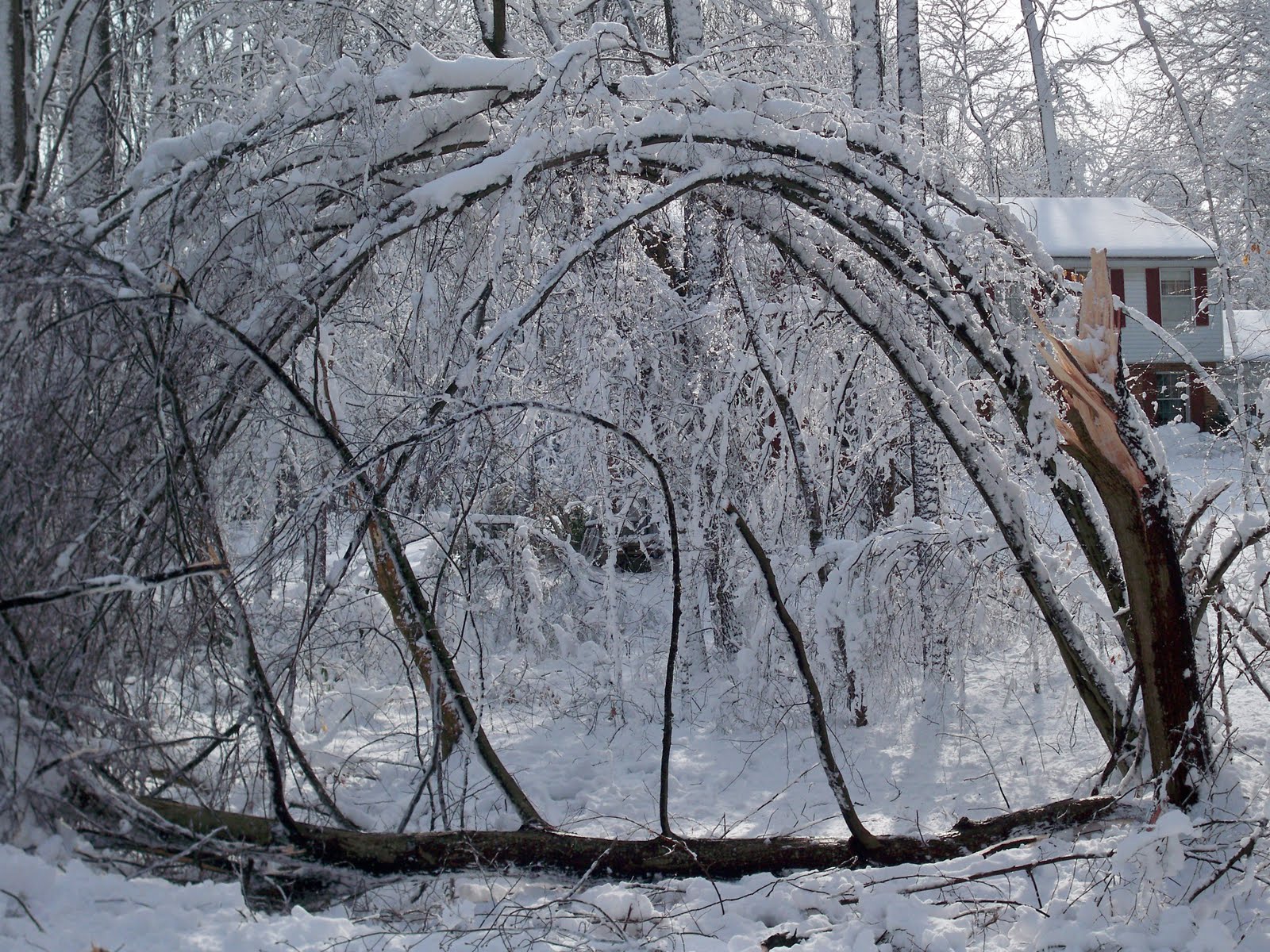
Walks in the suburbs this weekend revealed the full damage from our recent snowstorm. Trees without tops, our own witch hazel decapitated. Large limbs littering yards and driveways. And in the woods, downed trees block paths.
The pears and fir trees took it hardest. They are bent and broken. But there is scarcely a yard that’s untouched. The light brown of sheared wood stands in stark contrast to the silvery gray of weathered trunks.
This is nature’s way of pruning dead wood. But unlike the gardener who trims kindly and judiciously, wicked weather takes what it wants. Its methods are ruthless not artful. The unkindest cut.
I had just started this blog last year when Valentine’s Day rolled around. It was Sunday, and though I hadn’t yet developed a six-day-a-week rhythm for Walker, I took that day off.
This, then, is my first Valentine’s post —and the first about my valentine.
You may have met him in these pages before. He flits through them often: steadying my nerves, buoying my mood, even helping me begin this blog. He might cringe a little when I tell him that I’ve used a photo of our messy garage to illustrate one of my posts, but not enough to make me feel bad. For more than 20 years we’ve been raising children, keeping house, drinking endless cups of tea on Sunday mornings— sharing our lives. He is always there for me. He is calm and happy and forever a good sport.
While I sit around musing and pecking on my laptop, Tom is fixing a door, balancing an account, building a fire. He has the enviable ability to lose himself in his work, chores and hobbies. He is, always has been and always will be his own indisputably unique self. And most important, he has a heart of gold. Is it any wonder, then, that he was born on Valentine’s Day?
The house dress was a shapeless garment worn by grandmothers and great aunts. Simple cotton frocks in floral prints, they were what women wore when they didn’t plan on going out, when the chores of the day kept them inside, when they would never consider wearing pants.
I heard a radio report the other day on the evolution of the modern home that included this numbing statistic: In the 1920s, the average woman spent about five hours a day in the kitchen. A house dress must have been comfortable attire for scouring the oven, baking bread or running clothes through a wringer. Shapeless and liberating. No girdle required.
No woman I know wears a house dress now, unless you count some modern iterations that have little in common with their frumpy forebears. But I haven’t been home five minutes when I run upstairs, slip out of my blazer and trousers and pull on my sweatpants and sweatshirt. Comfortable and shapeless, perfect for cooking, cleaning or doing nothing, they are my house dress.