Browsed by
Category: history

Words That Live On

Words That Live On

Yesterday would have been the 90th birthday of Anne Frank. Seventy-seven years ago, she received a diary for her 13th birthday, a diary she would fill with words that would live on for decades, and, most likely centuries, beyond her.

The contents were in many ways typical — conflicts with her mother, questions about her future. But it was written in 500 square feet of hidden space that Anne shared with her parents, sister and four other people. And it was written amidst the horrors of Nazi Europe.

“When I write, I can shake all of my cares,” Anne wrote in her journal. “My sorrow disappears, my spirits are revived. But, and that’s a big question, will I ever be able to write something truly great, will I ever become a journalist or a writer?”

Anne would die not long after her 15th birthday. The diary she called “Kitty” was left behind in the “Secret Annex.” She could not take it to Auschwitz or on to Bergen Belsen, where she and her sister died of disease and malnutrition shortly before Allies freed the concentration camps. But a family friend saved the journal, and gave it to Anne’s father, Otto, who eventually had it published. It would be translated into 70 languages and sell tens of millions of copies around the world.

“It’s really a wonder that I haven’t dropped all my ideals, because they seem so absurd and impossible to carry out,” Anne wrote. “Yet I keep them, because in spite of everything I still believe that people are really good at heart. I simply can’t build up my hopes on a foundation consisting of confusion, misery, and death.”

(Above: a page from Anne Frank’s Tales book. She also penned what she called The Book of Beautiful Sentences — copying passages of writing that she liked — started a novel and planned a book called The Secret Annex. Photo and information courtesy of the Anne Frank Museum website and The Writer’s Almanac.) 

The Boys in the Air

The Boys in the Air

Today, as we celebrate the 75th anniversary of D-Day, I think not just of the boys who stormed the beaches but also of the boys who flew above them. One of them was my dad.

Frank Cassidy was 20 years old when he took the trip of a lifetime, courtesy of the U.S. government. It was an all-expenses voyage to and from what Dad called “Jolly Old” England. He was stationed at a base outside the village of Horham in East Anglia.

On June 6, 1944, Dad had just turned 21. He had become adept at crawling into the tail-gunner’s seat of a B-17 bomber and firing the gun when necessary. That day, he and his crew would fly two missions, softening up enemy defenses, backing up the infantry, the men who were landing and dying on the beaches of Normandy.

Dad always insisted that what he did was nothing compared with them. “I don’t think the American people appreciate what some of those men did,” he told a newspaper reporter in 2009. “Those guys, they deserve all the honors.”

With all due respect, Dad, I disagree. I think you deserve the honors, too.


100 Years

100 Years

The eleventh hour of the eleventh day of the eleventh month. Today we celebrate 100 years since the end of the Great War, World War 1, which killed an estimated 10 million soldiers.

My grandfather fought in the cavalry, and when I went with Mom to Europe many years ago, she shuddered as our train passed through Verdun and other battle sites.

The past not that long past to her, because it lived on through the memories of her father.

World War II is the war that lived in my memory, and in a way similar to Mom’s — because my father fought in it.

But it is World War I we memorialize today, the War to End All Wars (oh, how I wish that were true).   Here are the last paragraphs of Erich Maria Remarque’s All Quiet on the Western Front:

He fell in October, 1918, on a day that was so quiet and still on the whole front, that the army report confined itself to the single sentence: All quiet on the Western Front.

He had fallen forward and lay on the earth as though sleeping. Turning him over one saw that he could not have suffered long; his face had an expression of calm, as though almost glad the end had come
.


(World War 1 trenches, 1916. Photo: Wikipedia)

Make Bearable

Make Bearable

Last night was the final episode of Burns and Novick’s Vietnam War. It began and ended with Tim O’Brien reading from his book The Things They Carried. 

“They marched for the sake of the march. They plodded along slowly, dumbly, leaning forward against the heat, unthinking, all blood and bone, simple grunts, soldiering with their legs, toiling up the hills and down into the paddies and across the rivers and up again and down, just humping, one step and then the next and then another, but no volition, no will, because it was automatic, it was anatomy, and the war was entirely a matter of posture and carriage, the hump was everything, a kind of inertia, a kind of emptiness, a dullness of desire and intellect and conscience and hope and human sensibility.”

While he read, the people who had been our companions through this series — the Americans, the South Vietnamese, the North Vietnamese, the Viet Cong, the soldiers, the antiwar activists, the vets, the military brass — we got to see what they are doing now. They are teachers and counselors, a judge. But more of them than not, it seems, are writers.

This brought some comfort. The film stirred up feelings in all of us who lived through the war, raised questions that will never be answered, dredged up divisions that still rankle. But it showed that sometimes art can distill and, if not heal, at least lance, drain and make bearable.

Turn, Turn, Turn

Turn, Turn, Turn

Last night’s episode lasted two hours. As I drifted in and out of sleep (it was a long day), I witnessed rounds of mortar fire, heard old tapes of Johnson with McNamara, learned more about the Gulf of Tonkin error. Where have I been all these years? Obviously, not learning about Vietnam.

The conflict of my lifetime is being plumbed every night this week with a new Ken Burns and Lynn Novick documentary, “The Vietnam War.” Like a good baby boomer I’m watching every minute of it.

How strange to hear those voices again, Kennedy’s “heah,” Johnson’s twang; to see the faces that I remember from black-and-white newscasts. The history of our youth is strange. Is it history, if we’ve lived through it? Of course it is. It’s just that we’ve lived long enough for it to become so.

My favorite part is the ending of each episode and the music that accompanies it. Last night’s was “Turn, Turn, Turn,” the Byrd’s version. I like the harmony, I like the lyrics (hard to beat Ecclesiastes). It’s playing as I write this post. “To everything there is a season and a time to every purpose under heaven.”

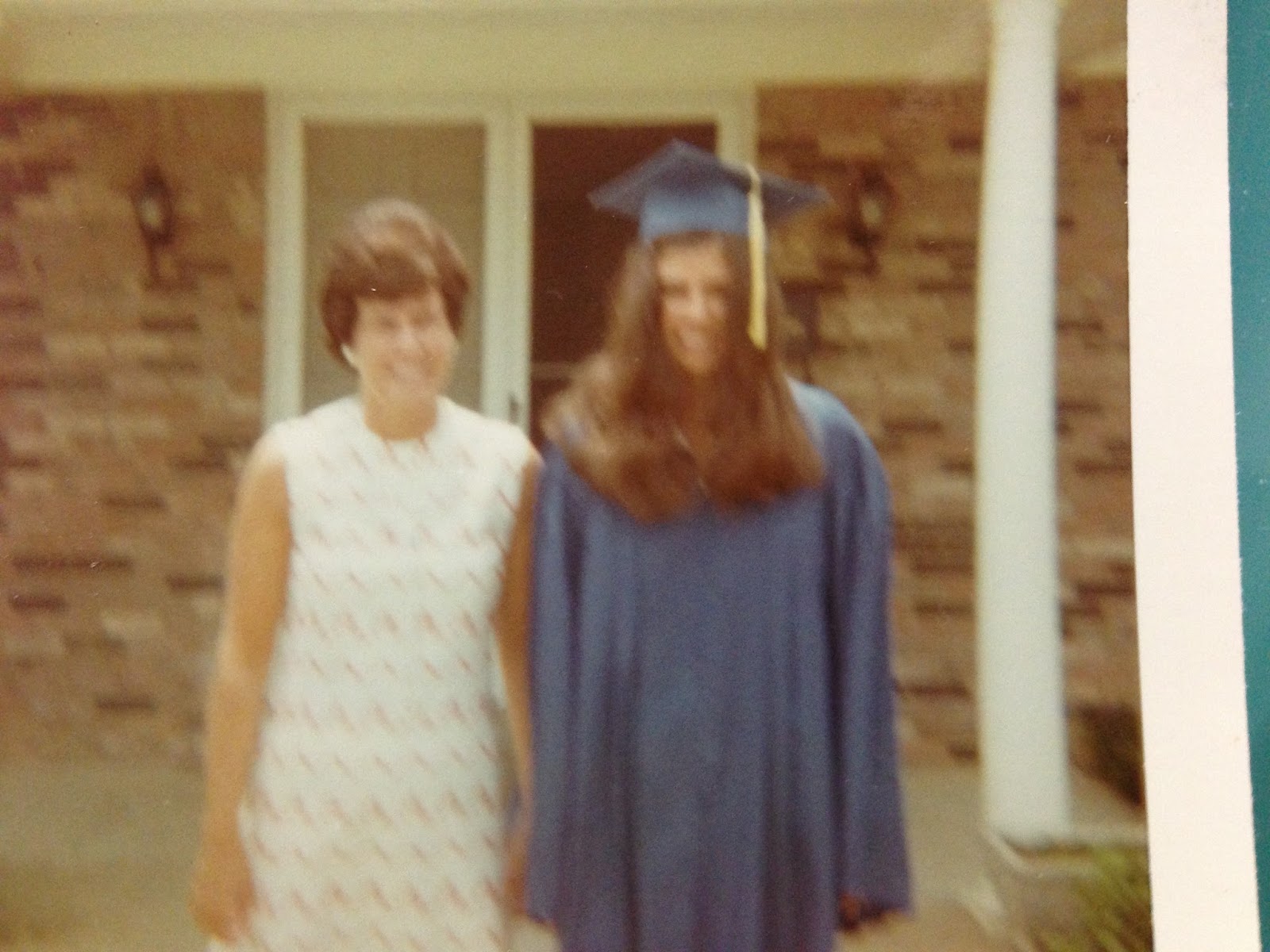
(Looking for an old photo from roughly this era — and this is the best I can do. Blurry is better in this pic of Mom and me on my high school graduation. Go Blue Devils!) 

18th-Century’ish

18th-Century’ish

A trip to the 18th-century today. To a time without cars and television and gender-bathroom issues.

This would be Williamsburg, Virginia. Only three hours down the road.

You can stay in historic houses there (we will) and have a hot buttered rum and a rasher of whatever it is they have rashers of.

You can also (and I have my eye on this) take a morning abs or Pilates fusion class at a decidedly 21st-century spa. Oh, and did I mention that there’s now a Williamsburg app?

Let’s just call it 18th-century’ish.

Rain and Memory

Rain and Memory

Thunderstorms belong to the afternoon. The buildup of heat and humidity, the pressure and then the release.

This morning was an anomaly. Cracks of thunder before 6 a.m. Copper pawing at the door, wanting to get to his safe spot in the basement. Driving to the bus in a downpour and seeking high ground to park the car.

Here’s where local memory comes in handy. The lot I use now was once flooded, cars submerged. Unsuspecting commuters had done just what I did today, raced up and parked and caught the bus. But on that day storm drains were clogged and rain fell several inches an hour.

When I pulled in this morning I noticed another driver who’d done the same — bypassed the closer, lower spots. I guess he remembers, too.

Remembering

Remembering

A lunchtime walk on Monday, heading south on First to the Mall, then turning back north at Seventh only to find myself at the Navy Memorial …  at noon … on Pearl Harbor Day.

There was a brass band, a color guard, music, salutes and a bugler to play Taps. So I stayed a while, listened to the invocation, put my hand on my heart for the National Anthem.

I had forgotten. And it is important to remember.

Lincoln Cottage

Lincoln Cottage

One hundred and fifty years ago today, President Lincoln was shot in Ford’s Theater. He was carried to a house across the street where he died hours later.

I pass the theater often on my walk home from work, pass it without looking, without thinking, pass it apparently without photographing it — since I’ve looked through all my photos and can’t seem to find one picture of the place.

The house above meant a lot to Lincoln. It was his getaway, his Camp David. Now called the Lincoln Cottage (located on the grounds of the Soldier’s Home), it was where he escaped from the city to write, to think, to spend time with his family. He would sometimes ride the three miles from the White House to the cottage unaccompanied — and he survived at least one assassination attempt en route.

Death was in the air here, too. The Lincoln Cottage was located within the grounds of a military cemetery and fresh graves were being dug at an alarming pace. But Lincoln treasured the relative tranquility of the place and wrote the final draft of the Emancipation Proclamation here. This humble house gave him peace.

Visiting the Past

Visiting the Past

I’ve lately spent a few hours in the cool, quiet recesses of the Smithsonian Archives. While this conjures up images of dusty stacks, in reality the building is new, open and sunny. Researchers sit in a glass walled room where archivists can keep a watchful eye. No pens, no purses, no coats or scarves. We stow our belongings in lockers and bring only pencils, paper, laptops and cameras.

What emerges is time and space for the quiet pursuit. The here-and-now drops away; the long-since-past emerges. It’s a nice place to spend some time, the long-since-past. I read about the 1918 flu and Model Ts and old roads on the prairie, two tire tracks amid waving grass. It was a place where you could buy an acre of land in Falls Church for $125 and build a house in ten days.

I leave the archives with my mind spinning. Once I walk out of that glass room, I’m not in the past anymore. But I’m not quite in the present either.