Browsed by
Category: travel

Packing Light

Packing Light

A trip to Africa requires not just one packing list but several. There’s the electronic one I’ve been tapping on my phone whenever I think of something on the run — ear plugs, a headlamp, the Kindle! 

There’s the scribbled one upstairs near the brand new suitcase — kitchen towels for Biba, a book for Apollinaire, candy, gum and pens for other friends I’m about to meet. 

And then there’s the carefully typed list Suzanne sent me a couple weeks ago — her attempt to rein in her mother’s (ahem) over-packing tendencies. After all, she took only two suitcases and a carry-on for two years.

So my new motto is travel light, take only what I need, nothing “just in case.” Let’s see how long it lasts!

Two Weeks from Today

Two Weeks from Today

If all goes according to plan, two weeks from today I land in Africa — first in Ethiopia, where I board a connecting flight, and then in Cotonou, Benin. It’s a trip I’ve wanted to take for three years, since Suzanne learned she’d be joining the Peace Corps.

I’ve tried to imagine it, but I get only as far as stepping out of the airport into a steamy, tropical afternoon. The sights and smells and sounds — I’ve heard about them, but they’re abstractions. So I’ve turned to … a book, of course.

In The Shadow of the Sun, the late journalist Ryszard Kapuscinski writes that three things struck him on his first arrival in Africa: the heat, the odor and the people. Here’s what he says about the aroma:

It is the smell of a sweating body and drying fish, of spoiling meat and roasting cassava, of fresh flowers and putrid algae — in short, of everything that is at once pleasant and irritating, that attracts and repels, seduces and disgusts. This odor will reach us from nearby palm groves, will escape from the hot soil, will wait above stagnant city sewers. It will not leave us; it is integral to the tropics.

 And here’s how he describes the people:

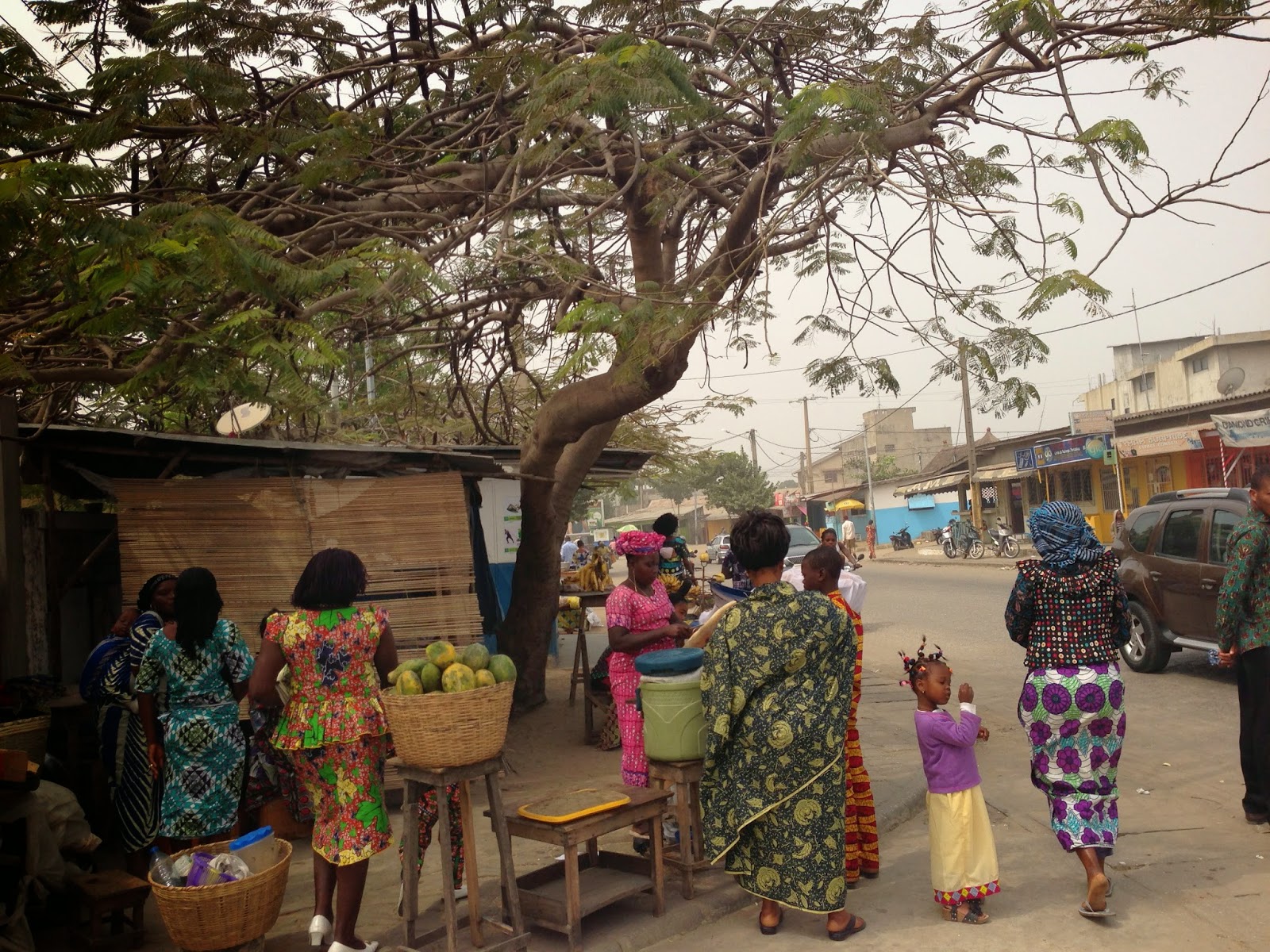
How they fit this landscape, this light, these smells. How they are at one with them. How man and environment are bound in an indissoluble, complementary, and harmonious whole. …  [They] move about naturally, freely, at a tempo determined by climate and tradition, somewhat languid, unhurried, knowing one can never achieve everything in life anyway, and besides, if one did, what would be left over for others?

I will have 19 days to meet the people, see the sights, sample the pace. To get a taste — just a taste — of a continent.

(Photo: Katie Esselburn)

Back to Africa

Back to Africa

I tracked Suzanne’s flight across the ocean — her plane was off the coast of northern Europe by the time I went to bed — and am now checking the status of her connecting flight to Africa. That plane is flying south over France, the Mediterranean, Algeria, Mali and Niger, and is scheduled to arrive in Cotonou at 9:30 tonight (3:30 my time) — 24 hours after we said goodbye at Dulles Airport.

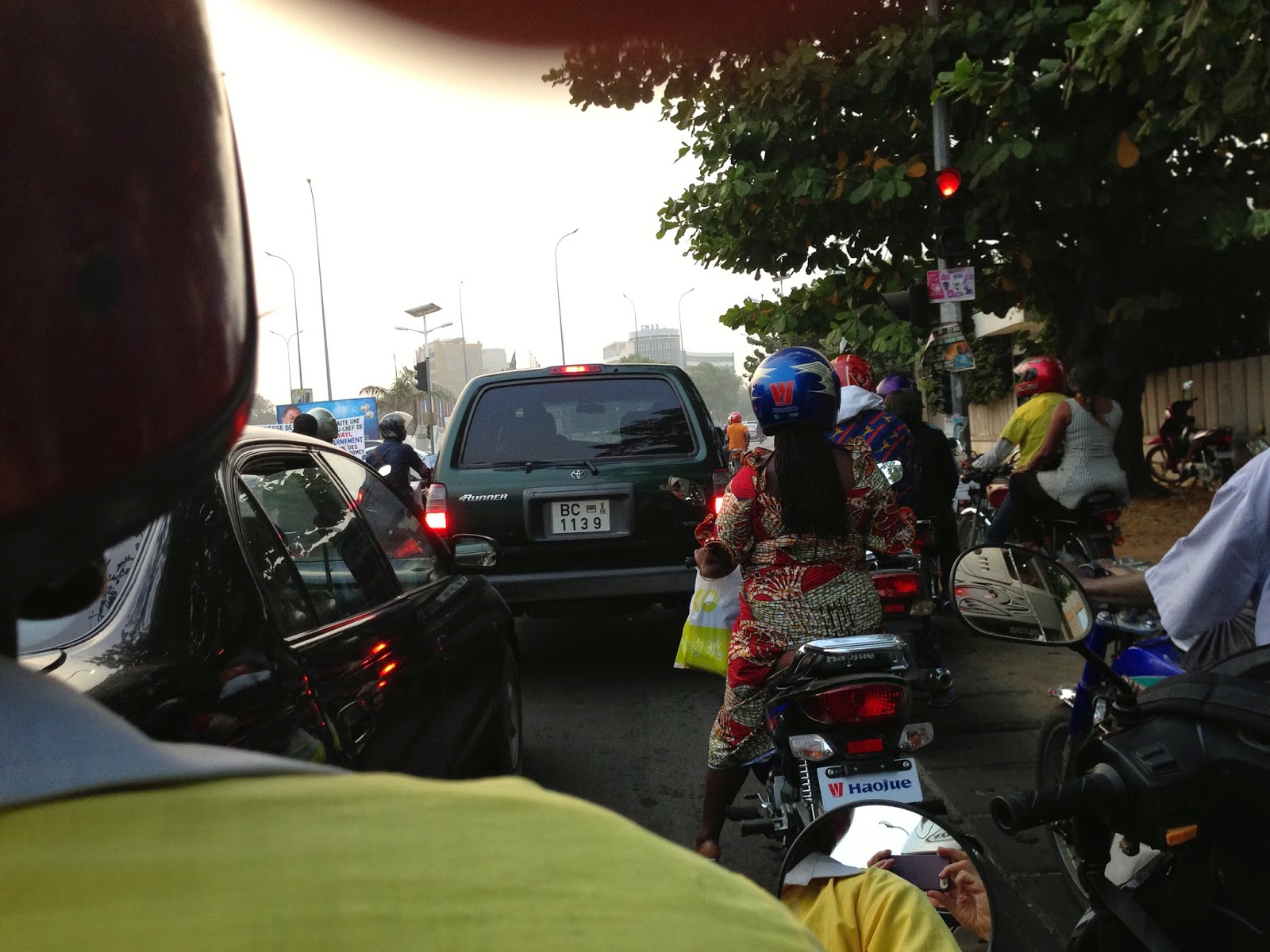
Suzanne returns to a life I can barely imagine — a place where taxis are motorcycles, kings ride on horseback, and electricity and running water are sometime things. Her digs in the capital are relatively deluxe compared to her life in village, where she drew water from a pump, took bucket baths and shared a latrine.

What struck me most from the stories she told is the deep faith of the people. Some worship Jesus, others worship Allah, most all believe in magic of one sort or the other. Many educated people live their whole lives without riding on a plane or leaving their country. Their lives are hemmed in by the unknown far more than ours are.

I was thinking of this today while reading Ursula Le Guin’s The Left Hand of Darkness: “‘The Unknown,’ said Faxes’s soft voice in the forest, ‘the unforetold, the unproven, that is what life is based on. Ignorance is the ground of thought. Unproof is the ground of action.”

Farewell to Suzanne

Farewell to Suzanne

For six weeks I’ve been joking that I would tie Suzanne to a chair to keep her from boarding the plane back to Benin. Now the moment is here: she leaves today.

But I’ve come up with a better idea. In a month I’m planning to visit her.

So it’s “see you soon” instead of “goodbye” — “a bientot” instead of “au revoir.”

Don’t know how I could let her go otherwise …

Tomorrow!

Tomorrow!

It’s not only possible now but entirely sensible to count down to Suzanne’s arrival in hours not days. No more than 32, if all goes well! Her plane is scheduled to touch down at Dulles tomorrow at 2:30 p.m. She’s well into her departure preparations, I imagine, and will leave for the airport in five or six hours for an overnight flight to Brussels, where she transfers to the plane that will bring her home.

The last time I saw her was June 24, 2012. A lot has happened since then.

This is one of the last images I have of Suzanne, walking with two heavy suitcases through a crowded Union Station. She would begin her long journey aboard a train for Philadelphia, meeting up with other Peace Corps volunteers there for the flight across the ocean to in-country training.

She’s not returning for good tomorrow — I wish! — but she does have a six-week leave, and I’ve warned her that she may find herself tied to a chair come December 1. Besides, we’re not thinking of departures now, only arrivals.

For now there’s a new day dawning, grocery shopping and last-minute tidying still to do — and only hours till she arrives.

It seemed like this day would never come. And now it’s tomorrow.

Fighting Fear

Fighting Fear

I try to think of something else but it’s hard not to. I have a daughter flying into Dulles from West Africa this weekend.  She’s not arriving from one of the affected countries but from somewhere close. And while at this point the extra scrutiny (temperatures taken, isolation if necessary) only applies to passengers arriving from Guinea, Sierra Leone and Liberia, I wonder if officials will widen the net, start checking those arriving from any West African nation.

It’s fear at work, I know. But fear is contagious, too. And just as there’s no vaccine for Ebola so also there is no immunization for fear. Information doesn’t help — it’s hard to read a newspaper or watch the news — but ignorance is no better.

One of the most poignant news programs I’ve heard about the epidemic described what doctors and nurses do in Liberia before starting their shifts. Here they are on the front lines, dealing with Ebola patients every day, wearing substandard protective gear and working in primitive conditions. And what do they do before anything else? They stand in a circle, they pray and they sing. 

If they can sing, so can we. Sing in their honor. Sing for their safety. Sing until the fear goes away.

Thinking of Scotland

Thinking of Scotland

For me it means solo travel (my first), discovering the charms of Inverness and Edinburgh, the endless depths of Loch Ness; the panorama of earth and sky and bare, dark hills leading up to Ben Nevis. I took the West Highland line to Mallaig, and watched the ferries scuttling off for the Isle of Skye. I felt like I was at the roof of the continent, on top of the world — and, in more ways than one, I was.

So this morning, when I learned that Scotland voted no to independence, I was excited. I know little of the politics and the frustration — mine is an admittedly romantic view of this misty, feisty nation.

But I’m glad it will keep its ties to the United Kingdom, glad it will not become another casualty in this strange new world.

Home Leave

Home Leave

Yesterday word came from Suzanne. Her home leave is approved! She will be arriving at Dulles Airport at 1:30 on October 20 — and she’ll be in the U.S. for six weeks!

The Peace Corps grants paid home leave to folks who sign on for a third year. Suzanne has already started her new job, as technical assistant to Population Services International and its Beninese partner, planning and training for the peer-education program there known as Amour et Vie. PSI estimates that in 2012 alone its services helped prevent 1,340 HIV cases, more than 70, 000 unwanted pregnancies and almost 30,000 cases of diarrhea.

The peer educators now give Ebola prevention suggestions, too. But their primary work is to bring about the sort of deep-boned changes that will someday lift the country out of poverty — and these will continue long after the epidemic is in check.

It’s good, important work — but it’s thousands of miles away. I’m beyond excited to know that our girl will be home soon — at least for a while!

Canopy Walk

Canopy Walk

As walks go, this was a short one, only about 80 feet. But it was 25 feet above ground — and it swayed as I moved. Up there amidst the live oaks and cabbage palms, I was not just in the foliage but of it.

Florida’s Myakka River Canopy Walk was modeled on canopy walks in the South American rain forests. It’s humble and natural and sturdily built (or at least I pretended that it was).

A 76-foot observation tower on one end let me climb up through the trees to glimpse a panorama of forest and river. I was above the canopy rather than under it.

My knees quivered and I thought about the fear that comes not just from height but from exposure. I felt a kinship with creatures that hide under rocks or brush.

Enclosure is safe. Exposure is dangerous — and exhilarating.

The Return: Some Perspective

The Return: Some Perspective

A rainy-day return to the office. Low light, lowered expectations; today’s goal to survive. Grateful for a certain rainy-day coziness and the quiet required to work hard and long to meet deadlines.

Just coincidentally, I was reading a passage from  Shirley Hazzard’s Transit of Venus as I disembarked in D.C. “Girls were getting up all over London. In striped pyjamas, in flowered Viyella nightgowns, in cotton shifts they had made themselves and unevenly hemmed … They were putting the shilling in the meter and the kettle on the gas ring. … “

Ah, I’m feeling better already. I have a store-bought cotton nightgown. I have an electric tea kettle. I pay for gas by the month not the morning.

Hazzard continues: “It is hard to say what they had least of—past, present or future. It is hard to say how or why they stood it, the cold room, the wet walk to the bus, the office in which they had no prospects and no fun.”

Oh dear. Have I ever thought like this? Of course. Poor me, back from a lovely vacation to my comfortable office! Poor me, paid to write and edit!

Hazzard has put it in perspective: It could be worse, and it has been.

“Poor me” better get busy.