Words That Live On

Words That Live On

Yesterday would have been the 90th birthday of Anne Frank. Seventy-seven years ago, she received a diary for her 13th birthday, a diary she would fill with words that would live on for decades, and, most likely centuries, beyond her.

The contents were in many ways typical — conflicts with her mother, questions about her future. But it was written in 500 square feet of hidden space that Anne shared with her parents, sister and four other people. And it was written amidst the horrors of Nazi Europe.

“When I write, I can shake all of my cares,” Anne wrote in her journal. “My sorrow disappears, my spirits are revived. But, and that’s a big question, will I ever be able to write something truly great, will I ever become a journalist or a writer?”

Anne would die not long after her 15th birthday. The diary she called “Kitty” was left behind in the “Secret Annex.” She could not take it to Auschwitz or on to Bergen Belsen, where she and her sister died of disease and malnutrition shortly before Allies freed the concentration camps. But a family friend saved the journal, and gave it to Anne’s father, Otto, who eventually had it published. It would be translated into 70 languages and sell tens of millions of copies around the world.

“It’s really a wonder that I haven’t dropped all my ideals, because they seem so absurd and impossible to carry out,” Anne wrote. “Yet I keep them, because in spite of everything I still believe that people are really good at heart. I simply can’t build up my hopes on a foundation consisting of confusion, misery, and death.”

(Above: a page from Anne Frank’s Tales book. She also penned what she called The Book of Beautiful Sentences — copying passages of writing that she liked — started a novel and planned a book called The Secret Annex. Photo and information courtesy of the Anne Frank Museum website and The Writer’s Almanac.) 

Good Things Coming?

Good Things Coming?

My punctual and reliable Arlington bus must now make a time-consuming detour to avoid construction in my work neighborhood. You can’t walk a block without hearing jack-hammers or the truck back-up sound. Amazon’s HQ2 is already making its presence known in the dusty streets, the demolition, even the scaffolding.

Having lived for five years in New York City, I consider myself a scaffolding expert. Not in the sense of knowing how to construct it, but in the sense of knowing how to walk beneath it, which used to be… gingerly.

With all due respect to Big Apple scaffolding, the Crystal City version is cleaner, sturdier — and kinder on the eyes and the feet.

In New York, I felt as if I was taking my life in my own hands to walk in a dark tunnel beneath a contraption of wood and metal. But the pedestrian walkway I take now is open and bright. It even has motivational phrases on the walls: Good Things Coming, it says.

Let’s hope.

What Are We Doing Here?

What Are We Doing Here?

I’m picking my way through Marilynne Robinson’s book of essays, What Are We Doing Here? I love Robinson’s fiction and am enlightened by her nonfiction. But I have to read the latter carefully, and more than once, so dense is the prose, so tightly packed are the ideas it holds.

The extra time is never wasted, as her ideas are countercultural in the best sense of that word. Robinson writes about humanism and religion — and she writes unapologetically. Most of our great institutions grew out of our theology, which she defines as “the great architecture of thought and wonder that makes religious experience a house of many mansions, open to the soul’s explorations.”

Robinson does not shy away from delivering charges. Here’s an example: “One thing theology must do now is to reconsider and reject the kind of thinking that tends to devalue humankind.”

To read Robinson is to be reminded of a world richer and fuller than the one we inhabit now, one where what she calls the “moral self, that old wanderer through the trials and temptations of earthly life,” was freer to roam and risk and challenge and live.

Come with Thy Grace

Come with Thy Grace

I often go to a Saturday-evening church service that “counts” for Sunday (it’s a Catholic thing), and was surprised when I arrived to see the red wall hangings and vestments. I had forgotten that it was Pentecost, or more technically, it was Pentecost Eve. Turns out, I had unwittingly worn orange, and so was semi-appropriately decked out for the feast day.

I’ve written about Pentecost before, noting that it was a celebration of clarity, that from the many voices came one.  What spoke to me this time, though, was the jubilation of it all: the extra prayers (a sequence before the gospel), the special blessing, and, of course, the music.

It dawned on me, then, and not for the first time, that one of the needs church meets for me is singing aloud. I’m not saying I don’t go for spiritual strengthening and inspiration. But to join voices with hundreds of others is not an opportunity I’m given every day.

We opened with “Come, Holy Ghost.” Thanks to my parochial schooling, I know the words so well that I didn’t even crack the hymnal till the second verse. “Come with thy grace and heavenly aid, to fill the hearts which thou hast made. To fill the hearts which thou hast made.” I could almost hear my seventh- and eight-grade classmates belting it out with me, struggling as usual to reach that high “D.”

Oodles

Oodles

Last night we went out to dinner — a friendly, chaotic Thai place. It was just the five of us, a rare occurrence in these days of married and otherwise partnered daughters. It was a lovely reminder of what started it all.

I’m so fortunate to have in my life the lovely men my daughters love. But I also treasure hanging out with the original us.

Layers of family, levels of family, oodles of goodness all around.

(The girls many years ago. It must have been after a band concert, which is why Claire, right, is in formal attire.) 

Fortunate Day

Fortunate Day

I was waking up slowly when the sound of a falling branch catapulted me into full consciousness. It’s a hazard of living in the midst of a waning suburban forest, a place where the old oaks have outlived their three score and ten.

This time we seem to have been spared. It was either a branch from the common land, or a smaller limb off the tree in our yard that’s already slated for demolition next time the tree guy comes around.

But the swoosh and thud did serve as a rousing alarm. It got me up and into the morning, where I took a delicious amble through humid air and young birds doing that little looping fly that is so endearing.

A day that begins with an early walk, no matter how one comes by it, is a fortunate day indeed.

The Boys in the Air

The Boys in the Air

Today, as we celebrate the 75th anniversary of D-Day, I think not just of the boys who stormed the beaches but also of the boys who flew above them. One of them was my dad.

Frank Cassidy was 20 years old when he took the trip of a lifetime, courtesy of the U.S. government. It was an all-expenses voyage to and from what Dad called “Jolly Old” England. He was stationed at a base outside the village of Horham in East Anglia.

On June 6, 1944, Dad had just turned 21. He had become adept at crawling into the tail-gunner’s seat of a B-17 bomber and firing the gun when necessary. That day, he and his crew would fly two missions, softening up enemy defenses, backing up the infantry, the men who were landing and dying on the beaches of Normandy.

Dad always insisted that what he did was nothing compared with them. “I don’t think the American people appreciate what some of those men did,” he told a newspaper reporter in 2009. “Those guys, they deserve all the honors.”

With all due respect, Dad, I disagree. I think you deserve the honors, too.


What He Learned

What He Learned

Today, walking to work from Metro, I thought about the book Everything I Really Need to Know I Learned in Kindergarten.  It was crossing the street that made it come to mind and, once there, it wouldn’t go away.

The book was quite a phenomenon when it was published in 1986, and a 25th anniversary edition appears to be selling briskly. In it, Robert Fulghum says that he stands by his simple rules, that he still believes if we only practiced what we learned in kindergarten we would all be better off.

What did we learn? Things like “share everything,” “play fair,” “clean up your own mess” and “when you go out into the world, watch for traffic, hold hands and stick together.”

Though it’s easy to poke fun at the simplistic message, given the state of our nation and our world, Fulghum’s words resonate even more deeply today than it did when he wrote them.

Exceptional!

Exceptional!

We’ve been dished out a couple of exceptional early June days with cool nights and mornings and bright, breezy afternoons.  It’s the kind of weather where you’re equally comfortable in long sleeves or short, blue jeans or capris.

It’s flexi-weather. Choose from a, b or c. Add d, e or f. Mix thoroughly and enjoy.

Which is what I’ve been doing. A short walk last evening took me only halfway round my usual course, but al fresco dining completed the night.

And this morning, I threw open the windows and let the air in.

We have so few days like this; I want to savor each one.

This Old Kitchen

This Old Kitchen

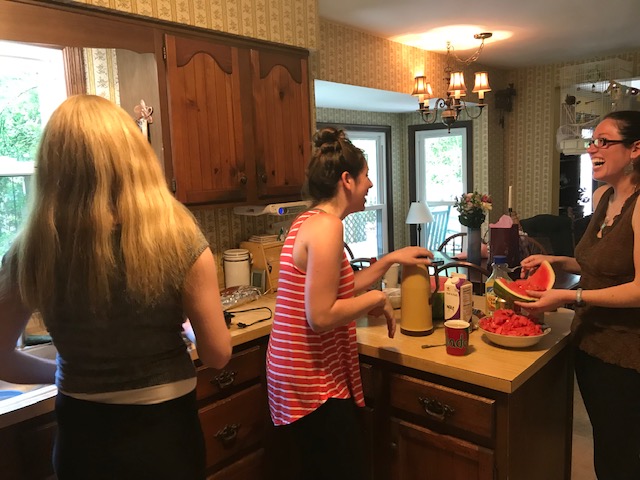
The wallpaper is original, the cabinets, too. The countertop is Formica and the appliances don’t match. Storage is minimal and opening the refrigerator door blocks off the entire room.

Yet, more than 11, 000 meals have flowed from this room and countless family conversations have occurred in it. It’s been the scene of celebration, jubilation and consternation.

It was put through its paces this weekend, with all the meals prepared, dishes washed and leftovers crammed into any fridge nook and cranny I could find. And of course with the girls together making coffee, slicing fruit — and hanging out.

Though we took a few “formal” family shots over the weekend, it’s candid ones like these that I appreciate the most. They capture the allure of the kitchen, the craziness of it, the love and laughter it has known.

Will we ever renovate it? I doubt it. But if we do, I hope all the good vibes remain.