Tread Well

Tread Well

Yesterday’s walk began in the woods, late afternoon light slanting in through the canopy. Copper and I crossed Folkstone Drive, strolled down Treadwell, a street I love not just for its name (perfect for walkers) but also for its length and lack of traffic and for the calmness I feel when I’m on it.

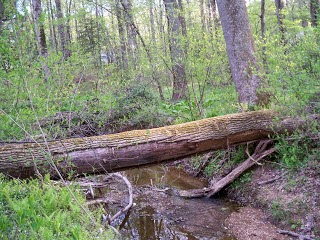
Treadwell ends in a pipestem with houses tucked deep in the forest. Before you reach it, though, there’s a path back into the woods. We took it, picking our way through some sticker bushes and crossing a creek that required my first sitting down on the bank (a hesitation Copper didn’t understand) before launching myself forward to the other side.

Once across the tributary, we could wander from one trail to another. I noticed the silence, interrupted only by the caws of a crow and the hum of a distant airplane. Was it the silence that freed my mind to appreciate the beauty, the jewel-green moss atop the decaying log, the ferns waving slightly in the breeze?

Nothing is not beautiful here, I thought: the weeds, the stumps, the whole trees uprooted and left lying where they fell, their root balls like the inside of giant umbrellas. All of it a pleasure to the eye.

As we grew closer to the exit, the woods became noisier. It was a landscaping crew grooming the yard of a nearby house. Two mowers and a weed whacker. Welcome back, they seemed to say with their jangle and bluster, welcome back to the world.

Little Voices

Little Voices

It’s summer time and into the click-click of computer keyboards and the businesslike tones of those  in Important Meetings comes another sound, a welcome sound — the high-pitched ping of little voices.

A couple days ago a colleague brought her baby to the office and I could hear the babbling and squawking from many doors down the hall. And both Wednesday and Thursday I ran into daycare kids on campus — yelling, laughing, taunting and teasing.

It brought me back to the days of the little voices in my own life, how I treasured them even then, knowing how precious they were, how fleeting. Now they’ve matured into the voices of adult women, not even a “like, you know” left from the teenage years. They are still precious to me, but they are different.

When I was knee-deep in child rearing I used to wonder why older folks would smile as I extricated  one of my noisy children from underneath a clothes rack or a church pew. Now I understand. They liked the sound of little voices too. Like me, they listened and remembered.

Late Arrival

Late Arrival

First there is the wakening, slightly panicky, the feeling that something is not right. Next, a peek at the clock. After 2 a.m. Surely she should be home by now.

Should I get up and look out the window? If the car is there I’ll rest easy; if it’s not, I’ll be awake till she gets home.

Last night it was the latter. A late arrival, but not much later than my wakening. I fall back to sleep, happy and grateful.

The morning after the late arrival is another story: Bleary and disbelieving. How can it already be day?

Picture Window

Picture Window

I saw them on walks in Lexington, what we had when I was growing up, what I see in older houses still, but not as much anymore.

The picture window provides an unbroken look at the out-of-doors. No parceled glimpses of street or flower or tree. The picture window is open and unbroken.

Or at least mine was. It was the way I first looked out at the world, and I wonder if it accounts for the fact that I like to be out in it now.

Picture windows, I read, are non-opening windows that allow light into a room. Ah yes, that’s right. That window didn’t open.

What strikes me now about the picture window is its name, which doesn’t refer to panes or light but to framing. The picture window frames what it sees and presents it to us brightly and tidily.

The world in a frame. Almost.

Pace Car

Pace Car

My companion for a good 120 miles of yesterday’s trip was a gray Ford Focus with Ohio plates. The driver was a young woman, about the age of my daughters, I think. She was careful. She allowed herself to go five miles over the speed limit, maybe seven or eight on a steep grade, but she never nudged up to 80.

I first became aware of the car when it passed me a minute or two after I passed it. Not good, I thought. We’re going to have a competition. But she didn’t venture far ahead of me, and I was content to follow her. So this early skirmish morphed into a steady companionship as we took the ups and downs of I-64 from Beckley to Lexington in tandem. When she passed, I passed. When she slowed, I slowed.

It’s a lovely stretch of road, high country with rows of blue mountains receding in the distance. But it’s also lonesome; I appreciated the vehicular companionship.

I often do this when I’m driving alone. Pick a car and stick with it. That automobile becomes my  personal pace car. I keep it in my sights, use it to measure my speed. And I make up stories for the driver. In my white-line-fever-addled brain, my car and the pace car become friends.

Personification makes the miles melt away, and we reached I-81 in no time. I pulled into the left lane to head north. Somehow I knew the Focus would travel south.

I drove three more hours to get home — but I never found another pace car. I missed the Focus.

Dinner Time

Dinner Time

I’m about to drive east, loading the car before dawn. The ten-minute span between one load and the other is the difference between darkness and light.

As morning comes, remnants of night stay behind. A stray star gleams in the lightening sky. Bats scour the air for one last feed before sleep.

For me, breakfast is down the road. For them, it’s dinner time.

All That Glimmers

All That Glimmers

I stepped outside last night right after dark to catch a glimpse of Lexington’s fireworks. A neighbor told me he had viewed the display from the backyard of a house three doors down, so I figured there was a chance.

At first I saw only smoke, evidence of local fire crackers and bottle rockets. But from time to time I’d hear the deep boom of the real thing. And then I spotted the colors, the reds and greens barely visible through the trees. Light forms pulsing up and out.

It was a cool evening and fireflies were winking ever upward in the sky. There were more than I see at home, more than I’d seen any other night this year. Their glimmers mixed with the manufactured ones in the sky. The effect was of a fairy land of dancing light. It was a mutual rejoicing, of earth and of all the creatures on earth.

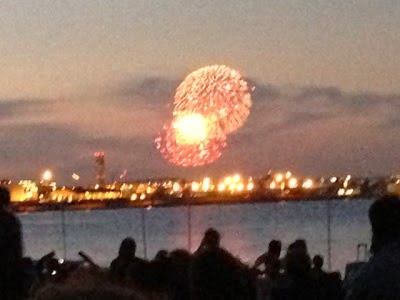
It wasn’t what I saw later on television, the spectacular fireworks from the nation’s capital (pictured above) that I watched last year from across the river. Last night’s light show was too ephemeral to be photographed. It was a moment of holding my breath. It was a moment of wonder.

Ale & Cobblestones: An Alternative 4th

Ale & Cobblestones: An Alternative 4th

Sometimes I’m glad it’s a holiday because I want to celebrate the holiday. Other times I’m glad it’s a holiday because I need a day off.  The lack of patriotic imagery at the top of the page will explain how I feel about today.

Actually, I’ve been laughing this morning over something I heard on the radio driving to Kentucky yesterday. It’s about an ad campaign for Newcastle Brown Ale, imagining if Britain had won the war.

“Coast-to-coast cobblestones, shoe shines on every corner, all the fish head pie you can eat. And at the end of the day you’d kick back and surf through all five of our government-run television stations.”

That’s dialogue from one of the spots. Other advantages of “Great Britain 2”: Lovely accents, free health care (if you don’t mind waiting a couple of years for an appointment) and colorful curse words.

The ads are hilarious. But don’t take my word for it. Listen for yourself. And dream about driving on the left, eating mushy peas and having tea and scones every afternoon.

Happy 4th!

The Beaten Path

The Beaten Path

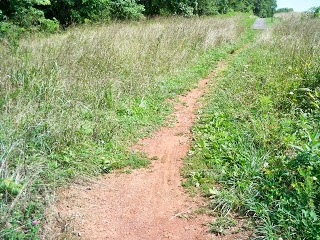
Sometimes I’m on it, sometimes I’m off it. But I always have a responsibility to it. For who will keep the path beaten if not the walker? Who else will clear it of weeds and stones? Who else will smooth it out, will wear it down to dirt?

On woods walks it’s easy to spot which paths are well trod and which have banished from neglect. Animals do their part; there are deer runs in the woods, too. But humans blaze the widest trails.

I find this thought comforting: That the forest needs me just as I need the forest. That in passing through I create the possibility of further passage. That each amble makes the next one easier. That each foot fall is creative.

This is more than just “use it or lose it.” It’s organic, symbiotic. It’s proof, once again, that we’re all in this together.

Power of the Perch

Power of the Perch

Watch birds for long and you’ll come to understand the power of the perch. It might be a feeder holder, as this goldfinch models, or the edge of the bird bath. Hummingbirds position themselves on the topmost wire of the tomato cage. Cardinals alight on azalea branches. Doves pace on the deck railing.

Many birds like to perch on the dead limbs that despite our best efforts at pruning still protrude over the backyard. There are only two large limbs, and I think they’re unsightly. But they are full of leafless branches on which birds can perch and chatter and clean their beaks. I’ve come to appreciate the utility of these dead limbs and wouldn’t want to remove them — even though they hang like swords of Damocles over the lawn.

Birds use perches to claim territory and assert power — the higher the better, of course. And in this they are not unlike humans.

But perches are also where birds sing and roost and court their mates. Perches are resting places, where birds watch the world go by. They are, in a word, home.