The Great Pause

The Great Pause

It’s almost December, trees are bare. Paths that seemed endless in summer green are exposed when winter comes. The community forest is not the leading edge of a wilderness; it is a parcel of land that didn’t perk.

But that’s not all. It is also is a landscape stripped to its essence. I take out my earphones and listen. I can almost hear the silence. The great pause. A momentary intake of breath before the hard exhale.

The fields are
empty; the nights are long. Early winter is peaceful, muted. It asks nothing
of us now.

Humble Sides

Humble Sides

Yesterday’s feast, like every other Thanksgiving meal I’ve ever cooked, was proof that though the turkey gets all the glory it’s the side dishes, the humble sides, that deserve it. They are where the real finesse comes in, the true effort; they are more difficult to prepare and, arguably, more scrumptious to consume.

Here it was fairly light as holiday cooking goes. The yams were baked, the potatoes were boiled — and I wasn’t responsible for the green bean casserole.

But the stuffing involved dicing and stirring, ditto the cranberry salad. And the pies (though a dessert and not a side dish) are always labor-intensive, though I wouldn’t have them any other way.

On the other hand, the turkey is easy to baste and roast — and it sits regally atop the table, the centerpiece, the champ.

The humble sides don’t seem to mind, though. They have long since accepted their relegated roles. In exchange, they avoid the slow, protracted, death march of the leftover — no sad progression from sandwich to salad to hash for them. The turkey, they know, gets its comeuppance in the end.

(What to eat the day after.)

The Parade

The Parade

The Macy’s Thanksgiving Parade just ended — with all its balloons, bands, commercialism and faux cheer. Still, I had it on in the background as I baked the pies, made the stuffing and popped the bird into the oven.

As I heard the familiar tunes, salutes to the latest toys and cartoons (all of which I’m blessedly oblivious to now!) and, of course the obligatory salute to the Big Apple (“It’s up to you, New York, New York”), I couldn’t help but think about the part the parade played in my childhood.

Was it the parade that made me fall in love with Manhattan long before I had a chance to live there? Was it the parade that filled me full of Big City dreams?

It certainly played a part.

Today I’m thankful for family and friends, for health and warmth and work. I’m also thankful for dreams. They may never quite measure up to reality. But that’s not what they’re for.

32 Degrees Fahrenheit

32 Degrees Fahrenheit

Once an English major, always an English major. And as an English major, I’ve always appreciated imprecision. The characters are motivated by greed — or maybe it’s ambition. The landscape mirrors the late 19-century love of technology — or maybe it’s the late 19-century fear of technology.

It’s the principle that’s important — and the principle is often imprecise, something to ponder or debate. It’s not black or white but something in between.

Which is all to say that I’m fascinated by the unerring precision of the natural world. Water freezes at 32 degrees Fahrenheit. Not at 34 or 36.

I was tremendously grateful for this fact yesterday, as I crept up the Baltimore-Washington Parkway to collect my college student. It took three hours to drive 54 miles. But if it had been three degrees chillier, it might have taken me six hours.

There I go again — thinking like an English major.

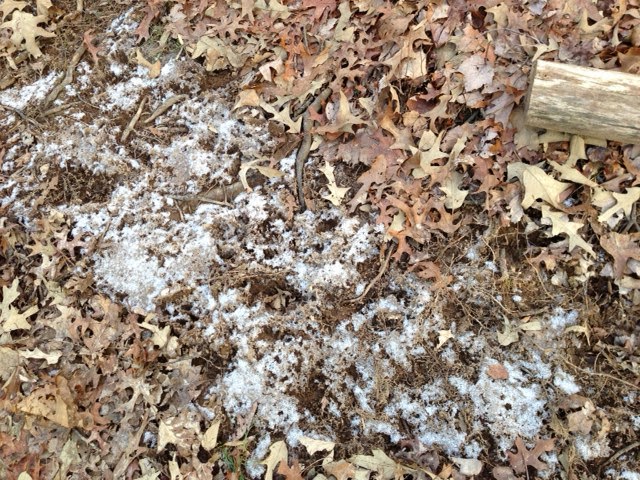
(This picture has very little to do with 32 degrees Fahrenheit. It’s an English major kind of photograph.)

Over the River …

Over the River …

And through the woods … traveling to the Thanksgiving feast has never been easy. But here in the megalopolis it’s taken on a new degree of craziness.

A nor’easter is expected to dump anywhere from two to four inches of rain in the next 24 hours. Snow and ice have not been ruled out. Flooding is a possibility. Traffic jams are guaranteed.

To gather at grandma’s all you needed was a sleigh and a team of willing horses. To reach family and friends at the modern table requires strategic thinking (should I leave at 2 or 1:30?), nerves of steel (which route through the mountains promises the least chance of snow accumulation?) and a go-for-it attitude.

But go-for-it we will. People are important. Whether they’re over the river and through the woods — or up I-95.

Color, Still

Color, Still

Most of the time, nature is kind. It gives us something to hang onto. In this case, fall color. Not all of it goes at once. Even yesterday’s wind gusts left a few tenacious leaves on the trees.

This gives the eye something horizontal on which to gaze, a relief from the unremitting verticality of winter’s bare trunks.

Is it just my imagination, or are the final colors more vivid, more alive?

Bouncing with Britten

Bouncing with Britten

Almost lost among the Kennedy anniversary hoopla was that yesterday was also the 100th anniversary of the birth of Benjamin Britten.

For some reason I’ve been on a “Britten kick” lately anyway, having taken one of the British composer’s CDs along with me (totally randomly) on my most recent drive to Kentucky. I’m no Britten aficionado — no “Peter Grimes” for me, thank you very much. But the more accessible stuff, like the “Simple Symphony” or “The Young Person’s Guide to the Orchestra” are highly hummable and provide hours of listening pleasure.

Last night, long after dark, I went outside and jumped up and down on the trampoline with Benjamin Britten’s music in my ears. I do some variation of this all the time — bounce while listening to the music of dead white guys. But for some reason last night the miraculousness of it all hit me with extra force.

Benjamin Britten was born 100 years ago. He wrote this piece in 1946. And here I am, 67 years later, his music piped into my ears with a device he could not have imagined, bouncing on a trampoline to its rhythms. Bouncing with goosebumps, I might add.

(Last night’s Benjamin Britten portal.)

What Died with Him

What Died with Him

It’s hard to say anything about President John F. Kennedy that hasn’t already been said. There was even a newspaper article about the pink suit and pill box hat Jacqueline Kennedy wore in Dallas that day. (They have been preserved, complete with blood stains, not to be displayed for another 50 years.)

What struck me last week, when I watched the two-part PBS special about JFK, is how young he was, how young we were.

Young and innocent.

This was before Watergate, Columbine, 9/11, Newtown. This is before we lost face, lost hope.

It’s as if he embodied all the promise of a younger nation — and all that died with him on November 22, 1963.


(Tourists visit Kennedy’s grave in Arlington Cemetery.)

November in the City

November in the City

Walking up the Metro escalator into the gray light of a D.C. morning, I see a woman with a turban, perched regally atop a folded box. Another woman, less regal, warms herself on a grate, hood over her head and, on her feet, impossibly high platform shoes.

I see the gray felt blankets from the homeless shelter abandoned on street corners. Chicken bones and cigarette butts blown up against the walls.

Around the trees are pansies the color of dark blood. In the distance, a car alarm sounds. And closer by, an ambulance.

Commuters walk quickly. Their shoes click briskly on the pavement. They don’t want to linger here. 

“It’s so much better than it used to be,” say old-timers of the neighborhood.  And I believe them; really, I do.

150 Years and One Day Ago Today…

150 Years and One Day Ago Today…

… President Lincoln delivered the Gettysburg Address. Yesterday’s coverage of the event noted that the speech was 272 words and it took Lincoln only two minutes to deliver it. It was preceded by Edward Everett’s two-hour oration, which is remembered now only because of what followed it: 10 perfectly crafted sentences that conveyed a nation’s aspirations and ideals.

One score and three years ago, I wrote about the Gettysburg Address. About how I memorized it in school, promptly forgot it and wished I had remembered it (among many other things).

Memorization seems even quainter now than it did in 1990. Why remember words when you can look them up on your smart phone? 

Perhaps the reason I gave so long ago is still true today. Learning a passage or a poem “by heart” liberates us, I said. “Once we know the words we carry their wisdom around with us; we are freed from the printed page.”

Lincoln’s words liberated us — in more ways than one.