The Bibliophiles Have Spoken

The Bibliophiles Have Spoken

I’d first heard the news from a friend a few weeks ago, someone who works in the Fairfax County Library system. Books were being tossed and librarians were being let go, she said. A new plan was in the offing, one with fewer librarians and fewer books, a plan later hailed as the transition “from a print environment to a digital environment,” according to a Washington Post article that broke the news last week.

When a county supervisor heard the news about the banished books, she rescued scores of good volumes from a dumpster and deposited them on the desk of a county official. The discarded books became a call to arms.

Since the news was made public, the Fairfax County Library has been told to put its new library plan on hold.

The books are safe. For a while, at least.

Farmer’s Market

Farmer’s Market

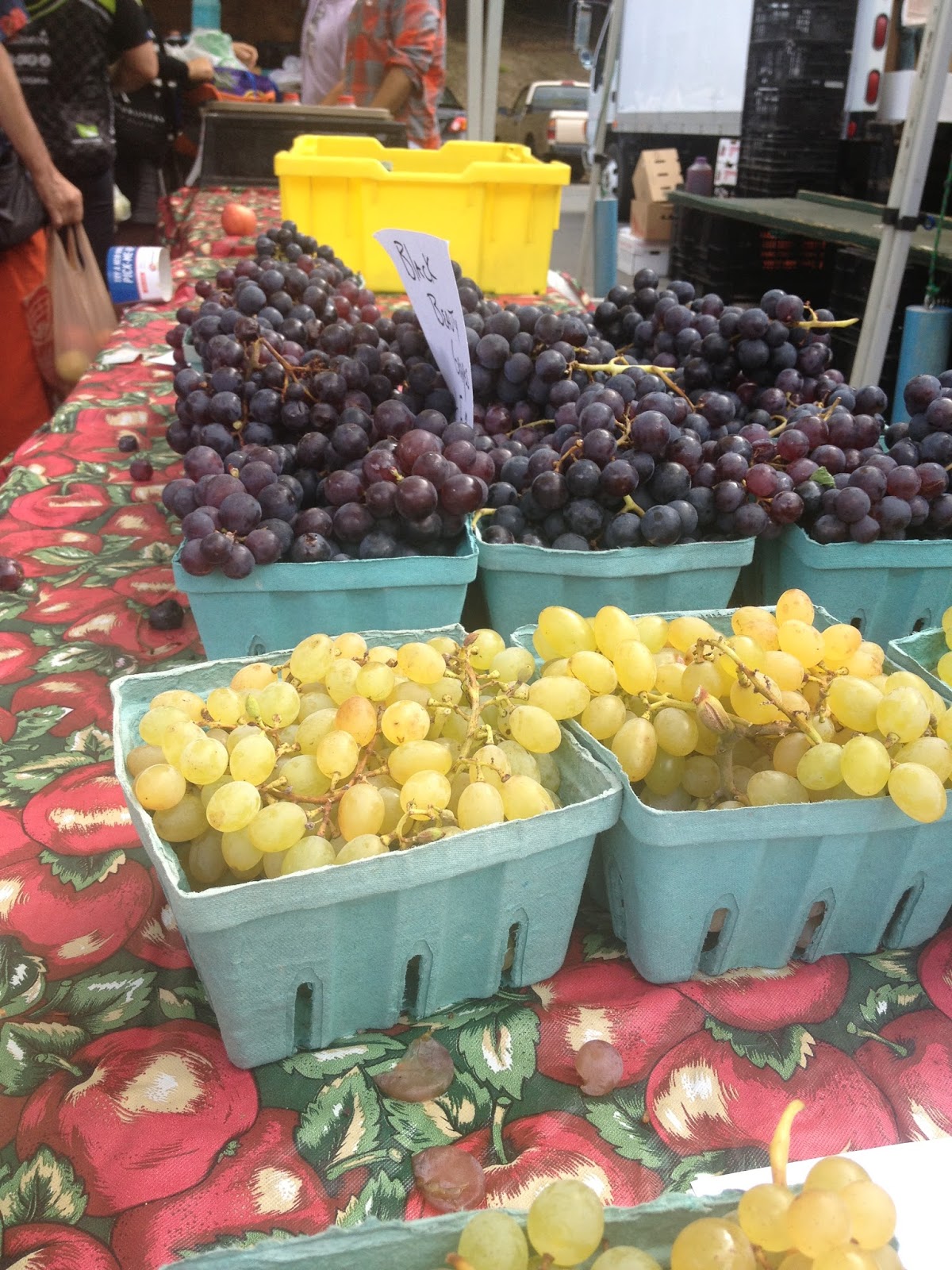
Warm sun, cool air, full harvest. The Reston Farmer’s Market is one of the bigger ones in the area, and even though we arrived at the end of it there were still plenty of tomatoes … and peaches … and eggplant … and grapes. 

Let the salads and stir-fries begin.

(Photos by Claire Capehart)

Hidden Garden

Hidden Garden

This is a corner of the yard you can’t see from inside, the outer edge of a small grove of trees that softens and shelters half the house.

Ferns, hollies, a crepe myrtle and a knockout rose are gathered here with little thought to their placement except hope that the rose and crepe myrtle would have enough light to bloom.

There is no gate, no wall or key, and it holds no fairy magic. But I like to think of this place as a hidden garden, because though it’s visible to neighbors, it is, for the most part, invisible to me.

Burying the Lead

Burying the Lead

Though it originates in our nation’s capital, this blog is decidedly apolitical — with a few exceptions, several of them also occurring, curiously enough, on 9/11. What I have to say today is not a solemn memorial, though — it’s an editor’s view of President Obama’s speech on Syria.

Maybe it’s because I’m in the final stages of getting the magazine to the printer and am thinking best with a red pen in my hand, but it struck me last night that the startling new diplomatic developments that began emerging  the day before yesterday were not so much fully incorporated into the president’s speech as they were tacked on at the end. This gave the address a confusing inconsistency.

For at least two-thirds of the 17-minute speech Obama told us why we should use force to punish the Assad regime for using chemical weapons against its own people — and then for the next five he told us that the vote to authorize such force was postponed in order to explore a diplomatic solution. We in the journalism biz call this burying the lead.

This didn’t just confuse me; it made me feel used. As George Orwell pointed out 67 years ago in his essay “Politics and the English Language, “…[T]he decline of a language must ultimately have political
and economic causes: it is not due simply to the bad influence of this or that
individual writer. But an effect can become a cause…” As he noted a few paragraphs later, “[I]f thought corrupts language, language can also corrupt thought.”

Perhaps there is no hope for political speech. Orwell didn’t think there was. “In our time, political speech and writing are largely the defense of the indefensible,” he said.  It’s hard to believe that the world has improved much in the last seven decades.

But if last night’s explanation had been more honest from the start, it would at least have gotten my attention.  And perhaps even earned my respect.

Waist-High Weeds

Waist-High Weeds

I found my neighbor, Teresa, weeding in the woods. “It’s Japanese stiltgrass,” she said, “and the only way to get rid of it is to pull it up.”

Tell me about it. I’ve been pulling it up all summer, but have never felt sufficiently ahead in my own yard to take on the common land.

But Teresa has. And does. She and her husband, David, often take a bag along on their walks to pick up trash in the neighborhood.

I do not bag and neither do I weed. Instead, I ponder the stiltgrass as I walk, notice the height of it, waist-high in spots, think about this wild vegetation taking over the woods, the fields, the yards.

It’s a green wave, a green sea, rolling ever forward. We can try to stem its tide, but we are powerless in its wake.

Light on Water

Light on Water

I walk when the time is right, when the writing and the chores are done. I don’t always consider the quality of the light.

Maybe I should.

Yesterday, Copper and I made our way through the woods as the sun slanted low through the oaks, glanced at their roots and spotlit the creek. The water shimmered in response, gave up its secrets, its depth, its hurry.

The light was a laser pointer teaching the landscape. Look here, it told me, here are sights you should not miss.

Big Sky

Big Sky

It is a day of clarity and blue sky, a day that makes me dream of the West with its forever-faraway views. What would it be like to live in the open, to give up the canopy we Easterners hide beneath?

In Wolf Willow, Wallace Stegner has some answers:

Over the segmented circle of earth is domed the biggest sky anywhere, which on days like this sheds down on range and wheat and summer fallow a light to set a painter wild, a light pure, glareless, and transparent. The horizon a dozen miles away is as clean a line as the nearest fence. …

The drama of this landscape is in the sky, pouring with light and always moving. The earth is passive. And yet the beauty I am struck by, both as present fact and as revived memory, is a fusion: this sky would not be so spectacular without this earth to change and glow and darken under it.

Books at Hand

Books at Hand

They’re piled on the bedside table, scattered on the coffee table, wedged two deep on bookshelves.

At least one commutes on Metro with me, often two, fiction and nonfiction. And always, of course, my own little black book, my journal, along for the ride.

Why must I have books around me? More books than I can possibly read?

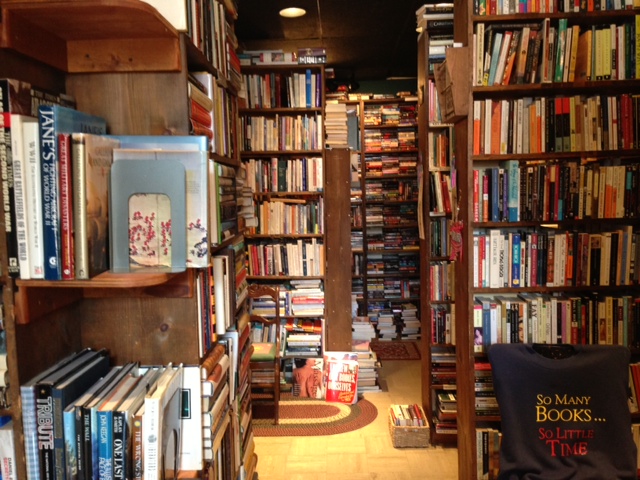
Same reason I’ve always loved bookstores and libraries, I guess, which has something to do with the special calm that comes over me when I’m in them.

Here within reach this Friday morning are two memoirs, a novel, a book on mindfulness and another on grace, two books on place and some historical fiction.

Will I read all of these within the next hour? Unlikely. I’m reading page proofs today. But having books at hand, knowing I can dip into them at any moment, is a way of being. Books are as essential as air.

The Places In Between

The Places In Between

It’s a pit stop, a place to get gas on I-64, a hilltop station with rocking chairs on a little front porch that provides this view as respite for white-line fever.

Well, almost this view. To snap this shot I walked down the road a few feet while filling up the van. But still, this is more or less what you would see if you had a few minutes to while away.

I paused only long enough to take this picture. An impatient driver, I allow myself no more than 10 minutes at a stop — and I don’t spend them sitting!

This photo reminds me of the journey not the destination. It reminds me of all the places in between.

Shopping Alone

Shopping Alone

It had been two weeks since I’d shopped for groceries. Two weeks of eating the ultimate leftovers, what’s left in the freezer after the kids have gone. But having exhausted most staples, I headed for the store.

I begin in the dairy aisle. No gallon of skim, just a pint of whole milk for my tea.

I skip the cold cuts, the Lunchables, the Fruit Rollups.

No candy or cookies or crackers. No goldfish! Kid cereal successfully bypassed, too; I go for the granola instead.

Meat, eh! Fish, double eh! I even pass on pasta. I settle on salad and one of those rotisserie chickens, the kind someone else cooks for you.

Before I leave I move through the produce aisle. The pears, I always bought them for Celia. The apples, those were for
Suzanne. Claire has always loved melon.

So I buy all three — pears and apples and
melon — just for the memories, you understand.

(Photo: 123RF)