Up Close

Up Close

There were fewer people then, but they huddled together. Eleven souls once lived in this tiny house, which consisted of one room downstairs (a bed, a hearth, a table) and a cramped stairway to the second floor. There, scads of islanders were born — including the mother of an old woman I met the day I visited this place, the oldest house in Chincoteague, Virginia (circa 1795).

Meanwhile, there are only three of us now in a once cramped center-hall colonial that is ever more roomy as the children move out. And we are one of the smallest houses around. Nearby neighborhoods are filled with McMansions, their two-story foyers and three-car garages of a different heft and scale than the houses here.

What sort of people does crowding create? And what sort of people emptiness? I re-charge in solitude and would probably have been driven crazy by the cheek-to-jowl existence of my ancestors. But still, there are times when I feel a deep-boned loneliness that’s not so much personal as evolutionary. Maybe it’s the crowded rooms of the past that I miss, the intensely shared life that never let us forget that we’re in this together.

Something to Say

Something to Say

“People like to ask me if writing can be taught, and I say yes. I can
teach you how to write a
better sentence, how to write dialogue, maybe even how to construct a
plot. But I can’t teach you how to have something to say,” says writer Ann Patchett, quoted in yesterday’s “Writer’s Almanac.”

Ahh, the ever elusive something to say. Seems self-evident, but of course is not.

Maybe the something to say is buried and must be excavated, shovel by shovel, until you hit pay dirt. Or hiding and must be tamed like a shy bird. Or blocked by a gate to which there is no key.

How many times have I sat with  fingers poised above a keyboard — or even with fingers flying only to realize 500 words later that these words are going nowhere.

“What do you want to say?” is the question.

Too often, I don’t have an answer.

The Measurement of Awe

The Measurement of Awe

Finally! An article from the Washington Post that is not about the fiscal cliff but about a real geological marvel.

A story headlined “Huge Gap for Geologists: How Old is Grand Canyon?”  explains that until recently, most scientists believed the canyon to be six million years old. But new techniques (and new scientists, one of whom is 36 years old) say the canyon could be 70 million years old. This would put its formation back to a time when dinosaurs roamed the earth.

The article (true to fiscal cliff style journalism) discusses how the new canyon theorists and the old canyon theorists are sparring.”It is simply ludicrous,” sniffs one professor of geology. Adds another: “We can’t put a canyon where they want to put it at the time they want to put it.”

All of this hardly matters when you stand on the lip of the south rim and look into what seems like time itself. Is it six million or 70 million years old?  This question may some day be answered. Will I ever see a scenic vista that moves me more? I was 13 when I first saw the canyon —and I haven’t yet.


(Photo: Grand Canyon National Park Service Flickr site.)

Eighteen!

Eighteen!

Today is Celia’s 18th birthday. Today she reaches
the age of majority … as we creak along toward the age of seniority.
Not really, though. A youngest daughter is a marvelous gift,
keeping her parents in fighting trim, bringing them face to face with the
future (whether they want to see it or not).
I went out before daybreak this morning to pick Celia a
rose. I had no trouble finding one; the whole yard was lit up by a full moon
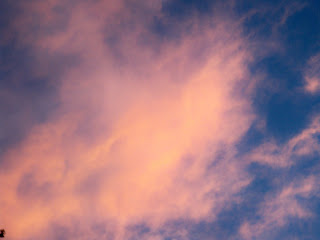
ringed in a pinkish halo of mist. Above the moon was a contrail, a single arched eyebrow — a shooting star pointing up
instead of down.
It’s a lovely day for a birthday.

Celia at two-and-a-half.
Friendship Priming

Friendship Priming

The newspaper clipping, neatly labeled “International Herald Tribune,” came from Kay in France. She had tucked the essay in with a note that said “this has ‘Anne’ written all over it.” 

The topic: structural priming, the unconscious influences on writing, how what we read settles into our brain and sets up shop there and, before we know it, we’re penning lines better suited to reports than poems. It’s a habit we can break by cleansing our “linguistic palate” — reading widely and “against type.”

The author, Michael Erard, has written short stories, essays, reviews and nonfiction books — but his day job is a think tank researcher. In other words, he says, “I’m a dancer who walks for a living.”  And he dances better, he says, if he shuts off the Web and dips into a page of Virginia Tufte’s Artful Sentences: Syntax as Style before beginning his creative work.

Reading this essay was like turning a kaleidoscope and bringing a new palette into place. It’s something I’ve thought about for years, but couldn’t have articulated.

And it’s worth noting that although I might have stumbled across the article online, it came to me because someone I love thought I would like it. Which makes it an example not of structural priming but of friendship priming, the uncanny and unconscious connections that exist, that flourish, between friends.

In the Wings

In the Wings

Watching a colleague’s fine film about a musician’s comeback from MS makes me think about music, how important it was to me growing up, how it has slipped out of my life, how I might bring it back.

Consider the offstage trumpet. Many composers have used it — Mahler, Respighi, Verdi — but the piece I remember it in most is Beethoven’s Leonore Overture Number 3. I was buried in the string bass section, still learning to play the instrument, while Jim Reed, first-chair trumpet of the Central Kentucky Youth Symphony Orchestra, stood in the wings of Memorial Hall blaring the call.

But it could be any orchestra anywhere, the trumpet in the distance, like the call to hunt or the approach of a royal entourage. It’s the acoustic equivalent of painterly perspective, a tonal shading, extending the orchestra beyond the stage.

Hearing it played (from minutes 9:17 to 10:12 of this recording) makes me think something important is about to happen. Not here, of course, but somewhere else. It is, therefore, a reminder to pay attention to the faraway and forgotten, to what’s offstage as well as on.

Wintry Mix

Wintry Mix

They’re forecasting rain and snow today. But it’s still autumn, I silently protest. It’s not even December yet. Let’s just say rain and hope for the best.

Weather is neither kind nor vengeful. I know this. Yet I must harbor some ancient belief or prejudice that makes me permeable to the meteorological mood.

One reason I like the climate of Washington, D.C., is that, despite its muggy summers, it’s a surprisingly sunshiney place. If a “mix” is predicted (like today), it’s more likely to be rain than snow, sunny than cloudy.  That’s a mix I can live with.

The Shenandoah Valley, snapped from I-81 on Saturday, when no wintry mix was forecast.

R.I.P.

R.I.P.

When I bought it, all three girls were living at home, one still in braces. When I bought it, the first iPhone had not yet been released.

Life was simpler then. An email was an email, a text a text. There was no cloud, or at least none accessible by a hand-held device.

I was proud of my flip phone. I could talk on it, text with it and even take photos with it (an innovation my earlier phone had lacked). I kept it in a case, for which the girls teased me mercilessly. They also teased me about my text messages, which I would laboriously type out letter for letter, including “Love, Mom” at the end.

For the last year and a half people could barely hear me when I called them. I stubbornly refused to replace the phone, though (it still texts! I only charge it once a week!), because I didn’t want to become a frantic email-checker (texter, tweeter?) who plays Solitaire on Metro instead of reading books.

So the iPhone has stayed in a box for 10 days, taunting me with its clever packaging, its superior camera (what I’m looking forward to most), its elegance, its functional beauty.  Until last night, when I gave in, kissed my flip phone goodbye and entered the 21st century.

But not before snapping a picture of my old phone and making it the wallpaper of my new one. A seamless transition. Kind of like the cloud.

All Gone

All Gone

A few days ago we basked in the mellow sun of late autumn, leaves falling slowly, desultorily, to earth. But arriving home on the back edge of the west wind, I find a cold, winter landscape in its place.

The stubborn leaves have finally fallen. Trees are gray and bare. All gone, all gone, the wind sighs. It is easy to feel bereft.

I remember the times of fullness. What is left after the last piece of pie.  All gone then, too. But isn’t that the point?

Missing Words

Missing Words

Half an hour into Wednesday’s eight-hour drive I realized that I had left my journal behind.  It wasn’t the sort of item one turns around for, this notebook of half-baked ideas, first lines of poems, morning thoughts. But for the last two days I’ve felt its absence.

What I’ve missed is not just the potential, the blank pages waiting. I pressed my calendar into service on that errand right away, and now the odd week or two when I had no appointments, nothing in particular to remember, are covered with scrawl.

No, what I miss is the weight I carry with me, the journal as repository. It’s as if without the words I’ve written I’m not exactly me.