Is Poetry Dead?

Is Poetry Dead?

This morning’s Washington Post tipped me off to a literary kerfuffle that has recently been playing out in its pages and online. An op-ed by Alexandra Petri, “Is Poetry Dead?,” has 375 comments and counting. I didn’t read all of them — only enough to convince me that no, it is not!

Petri’s piece seems to have been inspired by Richard Blanco’s inaugural poem and the fact that Blanco “has overcome numerous obstacles, struggled against opposition both
internal and external — in order to excel in poetry, a field that may
very well be obsolete.”

Petri raises valid points, criticizing not just poetry and poets, but a culture that has turned poetry from a romantic, individual act to a heavily workshopped, grant-driven endeavor.

But she certainly touched a nerve.

With rants and reasoning, 375 people took the time to defend the art form, many of them in posts that used the art form itself.

“Poetry turns darkness into light,” wrote one.

Another quoted William Carlos Williams, from “Asphodel”:

It is difficult
to get the news from poems
yet men die miserably every day
for lack
of what is found there.

Violets, Again

Violets, Again


Violets are part of my emotional-horticultural heritage. My mother has
always loved them and her mother, my namesake, always
loved them, too. I have very few of my grandmother’s possessions, but I
do have her violet-patterned cup and saucer set, and I treasure
it.

In a way, the violet is a strange flower to claim. Many consider it a weed. It’s mowed down as often as it’s cultivated.

But even without the family tradition, I would like this flower. Maybe it’s the color combination, the vividness of
the purple, the way it’s grounded by the green. Or maybe it’s the way it
clusters with its own, as if waiting to be gathered into a bouquet. In
the general boisterousness that is spring, the violet is shy and
unassuming; it doesn’t ask for much.

 For that reason, it’s an easy flower to love.

(Happy Birthday, Mom!)

King Lear Weather

King Lear Weather

It’s the end of January, not the month known for going out (coming in?) like a lion. But this year it’s doing just that. Wild wind, rough rain, flash flooding.

King Lear weather.

“Blow, winds, and crack your cheeks! rage! blow!
You cataracts and hurricanoes, spout
Till you have drenched our steeples…”

We are not the first to see weather as sign of a disordered world.

But this time, maybe we’re right.

(Not this steeple! It’s in Annapolis.)

A Study in Brown

A Study in Brown

I saw them yesterday as I left work, a flock of sparrows taking in the air, sunning themselves in the hedge at the end of the alley.

They looked so much like a painting that I had to stop, snap a picture — and appreciate the respectful distances they kept from each other, the way they blended in with their surroundings, a study in brown.

It was the sort of day when everyone was outside who could be.

And that included sparrows, of course.

View from the Tramp

View from the Tramp

I used to think of trampoline bouncing as a warm weather activity, something best done barefoot in summer. But this year (maybe because it’s been warm, maybe because I have a greater need to move to music), I’ve been doing it all fall and winter, too.

Last week I ventured out in the snow. It was a light dusting, and the stuff was powdery enough to sift right through the pad onto the ground. Yesterday I bounced after the sleet had stopped and the day had cleared.

If I bounce long enough, the backyard starts to look pretty good: the brush no longer needs chipping;  the trees no longer need trimming. They are shaggy friends now, these trees, with long, spindly arms that touch the sky.

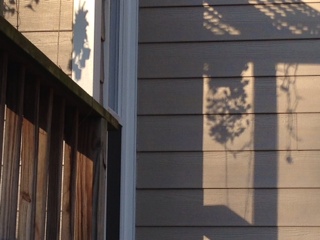
Winter Shadows

Winter Shadows

It’s lighter longer, but the sun still slouches low in the sky these January afternoons. So before it’s too late, I shoot winter shadows.

The posts, lattice work and vines make a delicate tracery on the siding. A monochrome reflection of an already color-stripped world.

Even the errant string of Christmas lights that dangles, unkempt, from the crossbeam looks elegant in reverse.

When the wind blows, the shadows wag in the fading light.

Wild Things

Wild Things

Cold air and snow drive the wild things closer to civilization. A bluejay perches on the rim of a wrought iron chair, pecks at the peeling paint, fluffs his feathers — his broad back to the window, a flick of his beak then he’s gone.

Minutes later, a fox trots across the yard, sleek, rangy, in no hurry as he makes his way to the woods. Searching for food, for small animals driven out of hiding.

And yesterday, on the way to the post office, I saw three vultures tearing at a dead deer beside the road. 

We may mulch our gardens, mow our lawns and prune our trees. But the animals know we are just visitors here.

Words from One World

Words from One World

After six months of phone conversations only I received my first real email communication from Suzanne this morning.

“I’m writing to you from the bustling metropolis of Kandi,” she began. And it must seem like a bustling metropolis to her, living in a village without electricity and running water. On the other hand, she intended irony. After all, she’s a child of the suburbs, grew up in the shadow of our nation’s capital, can maneuver a van around the Beltway at rush hour if need be.

Now, she travels on foot, bike, moto or bush taxi.

Seeing her message makes me want to drop everything, hop a jet to Cotonou and bush-taxi myself right up north to Kandi.

I won’t, of course. Not yet, anyway. This is her world now. I write about it only to remark on how the written word brings her new life to us in such a special, immediate way. Words winging their way from one world to another with the stroke of a key.

Surprise!

Surprise!

After several futile forecasts yielding nothing, we woke up this morning to a white world. Not quite an inch yet but it’s still falling and roads are cold enough that every flake is sticking.

Maybe weather-watchers knew this snow was on the way, but I didn’t, so I felt like a kid this morning when I glanced outside, saw the white coating on the deck, the flurries in the air. For just a minute I felt that leap in the heart: No school today! No school!

And then I remembered: I don’t go to school anymore. I go to work. And yes, we are having work today.


(We didn’t receive quite this much! This is an old photo…)

Contagious

Contagious

No masks yet; we haven’t come to that. But I flinch from my Metro seatmate, who hacks his way through the long ride in from Vienna. And I touch as little as possible, pressing a glove, or a sleeve or a paper towel into duty.

At church they announced a temporary hiatus of the common cup (a bizarre tradition anyway; other faiths, with their individual thimbles of wine, are more rational about this) and asked us to respect those who choose not to shake hands during the sign of peace.

In my pew no one shook hands. Was everyone sick? Did everyone think I was sick? Or was this the excuse we’ve all been waiting for? A retreat into private prayer.

Cold and flu season makes one thing clear: non-communication is contagious.