Morning Memo

Morning Memo

On days I work at home I watch the house slowly empty. First Celia, early, so early, for high school. Then Tom with bike and helmet. He’ll ride to work today. And next Suzanne, off to her job in Arlington.  A parade of goodbyes and then, finally, silence.

I pour myself another cup of tea. I read a few pages from a favorite book. And then I place my fingers on the keyboard, willing the words to come, hoping they will flow smoothly today.

Copper lounges by my side. Partings are hard for him, too. But he doesn’t need to process them.

Third Place

Third Place

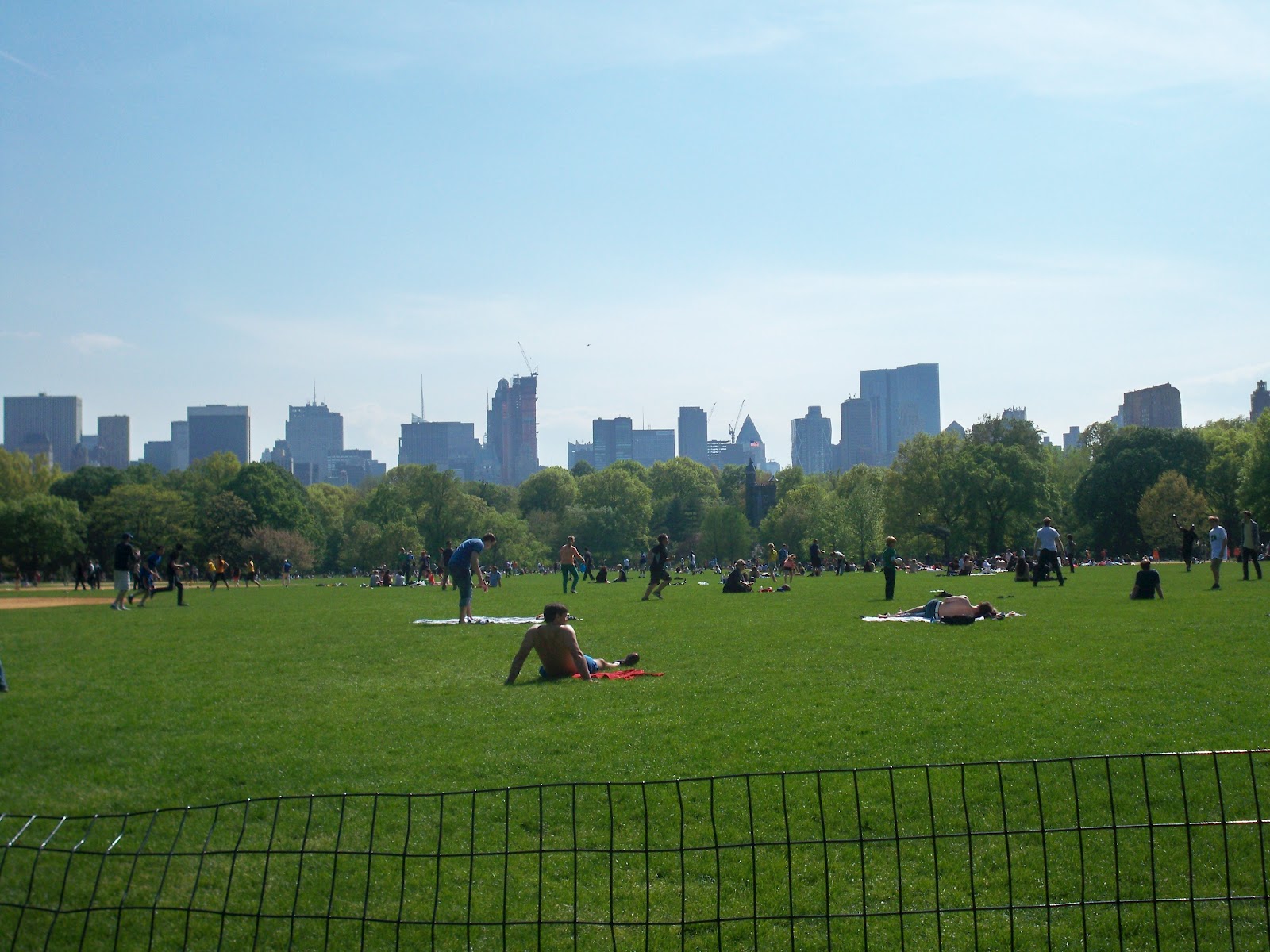
This is Central Park’s Sheep Meadow, a place to meet friends, to picnic, to hang out. It is neither home nor work. It is what Ray Oldenburg calls a “third place.” But there are few such places in modern cities. “Our urban topography presently favors those who prefer to be alone, to stay in their homes, or to restrict their outings to relatively exclusive settings,” Oldenburg says in his book The Great Good Place.

I would say this design flaw applies most of all to suburban topography, to the design of subdivisions without center and without stores and without a pleasant place to congregate for an hour or two.  I know of nowhere in my neighborhood where people can gather with a regular crowd for a beverage and some conversation; and there certainly are no Central Parks. The closest tavern is a sports bar with a dozen or more conversation-killing TV screens on the walls. The one local coffee shop closes at 2 p.m. We buy our goods at anonymous malls and shopping centers.

“The problem of place in America manifests itself in a sorely deficient informal public life,” Oldenburg says. “The structure of shared experience beyond that offered by family, job and passive consumerism is small and dwindling. The essential group experience is being replaced by the exaggerated self-consciousness of individuals. American lifestyles … are plagued by boredom, loneliness, alienation and a high price tag. America can point to many areas where she has made progress, but in the area of informal public life she has lost ground and continues to lose it.”

I finished Oldenburg’s book with a stunning takeaway point: that what we think are individual and family failings are actually deficits of community and place. That we have only just begun to plumb what placelessness has done to us.
On Broadway

On Broadway

The tune has been in my head the last few days. The tune is there because I was there. On Broadway, that is. Not the part George Benson sings about, not the place where “the neon lights are bright.” Not Times Square Broadway.

I’m talking Upper West Side Broadway. Corner grocers, vacuum cleaner stores, coffee shops. There was a time when I lived there that if I ran out of paper and had to run down to the tiny stationary store to buy some, I hesitated. I would have been on deadline then (I was always on deadline that year) and I knew I would run into at least a couple of people I knew on the way there and back. Could I afford the time to buy the paper and chat with the friends?

The answer, always, was yes.  I had lived there for a few months. And when I walked down Broadway I knew people. I didn’t need neon lights.

Saturday, during my 21-hour visit to Manhattan, I had time to walk from 114th to 77th Street. The sun was bright, the air was warm, the pedestrians were of every size, shape and color.  I didn’t know people to talk to along the way. But I had left one good friend at 113th Street and met another at 77th. My feet flew down the pavement. There was energy and street life. It was good to be back on Broadway.

Cross-section

Cross-section

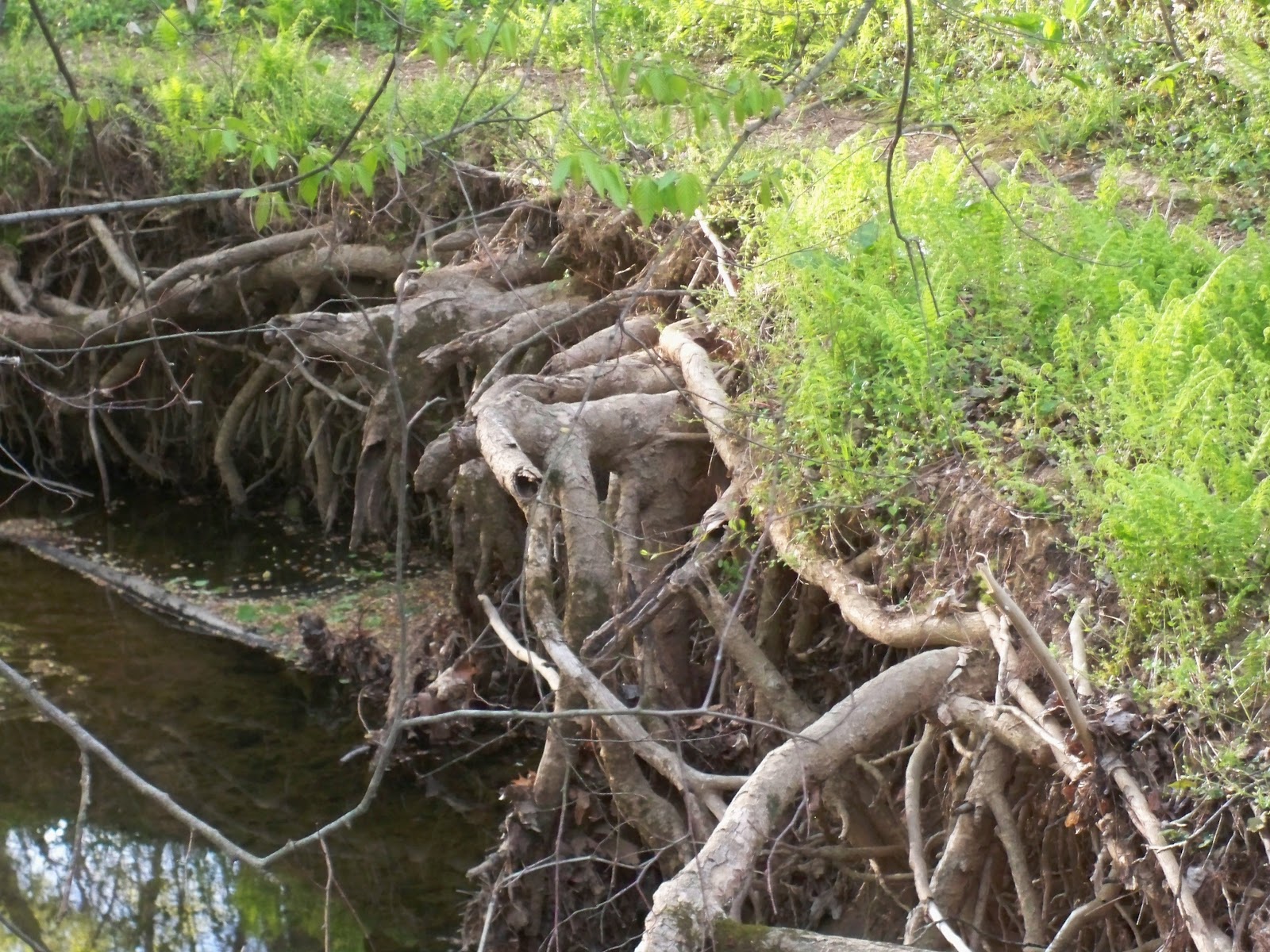
A cross-section of woodland soil laid bare by Little Difficult Run: See how the roots dominate the picture. Is it just here that they are threaded, wedded to the Virginia clay? Or do we walk on a carpet of them? Everywhere we tread, then, connected to a tree, a shrub, a plant. Our feet fall on the tuberous and the gnarled; our paths linked not just to other routes but to the very land itself.

Symposium

Symposium

Less than 24 hours in New York City, a quick trip up for my journalism school reunion. I almost didn’t go; I didn’t know if I wanted to tell people what I was doing. It’s not that I’m ashamed of my career; it’s a decent one by most standards. But my classmates are an impressive group of journalists. I wasn’t sure they would understand that what matters to me now is not the daily chase for plum assignments or the satisfaction of putting a magazine to bed. Instead, it’s reading and thinking and working on the ever-elusive next book.

What I discovered is that many of them are in a similar place. They too are switching gears, writing poetry, starting blogs. They are still an impressive bunch — but impressive as human beings, most of all.

This is where we held our party. Symposium: Plato’s work on the nature of love, the Greek word for drinking party and a funky little restaurant on 113th Street.

New Look

New Look

Today I met Blogger’s “new look.” This is disconcerting for a creature of timid technological habits. I have my tiny little comfort zone. Ask me to move beyond it and I flail about like a new swimmer in the deep end.

Still, I recognize that we either move ahead or fall behind. Treading water only works for a while.

So I plunge in, click on the tutorial and somehow, in the course of figuring out how to write this morning’s post, turn on my iTunes account and a song called “To the Morning” by Dan Fogelberg.  I don’t know how I did this. It reveals my technological ignorance in all its glory. But it was a strangely satisfying choice.

“There’s really no way to say no to the morning,” is the song’s key lyric.

There’s no way to say no to the future, either.

Sally’s Garden

Sally’s Garden


A few days ago our friend Sally invited us to her house to dig up ferns. Her crop was crowded and needed to be thinned, she said. So we ventured over, shovels in tow, on an unseasonably warm April afternoon.

We’d been to Sally’s house before but had never spent time in her backyard. It was nice, I knew, from looking out the back window. But I was unprepared for the beauty and calm spirit of the place.

In the native plants garden there are ostrich ferns and wood poppies and bluebells. A path winds along the perimeter with a pond in the middle and a little arched bridge. The yard is shady and cool, a habitat for birds and butterflies. It backs into a woods that stretches for miles along the stream valley of Little Difficult Run. Sally’s garden is one of those surprising suburban oases.

It wasn’t until we returned home, our car stuffed full of ferns and wood poppies for transplant, that I realized why “Sally’s garden” sounded familiar. It was the Yeats’ poem “Salley Gardens” it brought to mind, a verse put to song, a tale of regret and time passing and all sorts of emotions that are often hidden in the suburbs. But they are what give a place depth.

Down by the salley gardens my love and I did meet;
She passed the salley gardens with little snow-white feet.
She bid me take love easy, as the leaves grow on the tree;
But I, being young and foolish, with her did not agree.
In a field by the river my love and I did stand,
And on my leaning shoulder she placed her snow-white hand.
She bid me take life easy, as the grass grows on the weirs;
But I was young and foolish, and now am full of tears.

W. B. Yeats

Missing Out

Missing Out


I usually write here of things I’ve seen. Today I write of something I didn’t see. As the shuttle Discovery made its graceful curtain call on D.C. the day before yesterday, I was sitting in my office, preoccupied with matters I thought were more important. It wasn’t that I couldn’t get away. It was that I didn’t. I hadn’t known how visible the shuttle would be. Some folks even spied it from the roof of the tallest building on campus.

A few minutes before 11 a.m., Suzanne called: “Mom, I see it. It’s flying right over me on 66. Cars are pulling off on the shoulder. It looks like a dolphin on top of a whale.” We didn’t talk long. I kept imagining how she was gazing at the shuttle, driving the car and talking on the phone at the same time.

Yesterday’s paper was full of photographs and quotations. People waited hours to see the spacecraft. It’s the end of an era, they said. They imagined all the miles the Discovery had logged, the places it had been. They felt privileged to witness its last flight.

After I took myself to task for missing this spectacle, I tried to think positively. There’s no way to go back. So how to move forward? Here’s what I came up with: The world is rich and full of possibilities. But it will shrink to a pinhole if I let worries and obligations overwhelm me. The next time I have a once-in-a-lifetime opportunity, I’ll take it.

photo courtesy NASA vis Georgetown Law Facebook page

A Photo of Phlox

A Photo of Phlox


Waking from brief sleep, I make some tea and slowly come alive. We’ve moved from summer back to spring. The first birds are stirring. It’s the hour before dawn, when the day is just a hint on the horizon.

Soon I will drive in the gloaming past the shimmering azaleas, the fading dogwood. I will, in my haste, not have time to look, to really see, what I am passing.

But on an earlier day I have let the camera look for me. Here, on our normally sedate corner, a vivid crop of creeping phlox.

Cross Walk

Cross Walk


Yesterday I tried something new, something I hadn’t seen in the 23 years we’ve lived in this neighborhood — a crosswalk. It’s our corner’s first. A touch of the city in the suburbs. A time-out for the traffic. A vote of confidence in walkers everywhere.

I pushed the button, and I waited. And waited. And waited.

I started to run across the street against the light. After all, there were no cars coming. It’s what I usually do, wait for a pause in the stream of cars and then thread my way across.

But yesterday, since the cosmos (and the Virginia Department of Transportation) was giving me a break, I gave them one, too. I was a good citizen, a patient pedestrian. I waited my turn. But when the sign said “Walk” — I ran.