They’re Home!

They’re Home!

A little over a year ago we were making the sad trek to Dulles Airport for Suzanne’s return flight. She would be in Africa another year before returning yesterday “for good” — or at least for a few years, which means “for good” when you’re in your 20s.

Yesterday we watched many travelers emerge from Customs into the International Arrivals Terminal — a grandma who was instantly swarmed by two young grandsons, a man whose three beaded-hair daughters yelled “Daddy” and enveloped him in hugs.

And then, finally, emerging from the door, the two we were looking for. Appolinaire in a green sweatshirt over his West African print shirt, Suzanne in a thin flowered  blouse and a colorful lanyard for her passport pouch.

It was — they were — one of the most beautiful sights I’ve ever seen. But I saw them from a distance just for an instant, because soon they were smothered in hugs, too.

Out of Africa

Out of Africa

The second leg of their trip has begun, the one that will bring Suzanne and Appolinaire from a  village in the north of Benin, West Africa, to Washington, D.C. The trip began last night in the little Cotonou Airport and continued with a brief stop in Abidjan, Ivory Coast, before landing in Istanbul, Turkey. There they boarded their U.S.-bound flight, and now they’re heading home.

But preparations began over a year ago, pulling together the paperwork for the K-1 (fiance) visa, filling out forms, collecting photographs, sending the packet off and then waiting, waiting, waiting.

Luckily, the waiting was done in West Africa, a place where patience seems bred into the bone, where people think nothing of standing for hours on a hot roadside in hopes that the 200,000-plus-mile Peugeot that’s been carrying them to the next village can once more be coaxed to life so they can  cram into it and get going.

This patience, and the shrugged shoulders and hopefulness that go with it, is an excellent trait to carry along to the new world. It will help them navigate a complex culture and the inevitable waiting times and snafus built into becoming first a resident and then a citizen of the United States.

We’ve been needing a lot of patience ourselves lately as we counted down to the day — November 23 — that we thought would never come. And we’ll need an extra dose of it this evening as we crane our necks in Dulles’ bustling International Arrivals Terminal, looking, looking, looking for a dazed young couple to walk through the doors and into our arms.

State of the Leaves

State of the Leaves

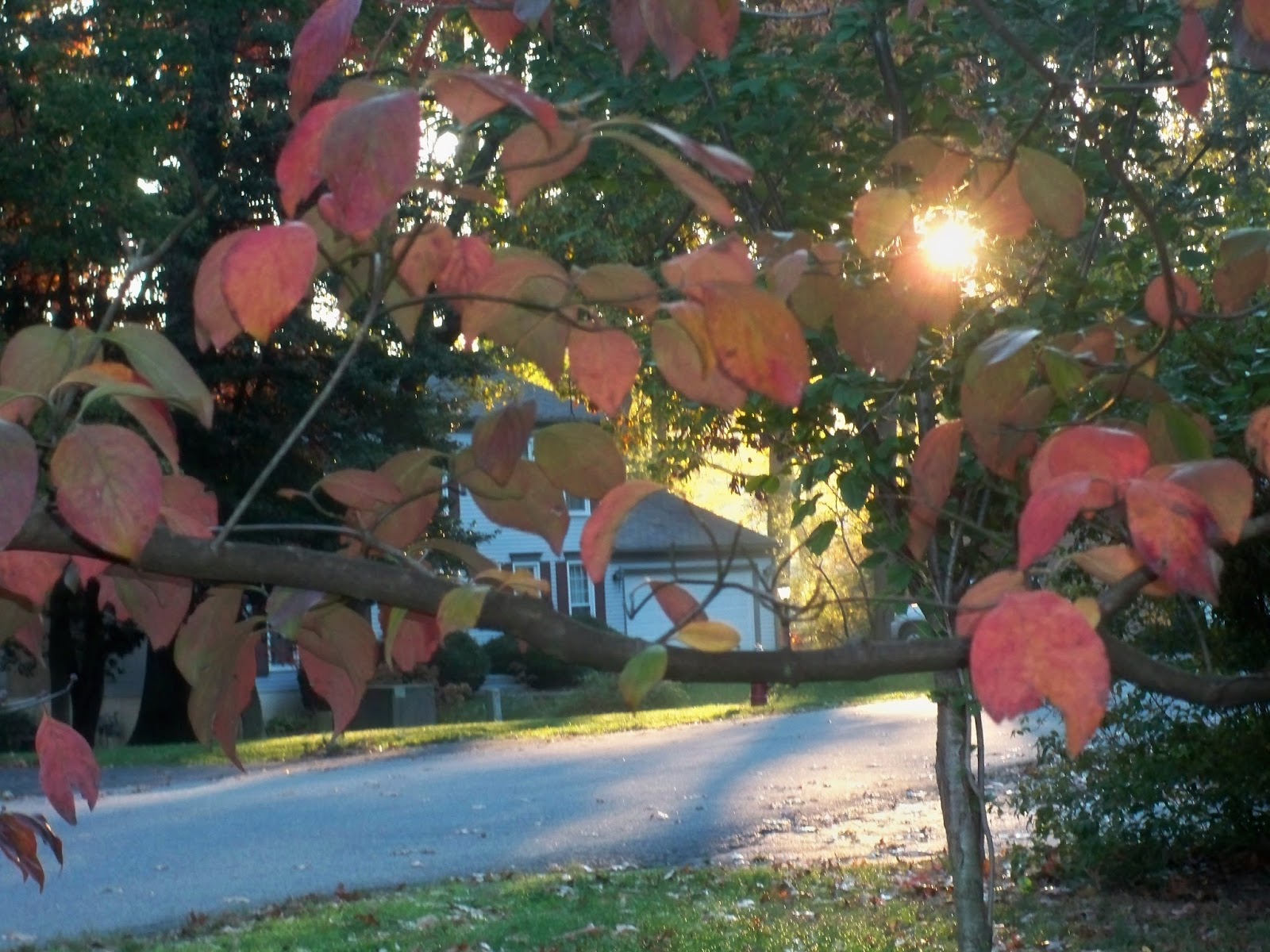
More leaves have fallen than are falling. They drift up against the fence and under the azaleas. They crinkle under foot. They cluster in the garden, cushioning each chrysanthemum petal that drops quietly to the ground.

In the woods some leaves hang on, stands of red and yellow, brave flags flying. And even in the backyard a yellow poplar shimmers in the breeze.

But by this point in the season, leaves have become the enemy. They must be raked or mowed, bagged or strewn. They are duty, not poetry.

Tale of Two Temperatures

Tale of Two Temperatures

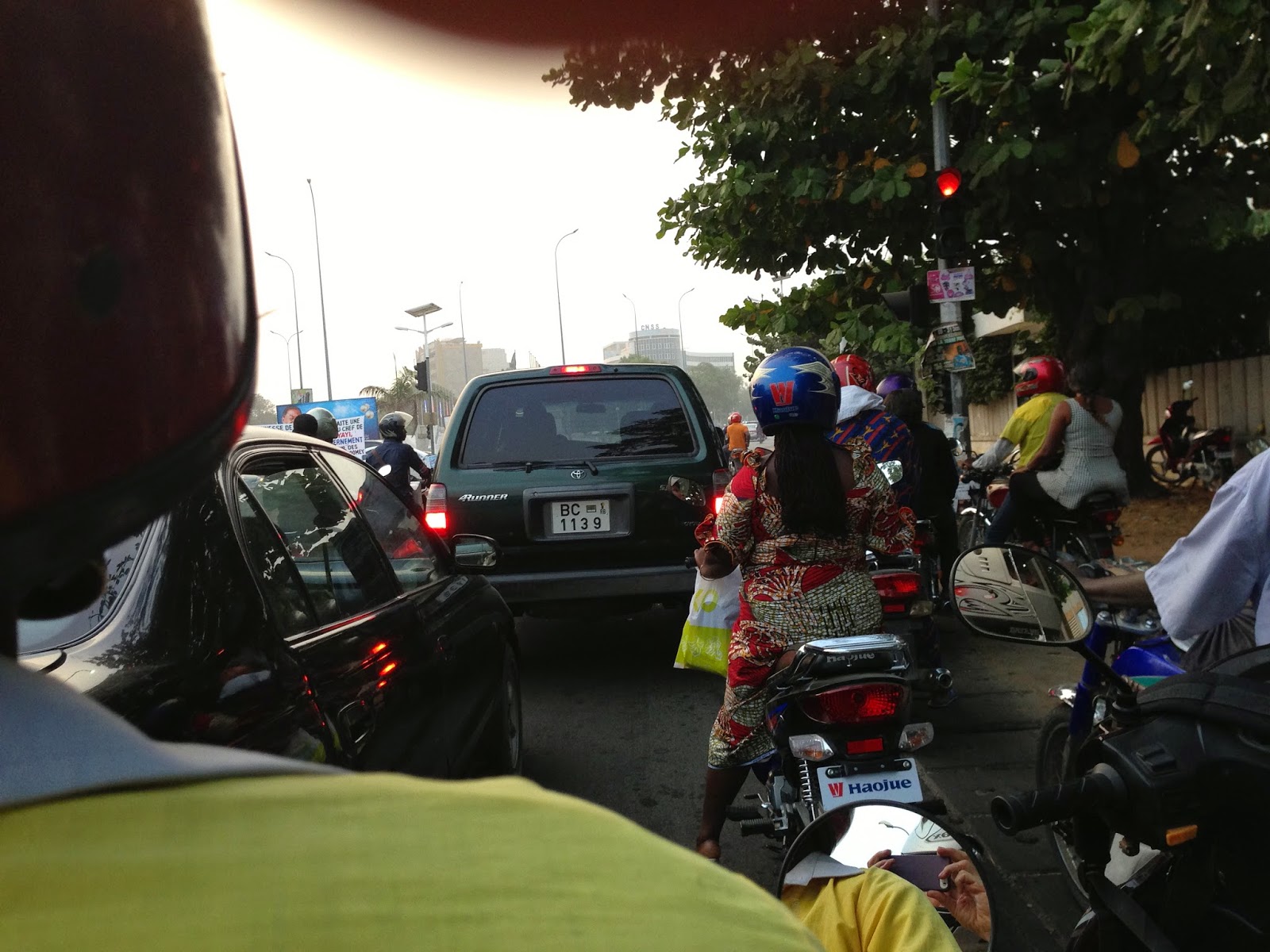
It’s 90 degrees today in Cotonou, Benin. It was 40 degrees when I woke up in Oak Hill, Virginia. Fifty degrees of separation — that’s a lot for a person who’s never experienced winter.This is just one of the many adjustments we’ll be witnessing in a few days.

I’ve been pulling for one of those warm winters that can sometimes grace these parts, especially when there’s an El Nino pattern. But the next few days promise brisk winds and seasonable temps, and my purple (excuse me, aubergine) wool coat has already been pressed into service.

Nothing to do but go with the flow, whether it’s warm or cold. Nothing to do now but hold on for the ride!


(Rush hour in Cotonou from the back of a zemidjan.)

Neigh!

Neigh!

Though I live in the suburbs, there are rural aspects to my neighborhood. Septic systems rather than sewers. A stubborn attachment to winding two-lane roads. And then there are the farms behind the houses across the street.

These are not big operations with silos and combines. These are not even the “gentleman farms” I got to know in New England. (Now those are my kind of spreads — picturesque orchards run by retired heads of English Departments.)

These are four-acre parcels with houses of varying value. Some still have the original ranches and split-foyers, but most have large multi-gabled mansions that were built after the originals were torn down.

Sometimes I walk on the trails that wind through this neighborhood. I imagine the kind of place I’d like to have — herbs, flowers, chickens, a writing cabin in the back — nothing profitable, of course. I while away time moseying and fantasizing.

But usually, before I get home, something has brought me up short. Maybe it’s a prickle-bush barring entry to a favorite cut-through. Or a pile of manure I notice too late. Some bit of rural reality that intrudes on my fantasies. “Neigh,” say the horses in the pasture.

Nay, indeed.

Springtime Color

Springtime Color

I see it from the back of the yard, a bright spot of color in the autumn garden. In a land of browns and russets this pinkish rosey purple stands out.

It’s just a mum that I transplanted in the summer, a potted plant left to root in the hodgepodge end of the flower bed. Truth be told I had forgotten about it. But now it’s reminding me of all the springtime colors that await us.

Only four more months till Easter.

Four Walls

Four Walls

It was a weekend to clean and organize. Dust was flying — so much so that I thought for a while I must be catching a cold. No, I was catching a house. A house that had been languishing for lack of attention lately, but a house looking much better after a few days of vacuuming and polishing.

I’ve been in the house a lot less lately and so have been appreciating it more. I love the way afternoon sun slants in the kitchen this time of year. It reminds me of the old days when the kids were young and playing underfoot there. One of them in the play kitchen that was tucked under the counter, another in the playpen parked in the living room in front of the hutch and the other stirring suds in the sink.

Oh, I was harried, I’m sure. I had a magazine deadline of some sort — I always did.  My mind was probably filled with the interviews I had to do and the errands I needed to run for the girls — new shoes or hair cuts.

But I have those days inside of me now, and the girls do, too. And soon  — God willing, a week from today! — we will all be reunited in that kitchen, as Suzanne returns after three and a half years in Africa. Returns not alone but with a Beninese fiance, Appolinaire Abo, soon to be our son- and brother-in-law!

So much has happened within these four walls, so much more will.

Darkness and Light

Darkness and Light

Today I’m thinking about Paris, about my dear friend Kay who has made it her home for decades. I’m thinking about the beauty of the place, the bridges and buttresses, the way the windows catch the setting sun.

I’m thinking about the forces of civilization and the forces of darkness and how their struggle is playing out across a world stage. And I’m thinking about our cities here, especially the one I now call home: the broad avenues and crisp flags flying. This city and all cities vulnerable.

Last night, watching the dazed survivors being carried to ambulances, listening to those who witnessed the horror first hand, it seemed that all was darkness, that morning would never come. Now the morning has come, but the horror is still with us. The sunlight has an edge to it and the clouds seem lower than before.

Landscapes of Childhood

Landscapes of Childhood

“We think it essential that a 5-year-old learn to read, but perhaps it is as important for a child to learn to read a landscape,” says Washington Post columnist Adrian Higgins in his article “The British Forest That Gave Life to Pooh.”

Higgins is the Post‘s gardening columnist, and he came to this topic after reading The Natural World of Winnie-the-Pooh, a new book by Kathryn Aalto. Aalto is a garden designer who spent time in the places where A.A. Milne lived with his wife and young son Christopher Robin. Milne drew on these landscapes to create his fictional world. There was the walnut tree that housed Pooh, and Owl’s aerie in an ancient beech. There was the real Five Hundred Acre Wood.

The beauty of the English landscape — and Milne’s memories of his own childhood decades earlier — made its way into the stories, and as such stands as a testimony not only to the power of topography but also to how important it is in the life of the imagination.

“As important as the Pooh stories remain, they speak to something of greater value, the importance of landscapes to children, places they return to, places they own, places to stage their own dramas, and places that imprint themselves on the mind,” Higgins writes.

I found these landscapes in the broad bluegrass meadows of central Kentucky, my children found them in the yards and woods of suburban Virginia. It doesn’t take a 500-acre wood; sometimes just an empty lot will do.

Two Cities

Two Cities

There are some advantages to living in a company town. One of them occurs on Veteran’s Day, when most of the government workforce is at home padding around in slippers and the city (or most of it) is left to the rest of us.

Yesterday First Street was almost empty as I fast-walked down to Constitution and then to Third. No one was picking up a salad at Phillip’s Sandwich Shop. No one taking a smoke break at the Hyatt service entrance.

And then … I reached the Mall.

While the rest of the city was in Sunday shut-down mode, the museum-and-monument district was bustling with life. There were babies in strollers and (seemingly a new trend) dogs in strollers. There were selfie-takers striving for just the right photograph with the Washington Monument. There were joggers and cyclists and pedicabs and double-decker buses, all in a glorious jumble. The carousel was doing a brisk business, too.

There are always two cites here, the one the tourists see and the other, workaday one. But today the boundaries between those two cities were etched in high relief.