A Different Hour

A Different Hour

Not my typical time to post — but that’s not the different hour I mean. It was my walk yesterday to Metro, more than three hours later than usual.

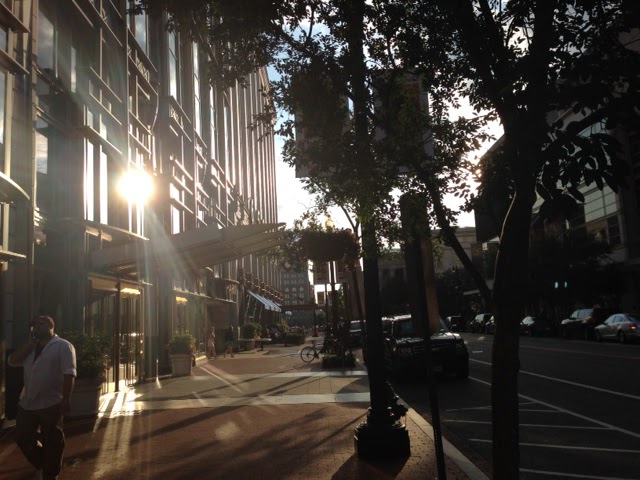
The light slanted in from the west on a day that was as exquisite as promised. The fact that I’d spent almost every minute of it inside made these outdoor minutes all the more precious.

The buildings were gleaming, the pavement stones shining and people lingered at sidewalk cafes and corner bistros. At Rosa Mexicana a man wiped his mouth with a large cloth napkin. He was eating guacamole from a stone bowl. At the corner of Seventh and F a beggar shook coins in a dirty paper cup. No one seemed inclined to add to them. Ahead of me, a couple strolled in the waning light, holding hands. He held a gym bag and leaned his head toward her when she talked, which she did, animatedly, all the way down the block.

I had Les Mis in my ears and the capital city in my sights. Day was turning to evening. It was a different hour. It was a good walk.
A Change in the Air

A Change in the Air

I love humidity, really, I do. I love the way it buoys me up, an invisible presence; the way it surrounds me. I like an air that can hold its own.

Sometimes after a long day in a chilled office I walk the hot sidewalks of a muggy D.C. and my fingers fairly tingle with the moisture in the air. The feeling comes back into air-condition-numbed extremities. I feel alive again.

And yet … this morning I woke up to a lovely, chilled, low-humidity day … and it feels divine.

Suddenly, there are closets to clean and yard work to do. There are books to read and comb through, materials to research. And this isn’t even counting what awaits me at the office.

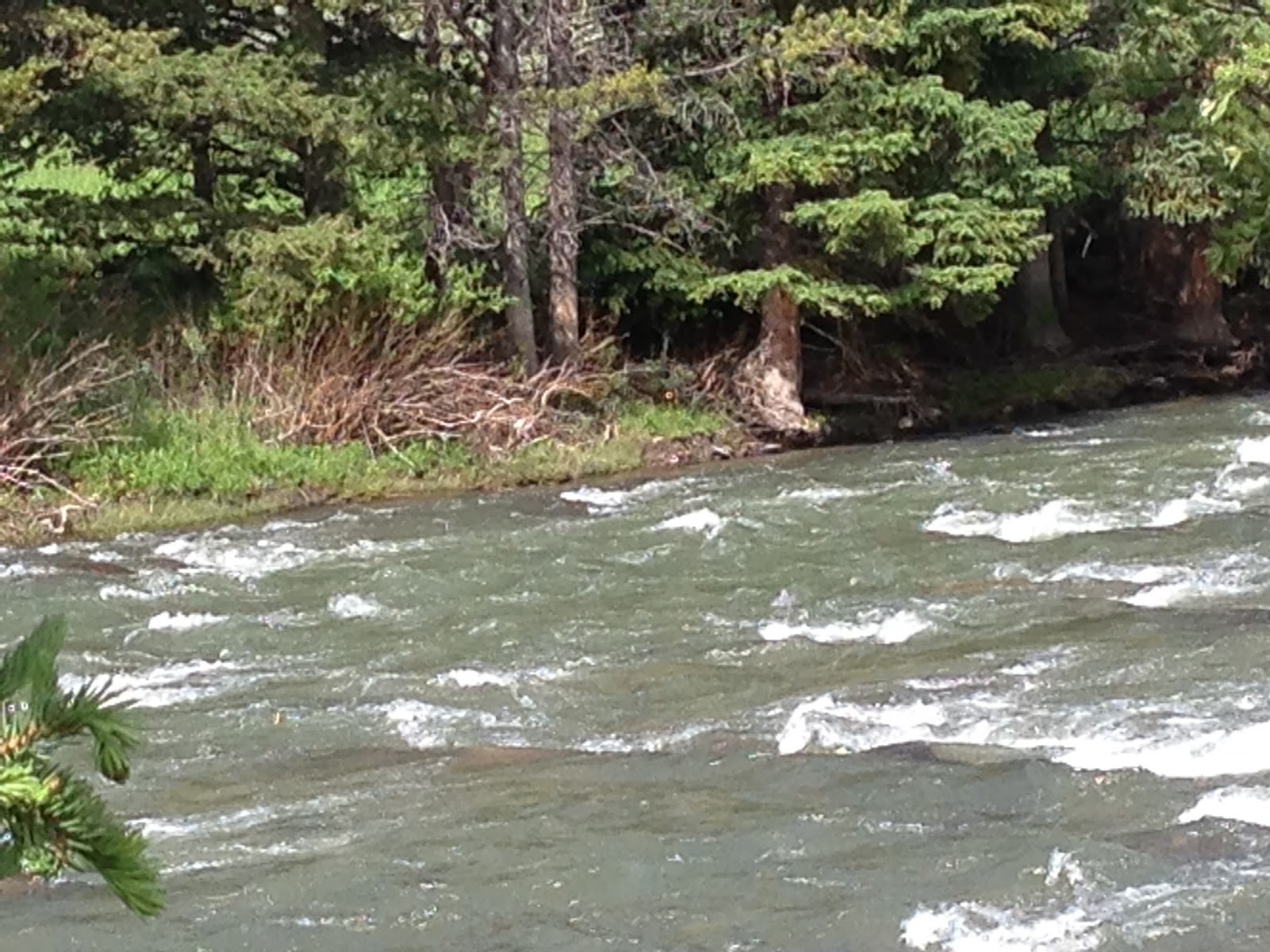
Summer torpor slows me down, and that can be a good thing, a corrective. But after weeks of stickiness, this low-weight air is invigorating, a mountain stream. It gives me a first-day feeling, a necessary fresh start.

Rows of Sharon

Rows of Sharon

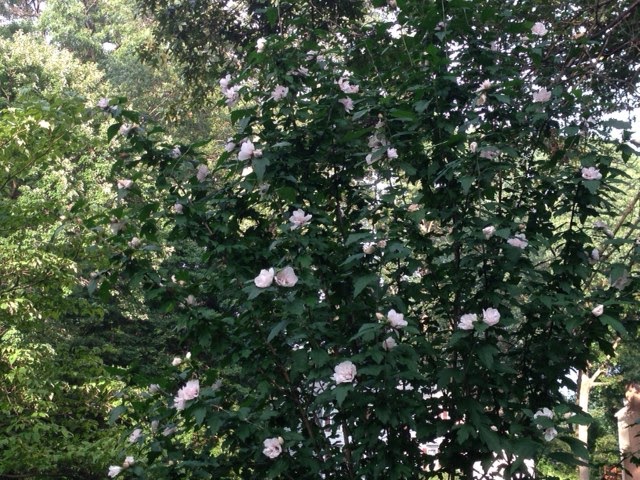
The Rose of Sharon is blooming now beside the driveway. The dark green plant is covered with plump, white, rose-like blooms. But it’s not my Rose of Sharon I want to write about — but a row of these plants that line a yard a block away from here.

I know the history of these small trees, know why they bloom where they do. The corner house is the home of “the faithful jogger.” Don’t know his real name, only that my children used to call him that years ago because every day, at least once a day and regardless of weather, he could be seen running up and down Folkstone Drive. He never seemed very happy, had a plodding gait — I always imagined he had taken up the practice for his health. All of which is beside the point except to illustrate the man’s persistence. He doesn’t give up easily.

And he didn’t give up when three years in a row bad wind or ice storms took down his split rail fence. Twice he built it up again. In fact, he was always one of the first people out clearing debris. Then a few days later, more fencing would appear.

This last time was different. Instead of planks he planted rows of spindly Rose of Sharon trees, the smallest, slightest stock, barely more than sticks in the ground. There were many of them, though, and I could see his plan — to create a green and living border, to make a fence that would bend but not break.

It’s been years now since those trees went into the ground, and years since he last jogged down our suburban lane. But those once-spindly trees are filling out into a proper, flowery border. They have matured to beauty and to fullness. And when I saw them the other day, I saw not just what they are but what they were, what they have become.

This is what happens when you walk a place; when you know not just its stories but its back stories as well.

7,800 Miles

7,800 Miles

It is 7, 214 miles from Washington, D.C., to Kigali, Rwanda, where Tom has gone on a business trip. In less than an hour it will be 7,800 miles — just a few hundred more — from Nasa’s New Horizons probe to Pluto.

Earth meets space, the Kuiper Belt, that which lies beyond our solar system in what surely deserves to be called terra incognita (except that it isn’t terra!).

Early pictures show an orange globe with a crown of methane and nitrogen ice and craters the size of the Grand Canyon. By tonight we will have more photographs of this celestial body, photographs that may help scientists decide whether to call it a planet or a dwarf planet.

What we have right now is a tantalizing glimpse, a collectively held breath — and of course, the wonder. 

Water, Water Everywhere

Water, Water Everywhere

A rainy Monday, so maybe not the best day for a post about thirst and the lack of public water fountains. But an article in yesterday’s Washington Post made me think about this endangered feature of communal life.

According to the International Plumbing Code, the number of public drinking fountains required in new buildings is down by half, the article says. There are a few causes. One is the consumption of bottled water, which has quadrupled in recent years. Another is fear of contamination, which ironically has grown since the Safe Drinking Water Act in 1974 began requiring municipalities to notify their residents immediately of any problems with their water.

But the lack of clean, safe public drinking water has actually hurt American’s health by driving young people to consume more sugary drinks, the article argues. And a preponderance of plastic water bottles is hurting the environment.

This article explains why I have to hunt longer to find a public water fountain. And it also makes me remember the water fountains of my youth. The one at Idle Hour Park, which made a deep whirring sound and produced a trickle of water that seemed to have been drawn up from the depths of a nearby swamp. And the one in the hall of my grammar school, which we would be allowed to stand in line and use on warm spring afternoons. Imagine 400 to 500 kids drinking out of the same fountain! Still, nothing has never tasted as good as the water that flowed from that cool — and I’m sure unsanitary — tap.

Summer Day

Summer Day

Yesterday was the perfect summer day. I thought this even on the way to the dentist, and if you notice it then, the impression must be valid.

The air was weighty and warm and filled with the sound of cicadas. There was no rain (this was key). And the morning held the promise of just enough heat.

In late afternoon, when I was walking Copper in the woods, a couple of big frogs were bellowing from the creek. They plopped in the water as we walked by. The katydids were chirping slowly, as if they could barely be roused from their dreamy, midsummer naps.

Spiders had been busy and webs were strung between the trees like tiny Buddhist prayer flag ropes. When they caught a leaf it waved cheerily in the breeze.

Trudging

Trudging

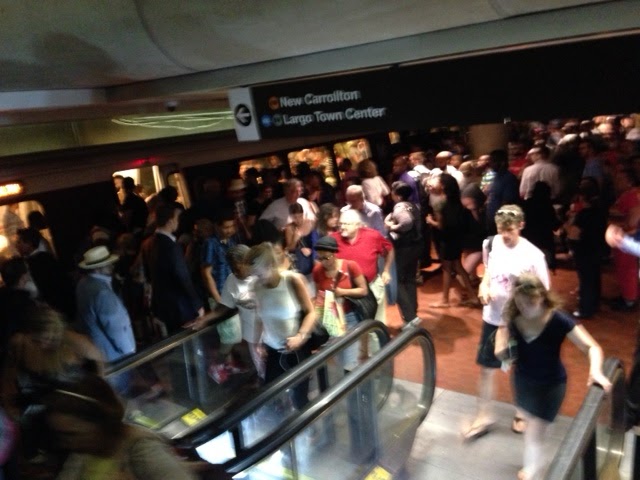
To commute is to trudge. Yes, one must be nimble, must dash quickly into the car as the doors are closing. But there is a good amount of trudging involved, too.

The other day, as I was hiking up a broken escalator, concentrating on the thin-strapped gold sandals of the woman ahead of me, I thought that if we can’t walk a mile in someone’s shoes, we can always walk a few paces behind them.

Doing so may not give us complete access to the stranger’s hopes and dreams and worries, but it does accustom us to her pace, to the effort she puts forth to climb a flight of stairs, which in some cases is herculean.

At the very least it requires a pause and a shifting of priorities, a switch from me to thee. I don’t like it, of course. I’d rather rush up the stairs at my own pace. But trudging keeps me mindful of the lives of others.

Dancing for Joy

Dancing for Joy

The rain was coming but hadn’t yet arrived. The clouds were low and there was a bustle in the air. I walked quickly to beat the weather.

Down at the Mall, it was time for packing up. A cleanup crew was taking down the tents and partitions, the props of celebration, and loading them into idling trucks. Tourists in t-shirts were snapping shots of the scaffolded Capitol. All around me was movement and energy.

But the best tableau came later, as I was leaving the office. I glanced down at the expressway, and there, amidst the dust and turmoil, a hard-hatted worker pivoted and jumped on the folded arm of a construction crane.

I stopped and stared, thinking at first that I was seeing things. But no, it was real — and, at 15 or 20 feet above the ground, seemed quite dangerous, too. But danger seemed the last thing on this guy’s mind. To him, the crane was a balance beam, a stage. I felt his joy travel up my spine.

Nearly Dark

Nearly Dark

A walk after dinner last night, nearly dark.  Bats dart between shadowy trees. A deer munches leaves at the house on the corner. When he sees me he stands still as as a statue. Next door is a little fountain, which makes a pleasant, splashing sound as I get close to home.

I try to figure out which neighbors are on vacation by the placement and pattern of their indoor lights. Then I start to think about the neighbors themselves, their triumphs and their tragedies.

There are a couple of ministers in the neighborhood, one of whom is a friend. He walks his dog late at night, and I’ve often wondered if he blesses the houses as walks by. Or at least offers up a silent prayer.

And that’s what I found myself doing. Not blessing or praying so much as holding these people in my mind as I walked by. Thinking about the woman who lost her husband more than 20 years ago, when her boys were still in elementary and middle school; about the man who had knee replacement last year; about the woman I never see anymore and how ill she looked the last time we said hello.

And these, of course, are just a small sampling of the humanity here. Who knows what stories these houses hold, these peaceful suburban houses.

America the Beautiful

America the Beautiful

The fireworks are over, the flags are packed away, but the patriotic melodies remain. One in particular. Every other band seemed to play it as they marched past us, and I heard it Sunday in church as well. So today I did a little research.

English Professor Katherine Bates wrote the words to “America the Beautiful” during a trip to Colorado the summer of 1893. She was inspired by the “spacious skies” of the west and the “amber waves” of grain she saw out her train window. But the words came to her in a flash of inspiration atop Pikes Peak, where there’s a plaque to commemorate the poem. Bates rushed back to the Antlers Hotel in Colorado Springs to write the words down.

Church organist Samuel Ward was moved to write the hymn that would later be paired with Bates’ poem when he was riding the ferry from Coney Island to New York City. He asked a fellow passenger if he could jot down the notes on the man’s shirt cuff, so full of the music was he, so eager to capture the melody before it left his head.

Two artists, two inspired moments — and two frantic and ultimately successful efforts to capture the muse before it flew away. The words and music were published together in 1910 as “America the
Beautiful.” Since then there have been many attempts to gain national
hymn or even national anthem status for this song, none successful. All I
can say is, it has my vote.