Mockingbird’s Place

Mockingbird’s Place

On vacation I finished reading Marja Mills’ The Mockingbird Next Door: My Life with Harper Lee, a memoir about living next door to the reclusive writer in Monroeville, Alabama.

Nelle Harper Lee and her sister, Alice, were already up in years when Mills met them while reporting an article for the Chicago Tribune. From those first contacts a relationship formed, and in this book Mills tells the story of the sisters’ old-fashioned life: visiting friends, feeding ducks, and living with the books and memories of decades in their hometown.

Although Lee quickly denied having authorized the book (a controversy that has probably boosted sales), I read the memoir enthusiastically anyway. Not just for a glimpse of the author but also for a portrait of the place that she enshrined as Maycomb in her novel.

“It’s the old Monroeville — the old Maycomb — that lives on in the imaginations of so many readers,” Mills wrote. “It’s the people and the places the Lees saw out the windows of the Buick all those years later.” Mills refers here to the drives she took with the Lees and their friends, expeditions that helped her appreciate a vanishing way of life.

“Nelle’s portrait of that community was so richly detailed, so specific and true to the small-town South during the Depression, that something universal emerged and, with it, the remarkably enduring popularity of the novel.”

I like thinking that what makes To Kill a Mockingbird great us is not just the characters — but also the place they inhabited.

Commuting on Foot

Commuting on Foot

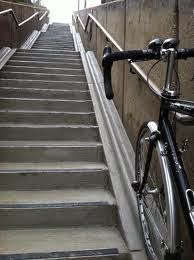
Yesterday I walked once again from the Wiehle Metro station to my car in a parking lot four miles away. Why is this worth mentioning? Only for this — that I am, finally, commuting on foot in the suburbs.

This is not an accomplishment to be shrugged off. And I don’t mean it’s my own personal accomplishment but an evolution in the way we live. That I can step off the train and travel on my own steam to the next destination is a marvel, given the way I started living here 25 years ago.

Then I couldn’t leave the neighborhood on foot because of cars barreling down narrow, un-shouldered roads. Now sidewalks and bike lanes take me to the grocery store and pharmacy; let me tap into Reston’s trail system, which used to be a tantalizing but unreachable distance away.

So to all forms of walking I celebrate here  — ambling meditatively through the woods, running pell-mell through the meadow, strolling briskly through the city — let me add the walk which is not a destination in itself but which has a larger purpose. It not only takes me out of myself; it takes me home.

Canopy Walk

Canopy Walk

As walks go, this was a short one, only about 80 feet. But it was 25 feet above ground — and it swayed as I moved. Up there amidst the live oaks and cabbage palms, I was not just in the foliage but of it.

Florida’s Myakka River Canopy Walk was modeled on canopy walks in the South American rain forests. It’s humble and natural and sturdily built (or at least I pretended that it was).

A 76-foot observation tower on one end let me climb up through the trees to glimpse a panorama of forest and river. I was above the canopy rather than under it.

My knees quivered and I thought about the fear that comes not just from height but from exposure. I felt a kinship with creatures that hide under rocks or brush.

Enclosure is safe. Exposure is dangerous — and exhilarating.

Drenched Garden

Drenched Garden

Spongy mulch, dripping ferns, glistening flowers.

The summer garden got a good soaking yesterday, and this morning it is renewed, refreshed, restored.

I’m still thinking about the tropical gardens, though, the orchids and bromeliads, how they draw their sustenance from rainfall cupped and gathered, how they use it to make food.

Plants of the air, plants of the earth — water common to both.

The Return: Some Perspective

The Return: Some Perspective

A rainy-day return to the office. Low light, lowered expectations; today’s goal to survive. Grateful for a certain rainy-day coziness and the quiet required to work hard and long to meet deadlines.

Just coincidentally, I was reading a passage from  Shirley Hazzard’s Transit of Venus as I disembarked in D.C. “Girls were getting up all over London. In striped pyjamas, in flowered Viyella nightgowns, in cotton shifts they had made themselves and unevenly hemmed … They were putting the shilling in the meter and the kettle on the gas ring. … “

Ah, I’m feeling better already. I have a store-bought cotton nightgown. I have an electric tea kettle. I pay for gas by the month not the morning.

Hazzard continues: “It is hard to say what they had least of—past, present or future. It is hard to say how or why they stood it, the cold room, the wet walk to the bus, the office in which they had no prospects and no fun.”

Oh dear. Have I ever thought like this? Of course. Poor me, back from a lovely vacation to my comfortable office! Poor me, paid to write and edit!

Hazzard has put it in perspective: It could be worse, and it has been.

“Poor me” better get busy.

Backward Glance

Backward Glance

I was out early today, pounding the hard pavement instead of the hard sand. Hard sand softens footfall; hard pavement does not.

But here in the suburbs hard pavement is often the only choice.

I’m glad my thoughts are not yet hard. They are still vacation thoughts — dreamy, slow and in no hurry to return to reality.

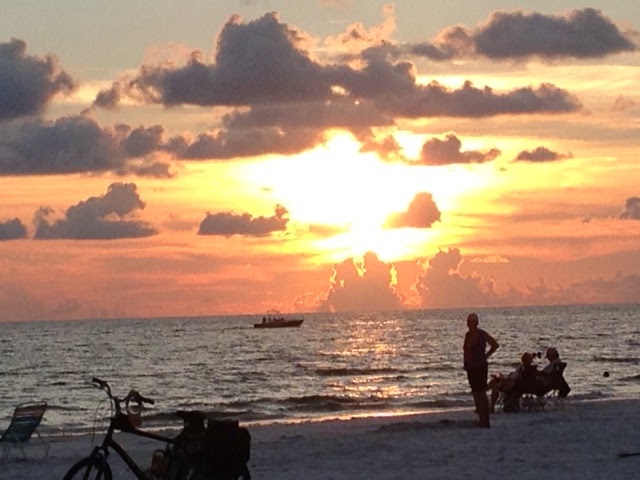
So here, in their honor, a vacation photo.

Beach Traffic

Beach Traffic

Foot traffic on a beach goes two directions— up and down along the strand and back and forth from towel to surf.

When I walk the beach I take the former. I’m a woman on a mission, moving quickly, arms swinging. I’m not alone in this purposeful movement. There are bikers and runners and beachcombers, all of us with goals in mind.

The bathers, on the other hand, amble easily toward the waves. They stop and start. They turn back. They pose for photographs. They brake for sand castles. 

Yesterday on the beach a man performed the slow, intricate steps of tai chi. He summoned up the calm of the ocean into his arms and legs. He was going neither up and down nor back and forth. He wasn’t going anywhere at all. He was simply being.

This is what I take with me from the beach.

Summer Radio

Summer Radio

I had forgotten what it was like —the splash of pool or surf, laughter in the distance and always, always the radio. In many ways it was the sound of summer, the low simmer of pop tunes from the transistor.

With the advent of the Walkman decades ago and for many years now the iPod, music is only in our  ears and not our neighbor’s. But this week I’ve lounged beside a pool and listened to tunes from the 60s, 70s and 80s.

Can’t remember the songs themselves; they weren’t important. It was the whole experience: the scent of sunscreen, the movement of breeze, the heat of the sun. The radio sounds just completed the circle.

It’s the sort of summer I always remember, and this year it’s summer still.

Leaping Lizards

Leaping Lizards

Alliteration aside, these critters really do leap. This little guy did. I was inching close to another reptile, a slender, smiling chameleon (they’re all slender and smiling to me), when I was startled almost to camera-dropping by this lizard.

One moment he was on the pavement and the next he was on the trunk of a palm tree, where I snapped this photo. And he stayed there long enough that I could snap several more.

There are no lizards where I live so I’ve been enjoying the fauna here. I probably look as strange to natives as the squirrel-gawking visitors to D.C. do to me.